
Itinerary
Day 9 – This morning you will begin with a visit to the famous Trevi Fountain, and on to the Piazza di Spagna, where you can climb the Spanish Steps. You will visit the Pantheon. Lunch on your own.
In the afternoon, you will proceed with the visit to the catacombs, burial place and meeting place of the early Christians. They were forced to meet in secret, underground, to escape persecution during the time before Constantine.
Farewell dinner at a local restaurant. Overnight will be at your hotel.
Finally found time for Day 9 part 2!
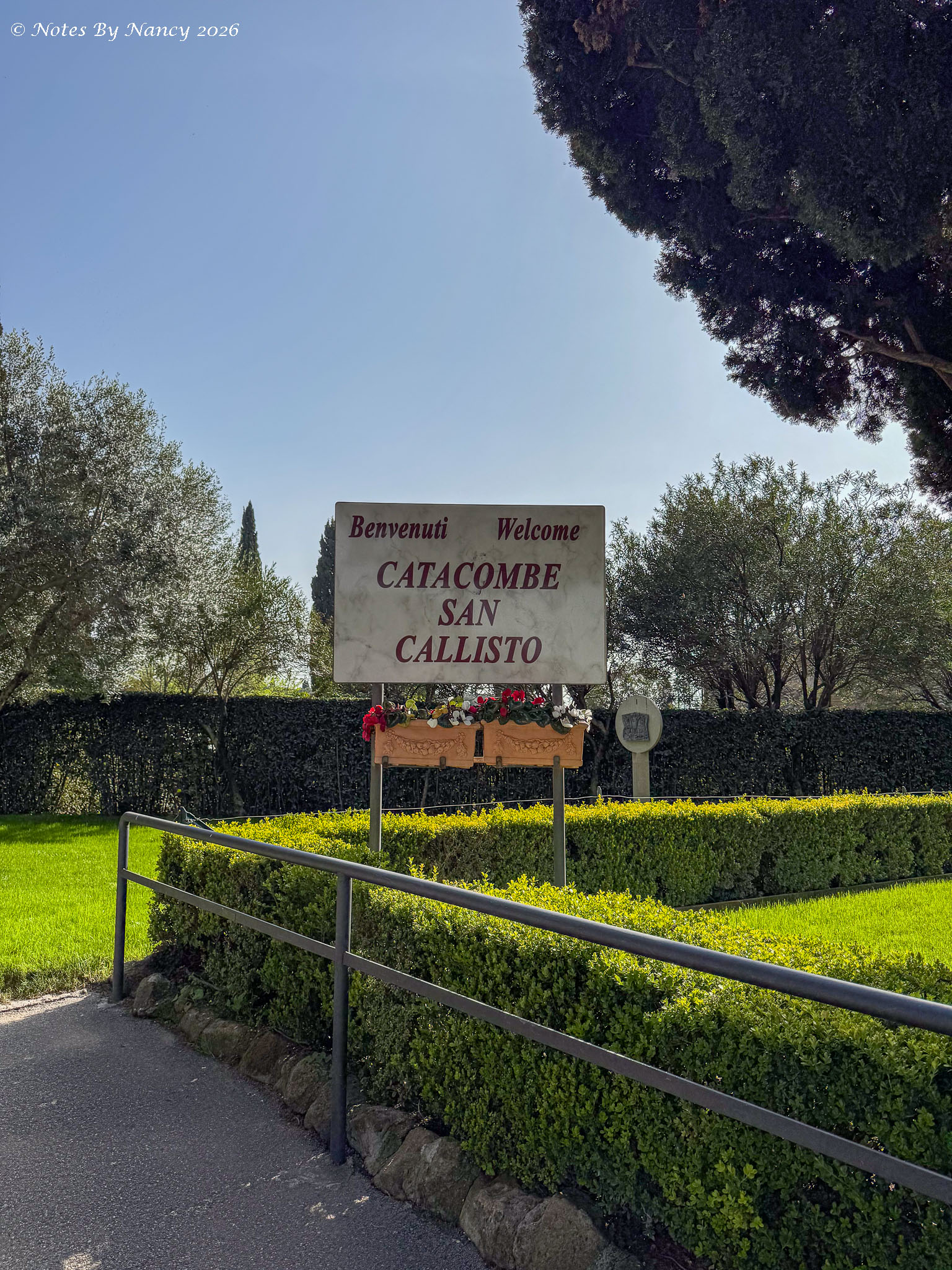
Catacombs of Saint Callixtus
Our bus picked us up near Piazza Navona after our morning walk and lunch/free time (Note 126) and we drove outside the old city of Rome to the Catacombs of Saint Callixtus. I’d always thought the catacombs were under the streets – but apparently that is Paris and those are from the late 18th century. These originated in the mid-2nd century! Like all cemeteries during that time, they were located outside the cities for sanitary reasons. Originally for Christians and created from private land donations, this location came under the jurisdiction of the Catholic Church in the 3rd century following the Edict of Milan which ended religious persecution under Emperor Constantine’s rule. Over 500,000 Christians were buried underground here until the 5th century when the Church returned to above ground burials.
This site is approximately 90 acres with 4 levels 20 meters deep comprising about 12 miles of tunnels. The oldest burials are closest to the surface, then they kept digging deeper for newer burials. Many martyrs (indicated by the Greek abbreviation MPT for martyr) and several popes were interred here at Saint Callixtus.
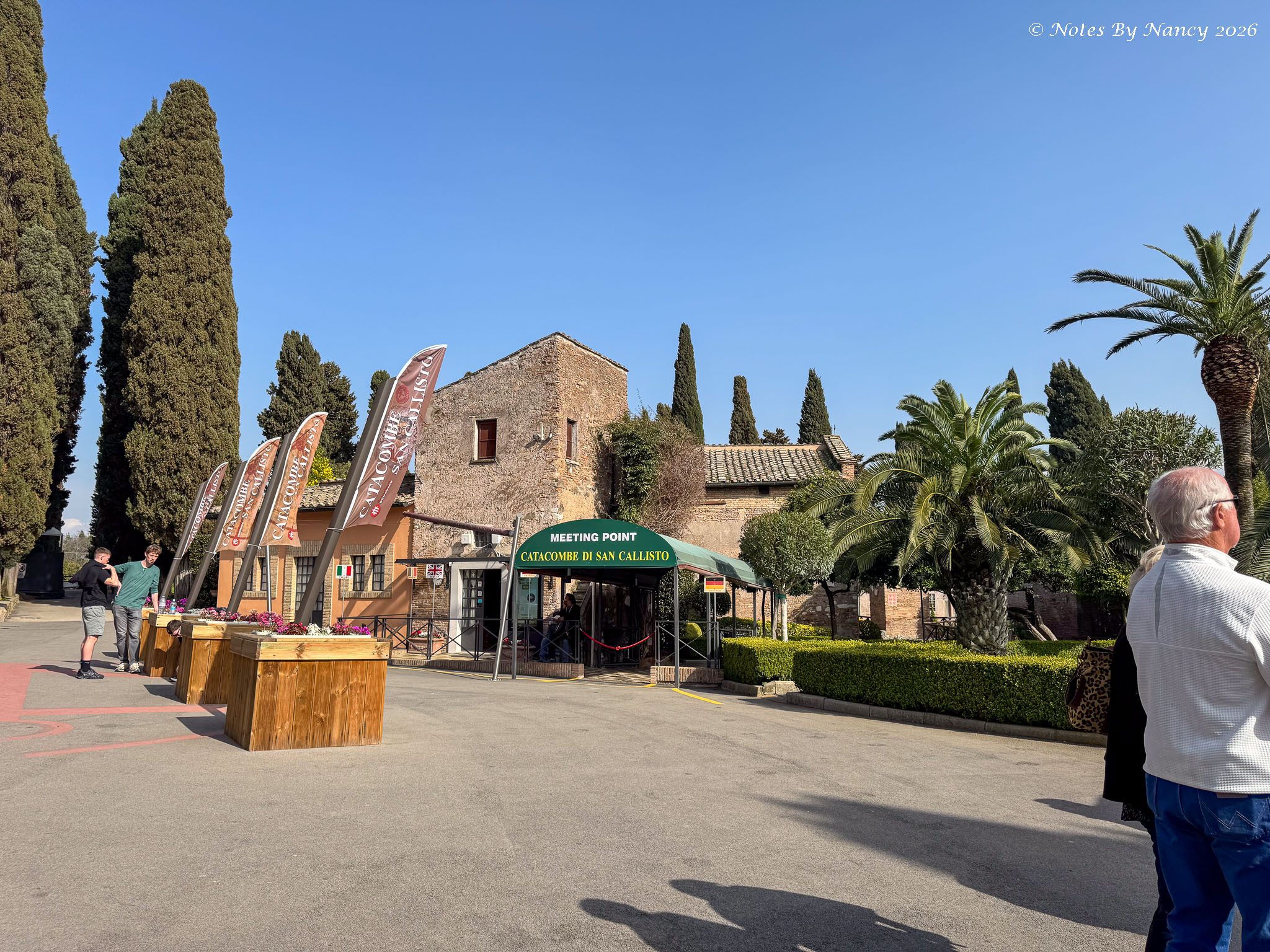
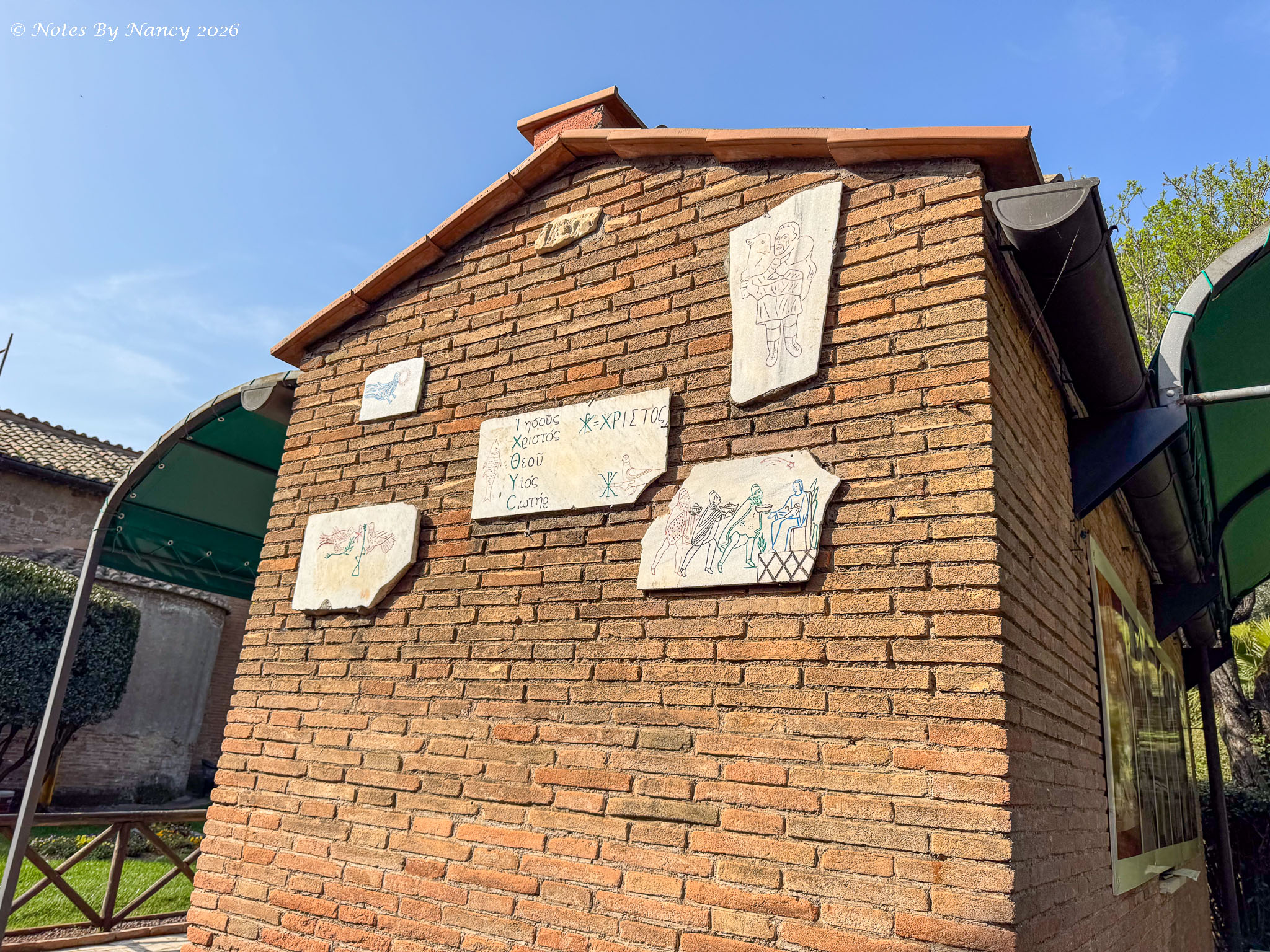
Before descending, our guide provided lots of information and showed us some of the artifacts found and explained many of the symbols. Frescos and mosaics decorate many of the crypts.
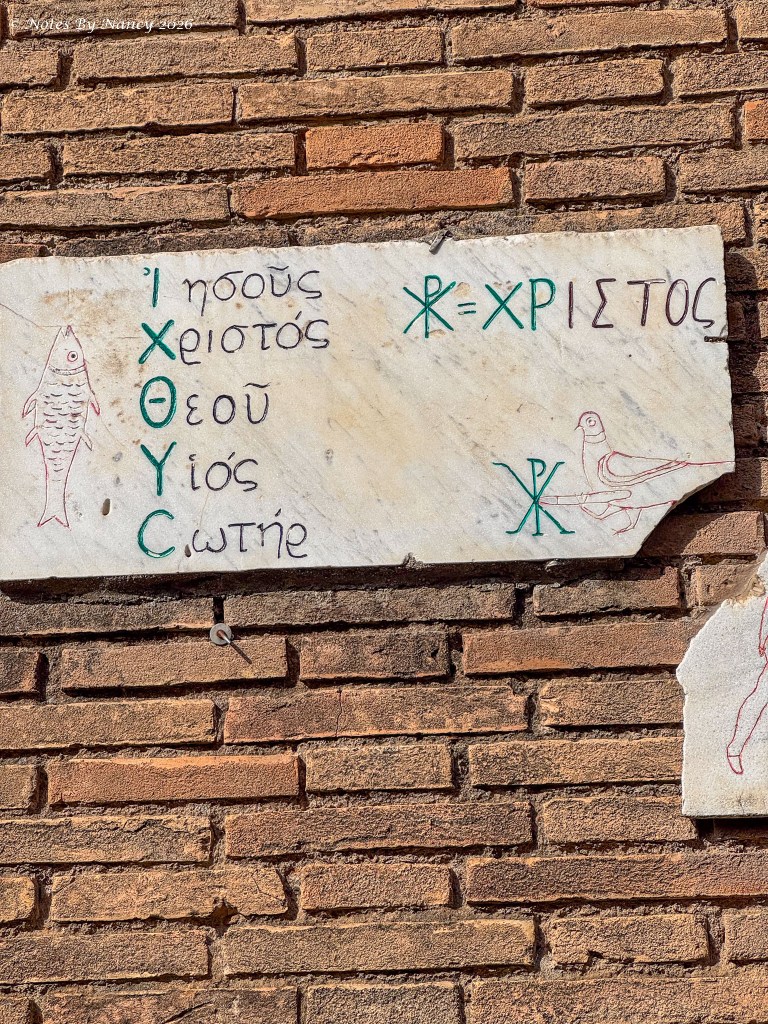
Left – The fish – Greek IXTHYS (ichtùs) – an acrostic for Iesùs Christòs Theòu Uiòs Sotèr = Jesus Christ, Son of God, Saviour;
Right – the monogram of Christ – X (chi) and P (ro) – engraved on tombstones of Christians
Pictures weren’t allowed once we descended below the surface, but you can find some interesting photos and more information on the official website linked here. Official tours are provided in several languages but tickets must be obtained online via the website in advance.
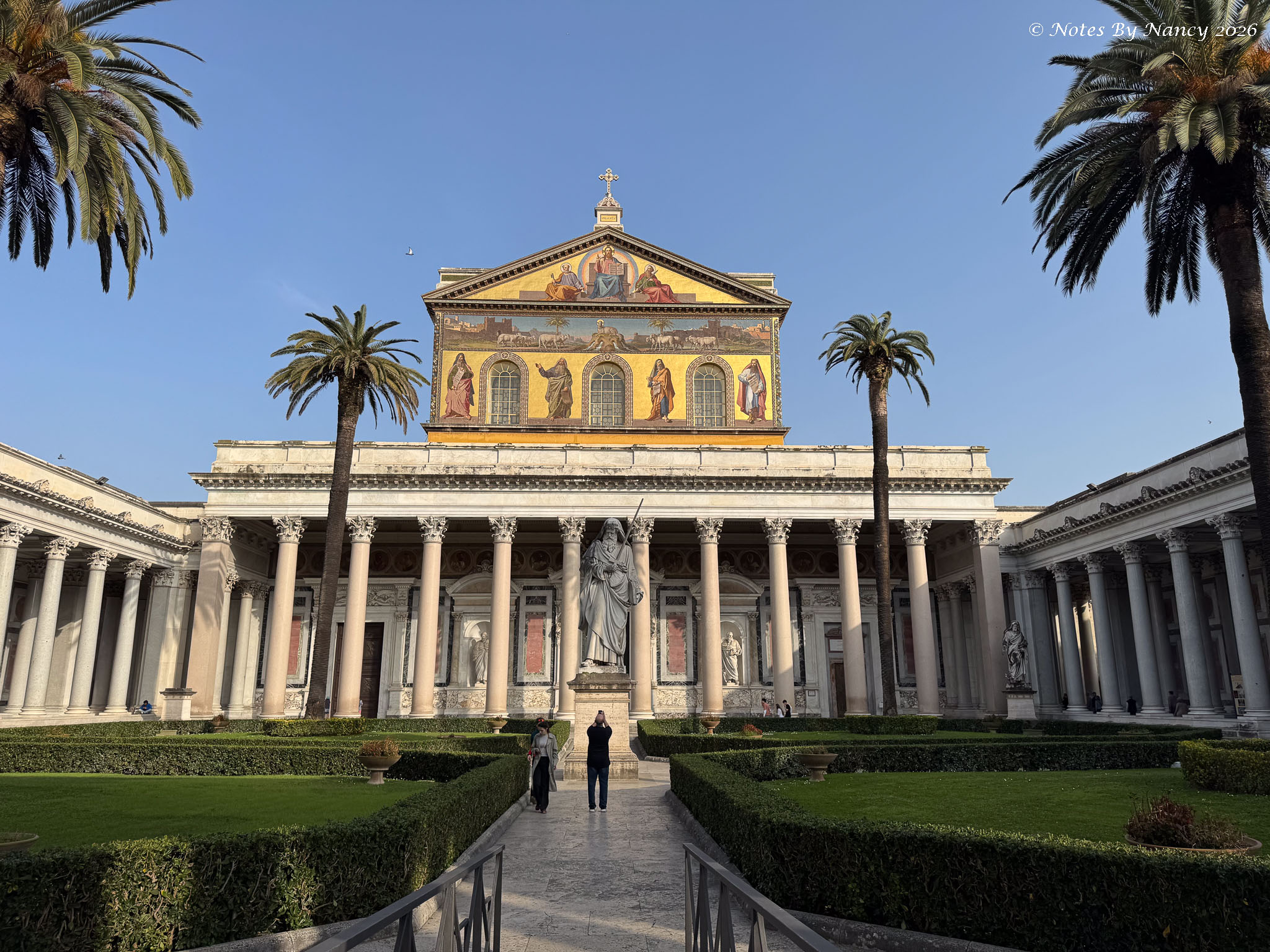
Papal Basilica of Saint Paul Outside the Walls
Our timing worked that we were able to make one more stop to visit one final church of significance – St. Paul Outside the Walls – located about 4 km west of the Saint Callixtus catacombs and about two blocks southeast from the Tiber River. “Outside the Walls” refers to the Aurelian Walls surrounding Rome which were constructed between 271 and 275 by Emperor Aurelian. While it is well-known that St. Peter’s Basilica in Vatican City is built over the traditional burial place of Peter, I was not aware that there was also a church established at the traditional site of Paul’s burial and this is it!
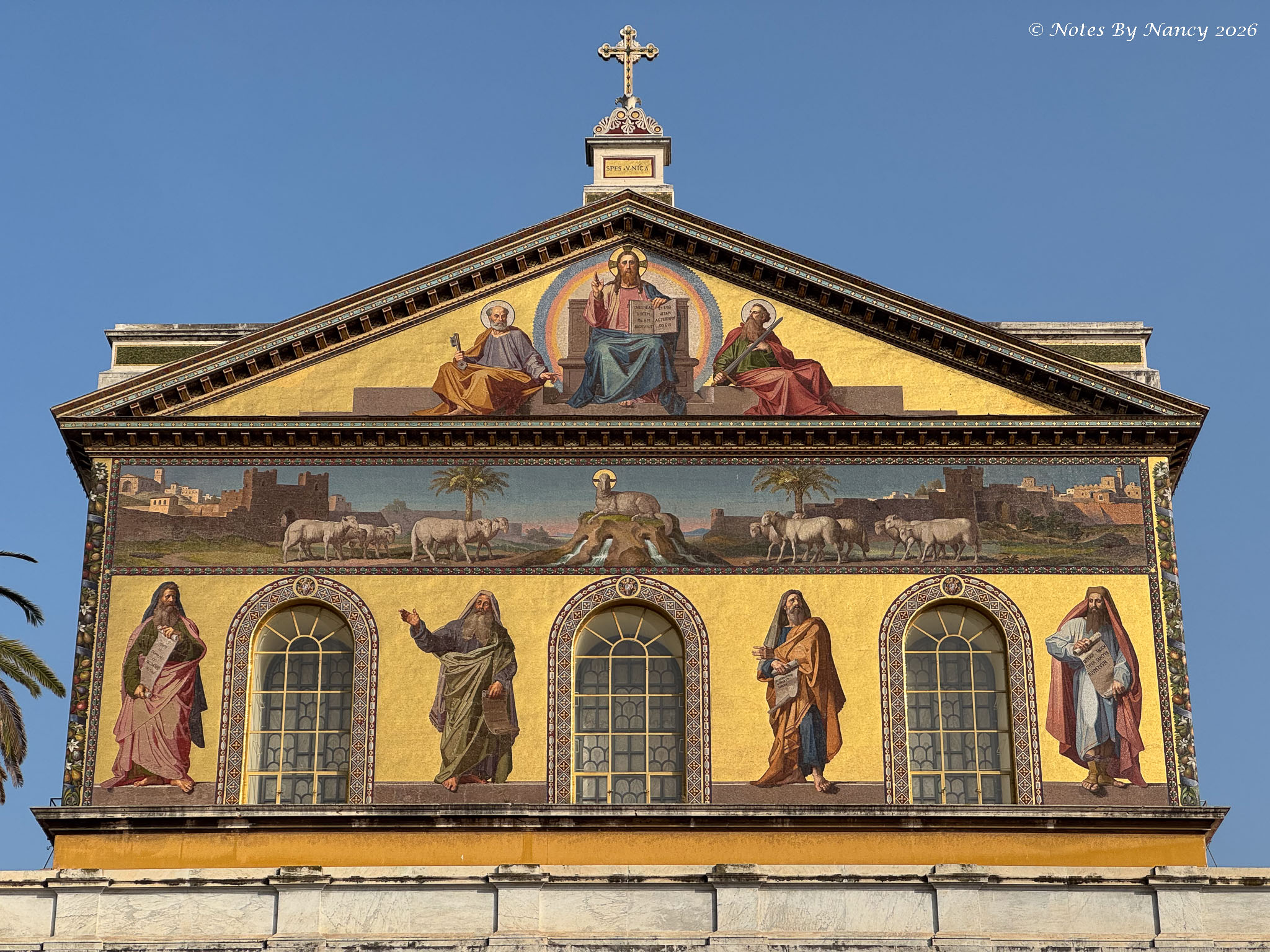
Enter Constantine the Great again – he founded a basilica here which was consecrated in 324 by Pope Sylvester. Over the centuries, two monasteries were attached (one for men and one for women), the building was expanded, was damaged by earthquakes, fires, and invaders, was repaired, fortified, etc. on repeat. In 1823, however, a fire almost totally destroyed the basilica. The “reconstruction” resulted in the building seen today which reused the same footprint and architectural design while salvaging as much original material as possible. Donations came from all over the world, including Russia (malachite and lapis lazuli) and Egypt (alabaster columns and windows). The “new” St. Paul Outside the Walls was reconsecrated in 1854 by Pope Pius IX, although additional construction continued into the 20th century.
As far as churches in Rome go, it is second only to St. Peter’s in size. To me, it was just as impressive as St. Peter’s – and maybe more so. But perhaps that is due to my preference for the clean lines of St. Paul’s over the Baroque ornateness and curvy lines of St. Peter’s. We only had about 30 minutes to spend here, but there is a museum with many of the archeological discoveries from the site’s centuries of development which would have been interesting to explore if we’d had more time.
Here are some of my favorite images from both the exterior and interior.
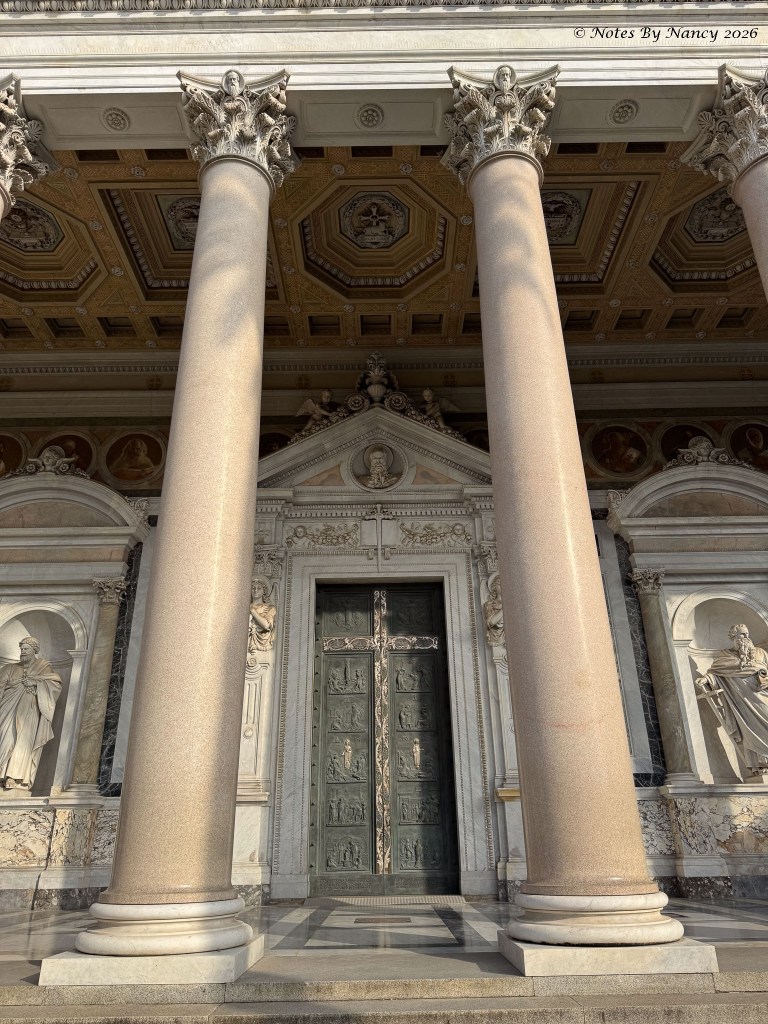
Main Entrance – Green bronze door with silver cross inlaid with lapis lazuli and other stones
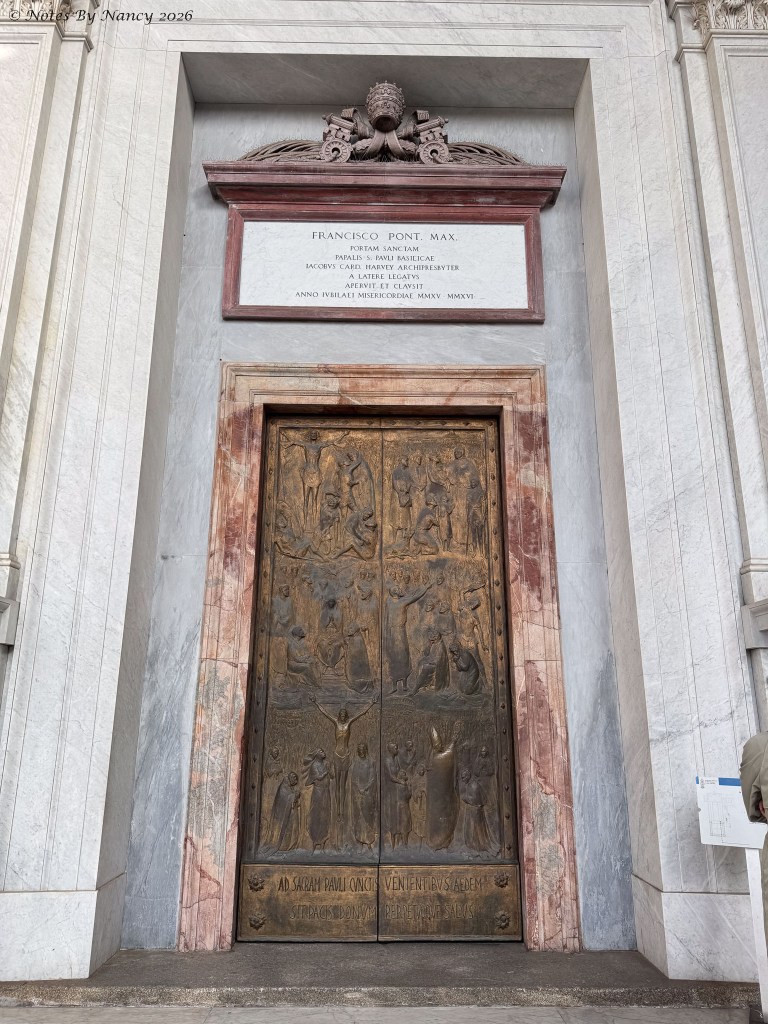
To the right of the Main Door is the Holy Door (from 1931) only opened during Jubilee years
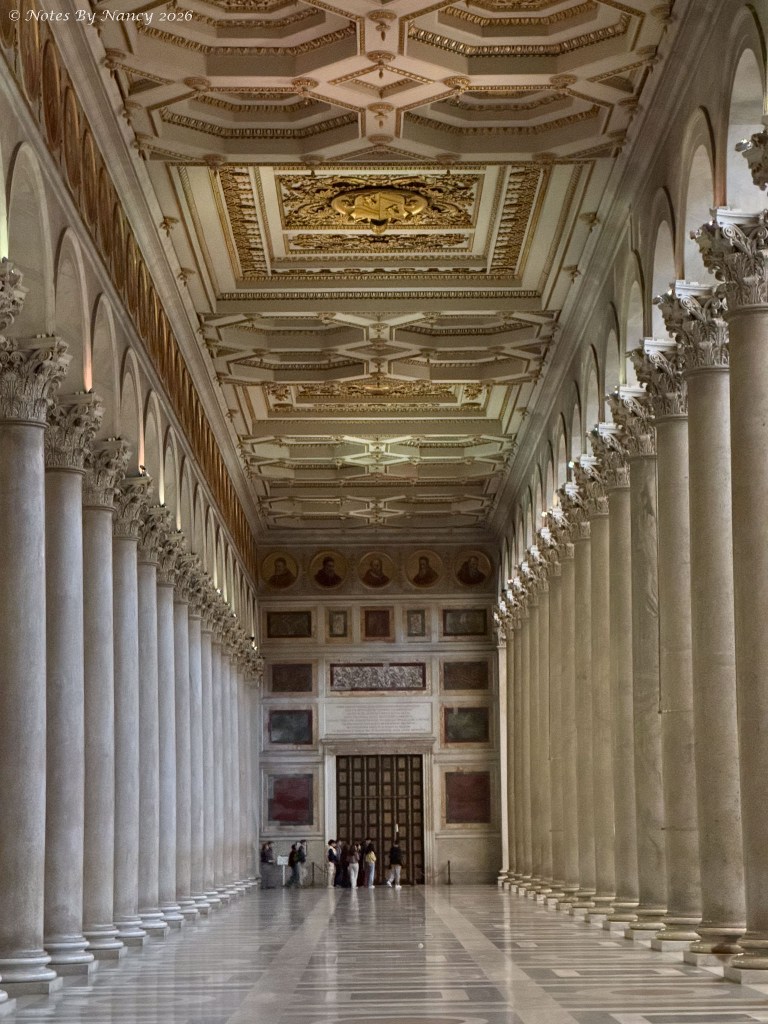
Inside the Holy Door is the Byzantine bronze 56-panel door from 1070 – also only opened during Jubilee years
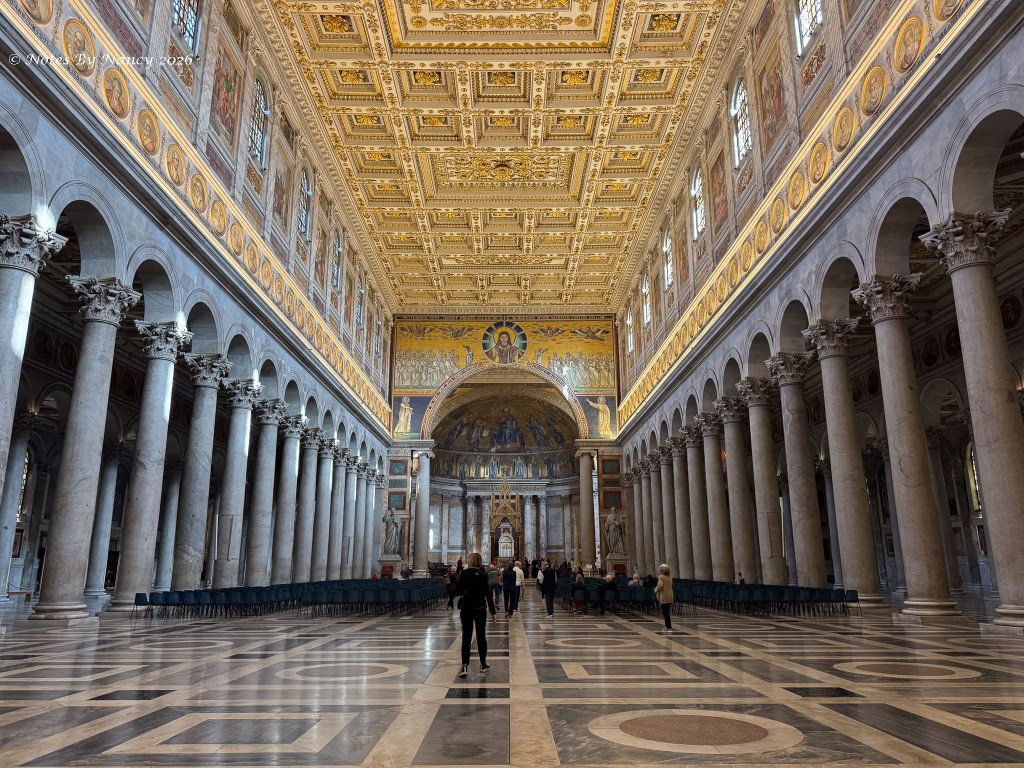
The nave is 432 feet (131.66 meters) long, 213 feet (65 meters) wide, and 97.4 feet (29.7 meters) high. It is almost overwhelming.
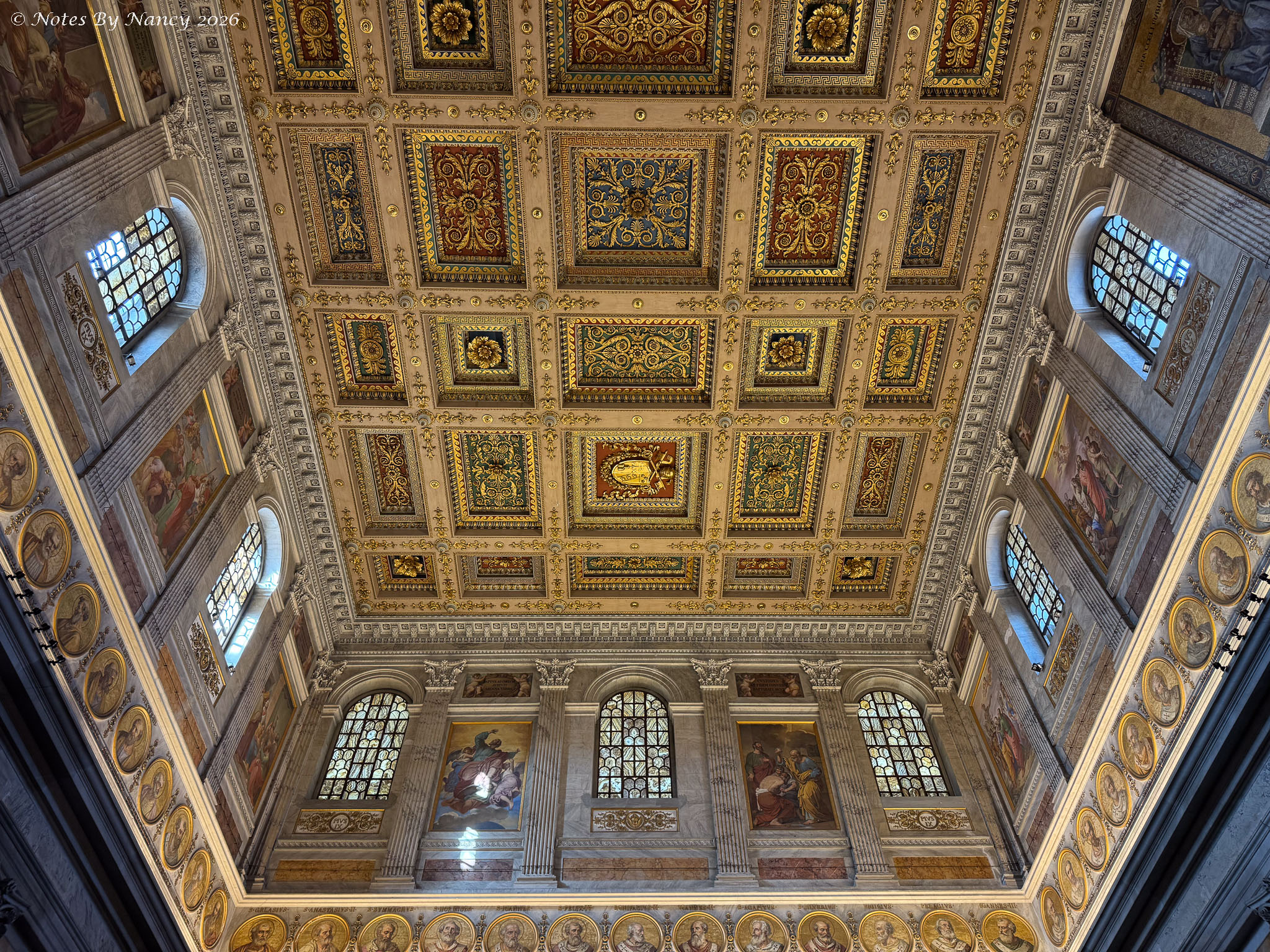
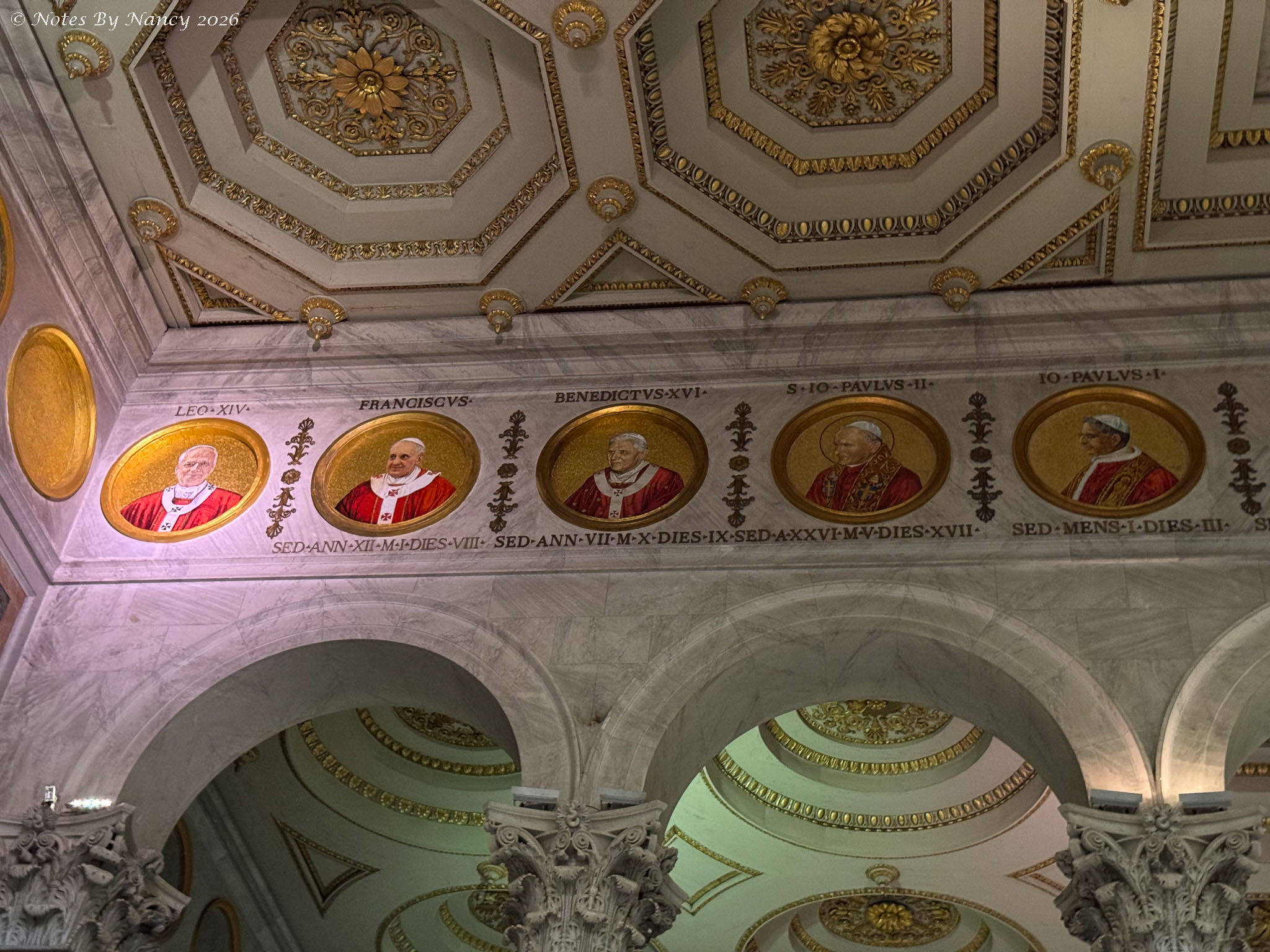
Along the sides of the nave are mosaic portraits of all 267 popes – seen in these images which include the ornate coffered ceilings and upper walls. Yes, that’s Leo XIV, the current pope, under the spotlight!
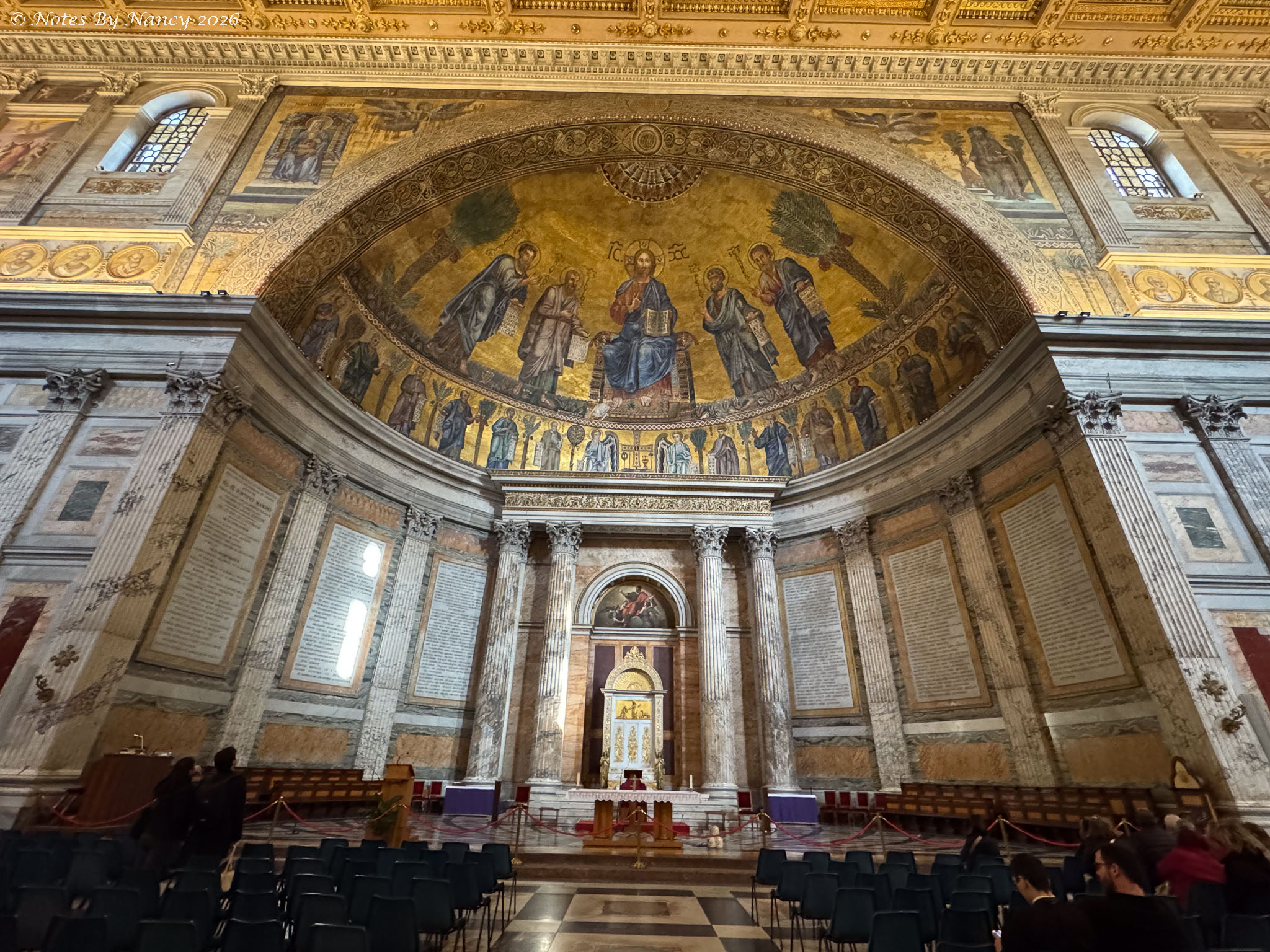
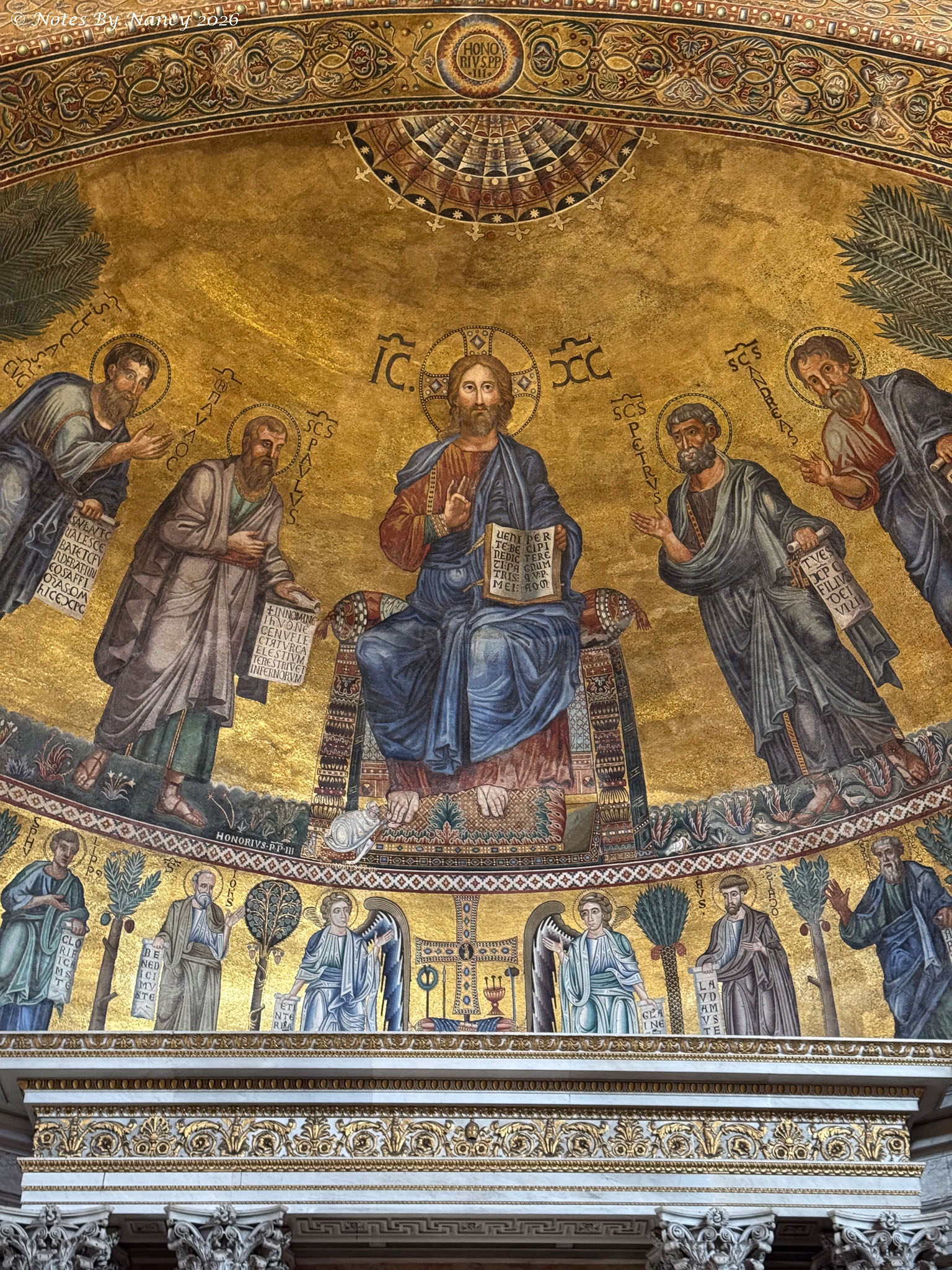
Mosaics in The Apse
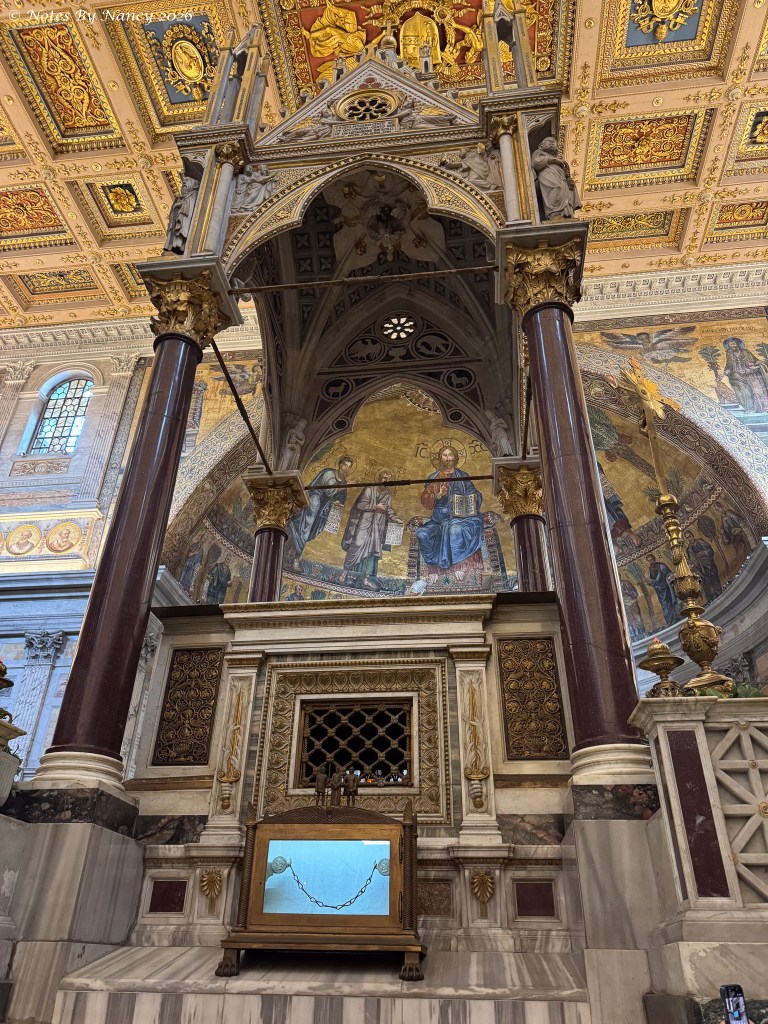
The canopy over the main altar is by Arnolfo di Cambio in 1285 and sits above the chains of Paul and above the site of Paul’s tomb. This magnificent structure survived the 1823 fire.
The window in the floor allows pilgrims to see the tomb of Paul. There is a railing all around and if you are undertall, like me, it is difficult to see much!
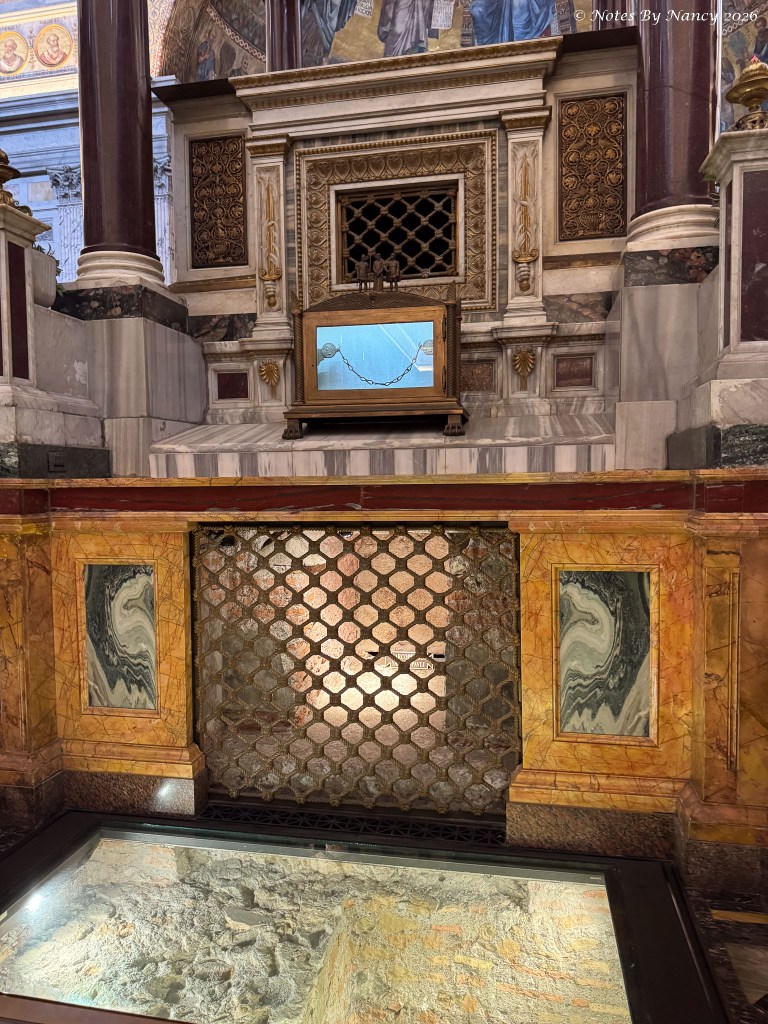
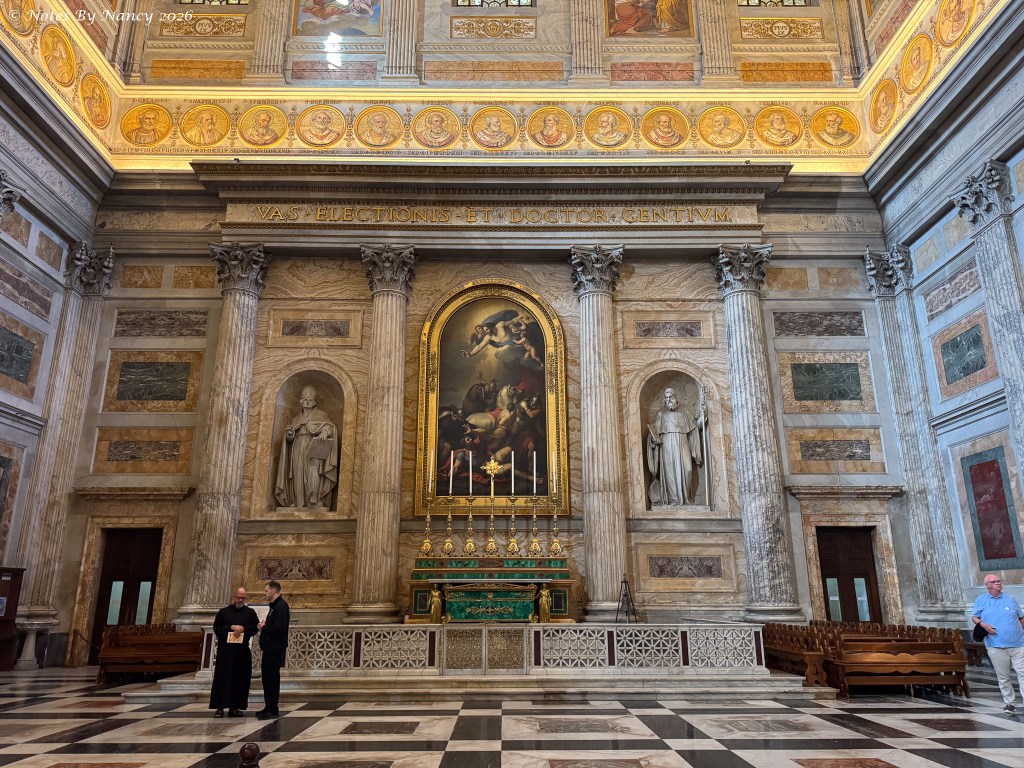
Altar of the Conversion of Saint Paul
Latin text above the altar translates to “vessel of election and teacher of the Gentiles”
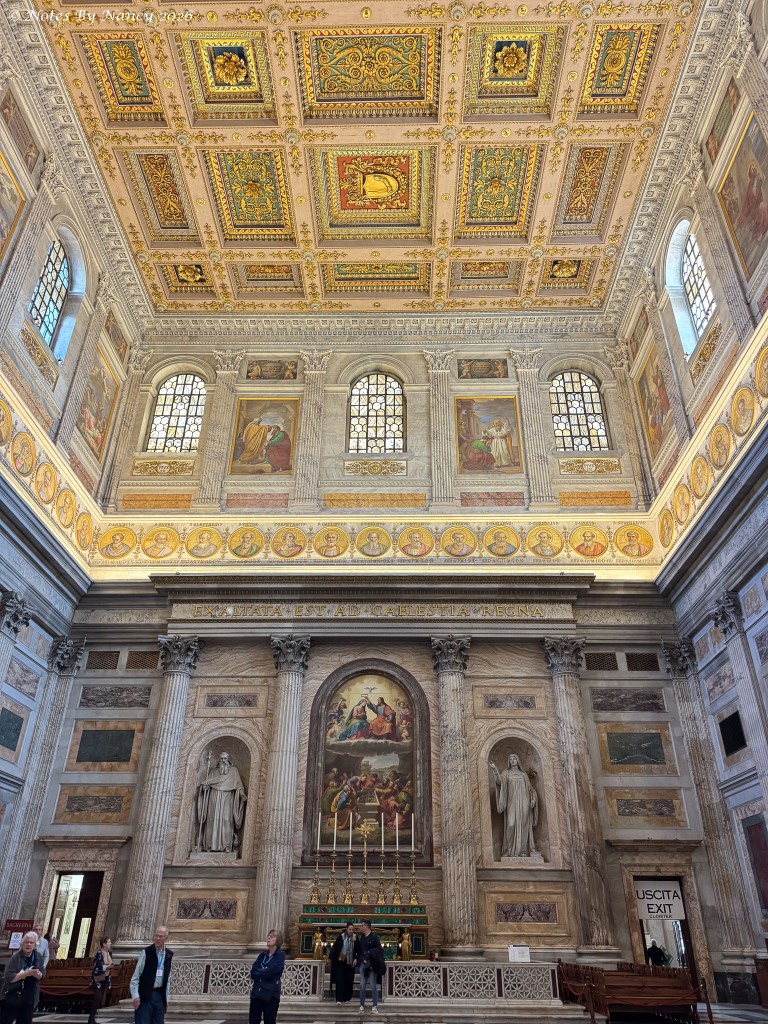
Altar of the Assumption
The windows are translucent alabaster.
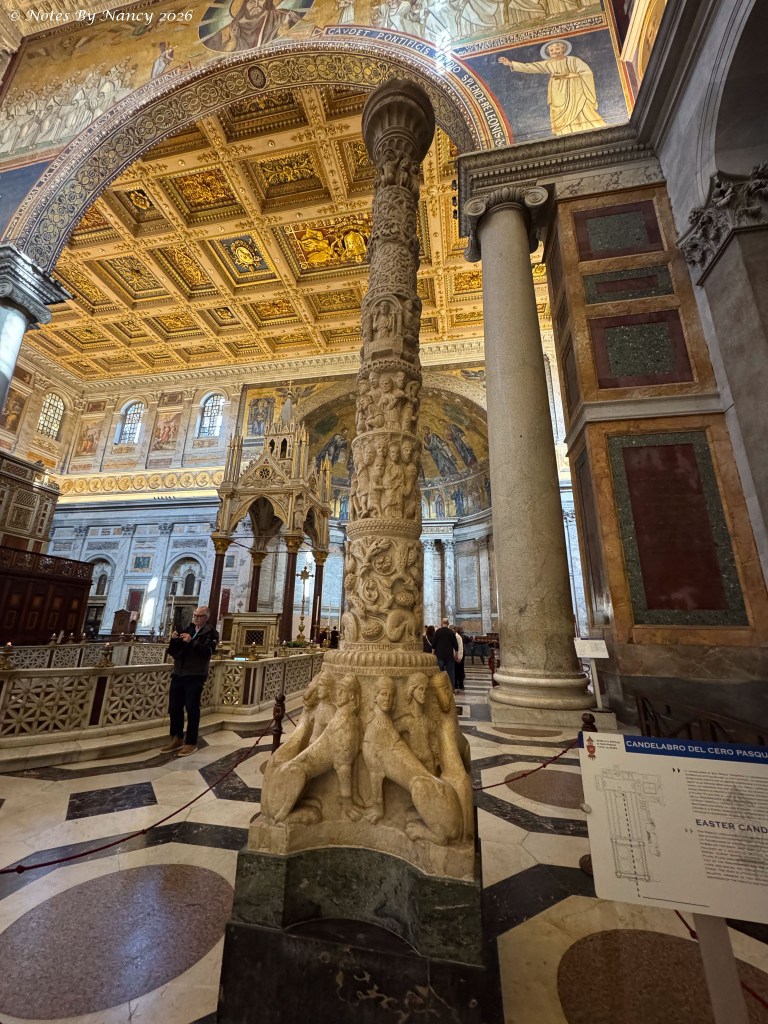
Created around 1170 by Nicola d’Angelo and Pietro Vassalletto, the Easter Candlestick is a 18.4 foot-tall (5.6 meters) marble sculpture depicting the Passion and Resurrection of Christ. This Romanesque work also survived the 1823 fire.
For more in-depth information about St. Paul’s Outside the Walls, here’s the official website link.
And, with that the trip was pretty much wrapped up! We had our final group dinner, said our goodbyes, and headed to our room to finish packing for our early morning departure to the airport ahead of the majority of the group.
Final Thoughts
We covered a lot of ground in 8 days! Our local tour manager, Flavio, was fun, engaging, and helpful. He herded our “group of cats” well and probably took care of issues we never knew about to enable a smooth and enjoyable trip. We reconnected with some friends and made new friends on this trip. We not only learned about cultures (both secular and religious) and time frames different from our own, but experienced them, too. Dr. Todd Still did a wonderful job tying together the people, events, and locations mentioned in the New Testament with the places we were seeing, helping us to better understand how early Christians lived and worshipped, and how the gospel of Christ spread both in spite of and because of the Roman Empire.
Looking back on the trip now, several weeks later, the experiences that I will most remember are all the pilgrims in Assisi (and the steep hills!) to see the 800-year-old bones of Francis (Note 119), the moment that I saw Michelangelo’s David in Florence (Note 120), realizing the vastness of the Vatican’s collections and seeing the tenderness in Michelangelo’s Pieta in St. Peter’s Basilica (Note 122), as well as comprehending the scope and size of Pompeii and how that terrible event froze time for us to study and learn more about city life in the Mediterranean 2000 years ago (Note 125).
I hope that we have the opportunity to travel with Dr. Still again on one of his trips as this one was so well-organized and educational.
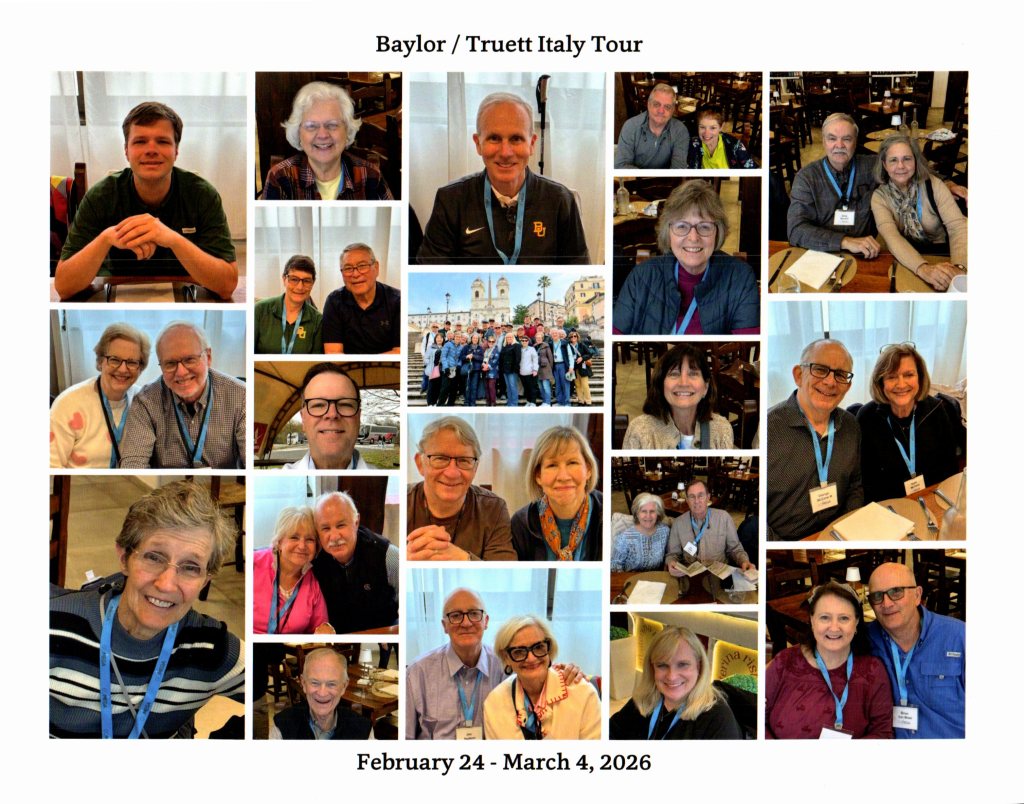
Lastly, one of our group, Brian, put together a collage and mailed a printed copy to everyone as a memento of the trip. And, yes, he included all the names on the back! Thanks Brian!



 Notes By Nancy
Leave a comment