
Itinerary
Day 9 – This morning you will begin with a visit to the famous Trevi Fountain, and on to the Piazza di Spagna, where you can climb the Spanish Steps. You will visit the Pantheon. Lunch on your own.
In the afternoon, you will proceed with the visit to the catacombs, burial place and meeting place of the early Christians. They were forced to meet in secret, underground, to escape persecution during the time before Constantine.
Farewell dinner at a local restaurant. Overnight will be at your hotel.
Piazza della Trinità dei Monti
This morning our bus drove us about 15 minutes to the Piazza della Trinità dei Monti (Trinity of Mounts) next to the 15th-century Catholic church for the French Kings, Trinità dei Monti, with its dual bell towers, unique in Rome. In the middle of this piazza stands an obelisk (Sallustian Obelisk) from the 2nd or 3rd century AD.
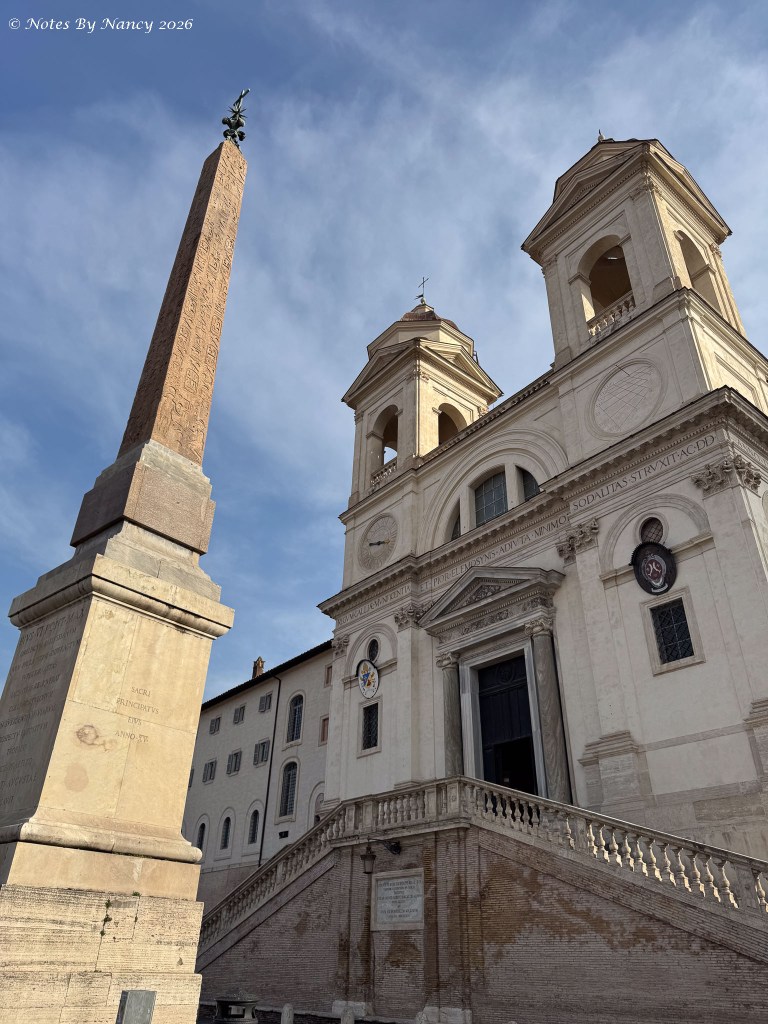
Originally located elsewhere in Rome, it was repaired and moved to its present location in 1787 by Pope Pius VI.
The symbols of the pope and a cross were added to the top, along with some inaccurate “hieroglyphics”! There are more ancient Egyptian and Roman obelisks in Rome than anywhere else in the world.
The church sits on top of Pincian Hill (Mt. Pincio) with a great panoramic view over Piazza di Spagna and Via Condotti with its high-end shopping.
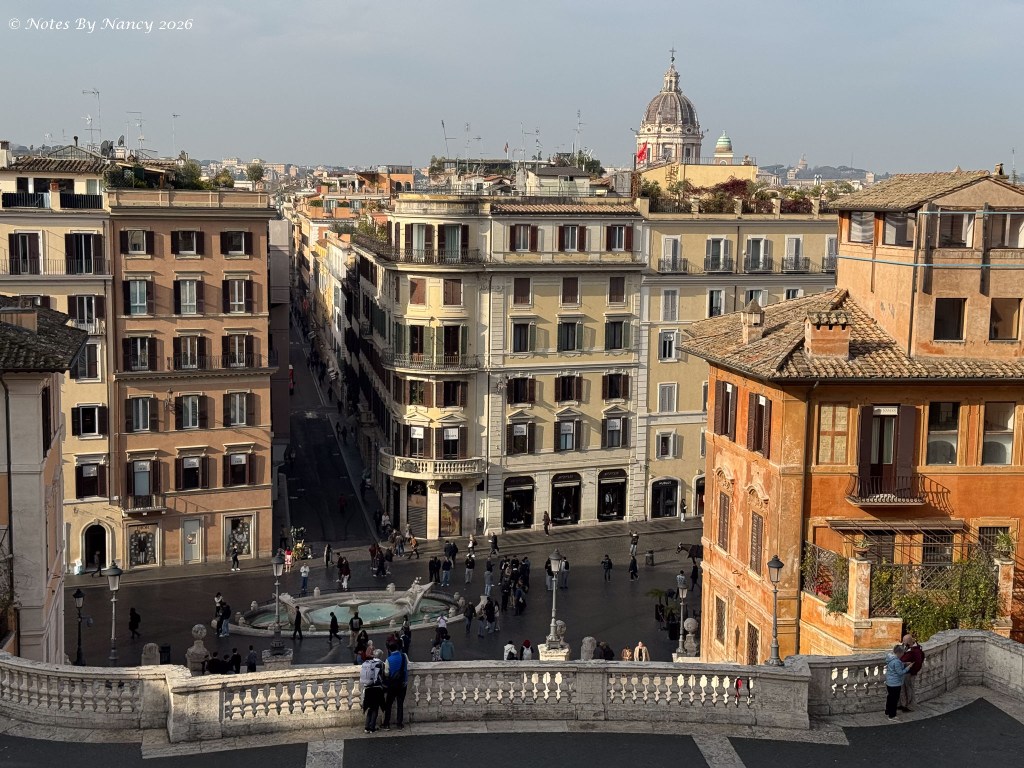
From here, we walked down the famous “Spanish Steps” leading to…
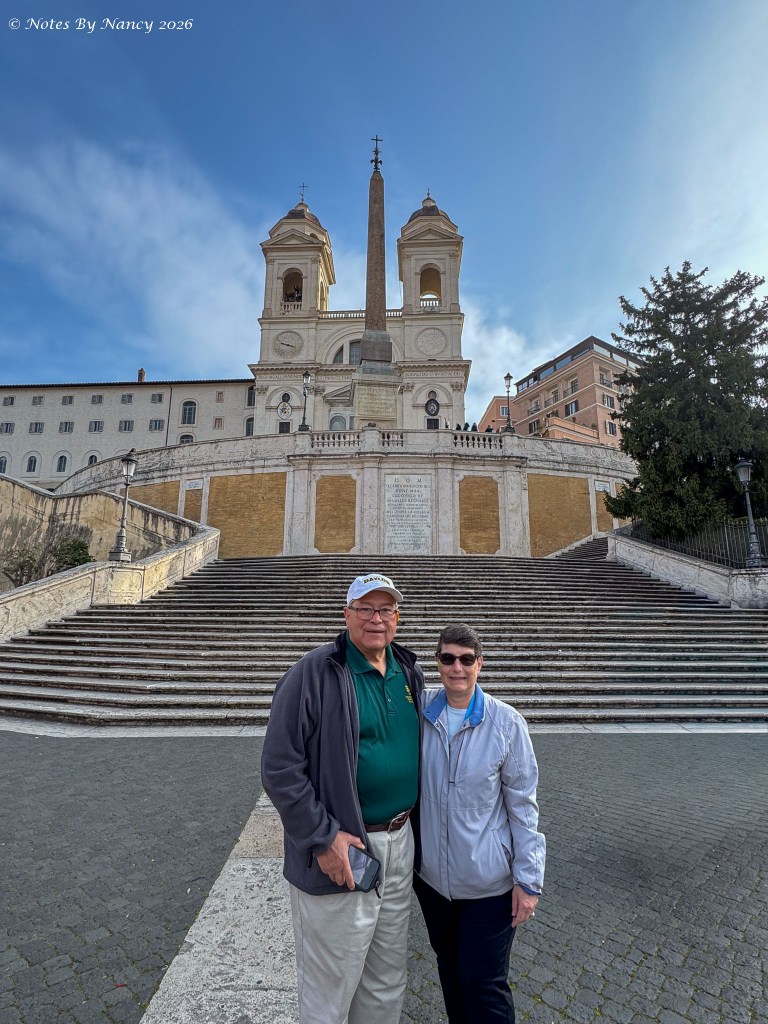
Piazza di Spagna
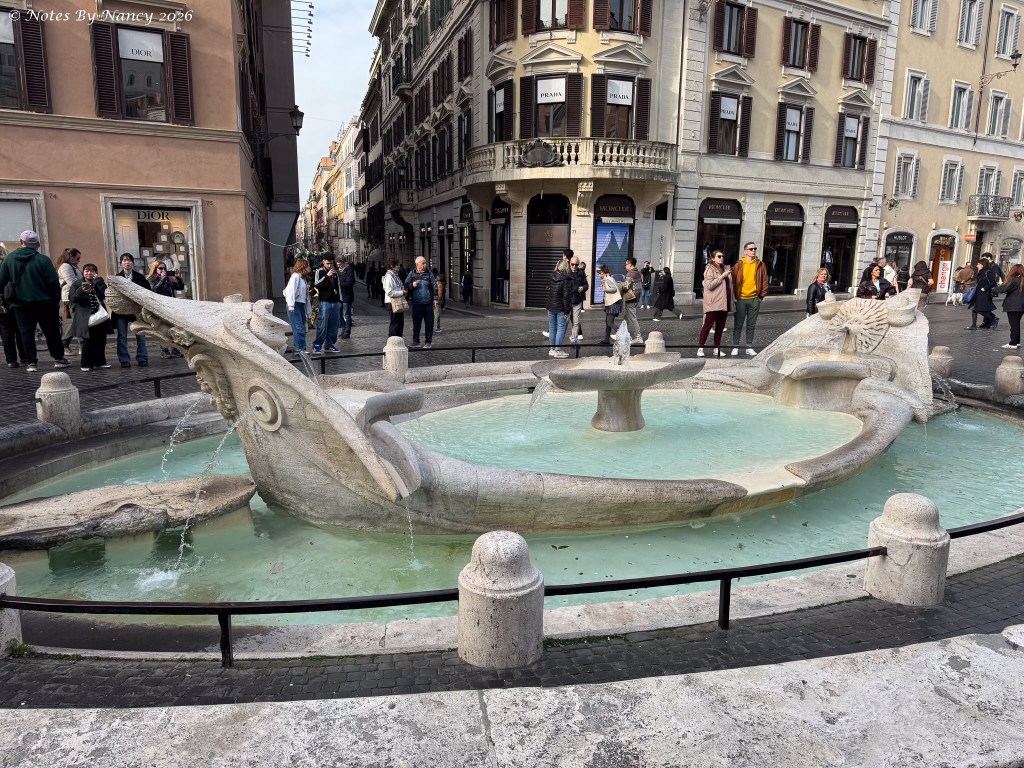
with the Fountain of the Barcaccia (Longboat) at the bottom of the steps.
A couple of blocks away in the adjoining Piazza Mignanelli is the 19th-century Column of the Immaculate Conception with a bronze statue of Mary atop an ancient Corinthian column and statues of Moses, King David, Isaiah, and Ezekiel at the base – each of whom predicted the Virgin Birth.
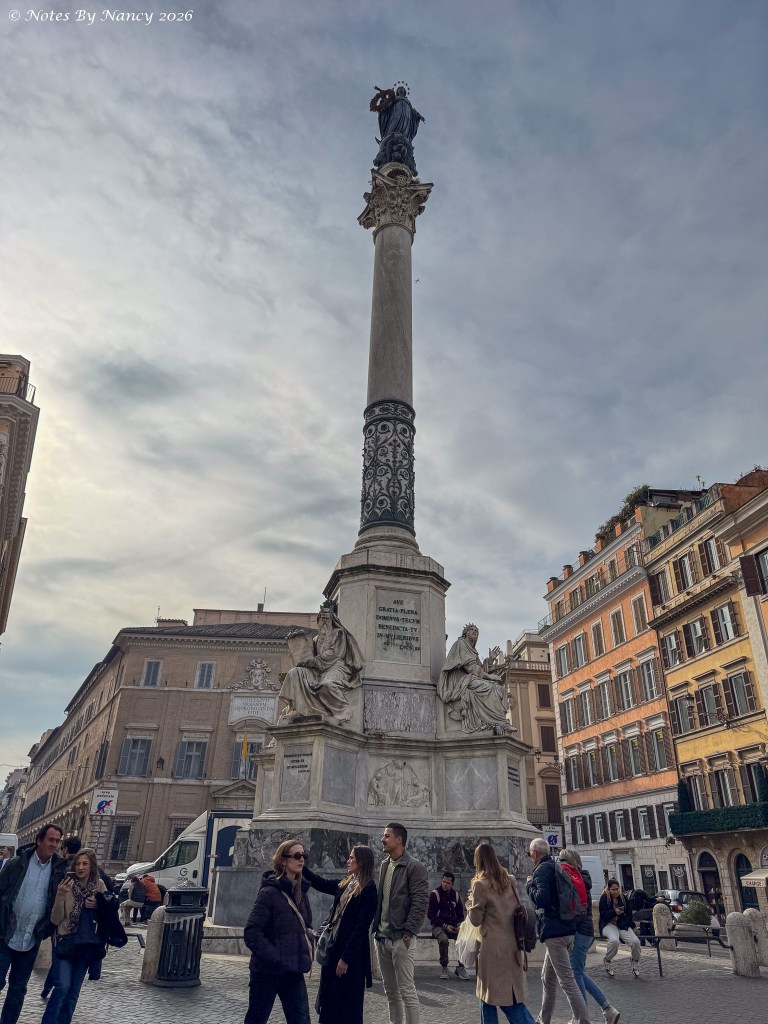
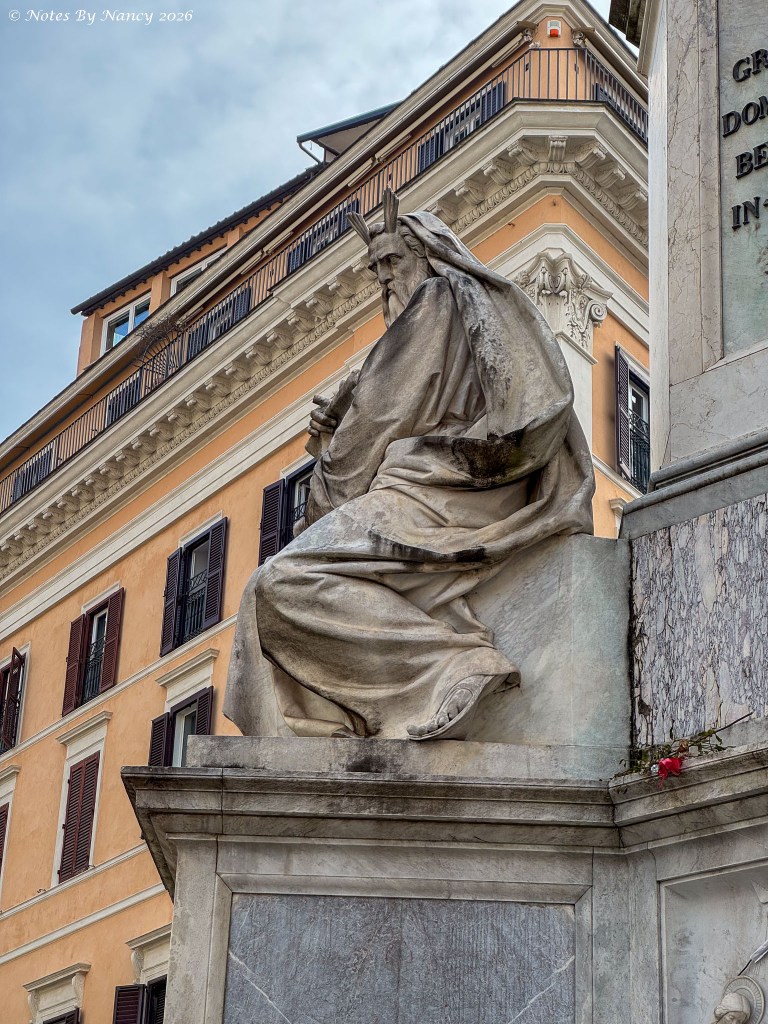
You will note that Moses appears to have horns. Per Google’s AI Overview: Michelangelo’s “Moses” (c. 1513–1515) is a famous marble sculpture located in Rome’s San Pietro in Vincoli church. The horns stem from a Latin mistranslation of Exodus 34:29, which described Moses’ face as “horned” (“cornuta”) rather than “radiant” or “shining” after descending from Mount Sinai. Michelangelo, following medieval tradition, interpreted this passage literally in his sculpture.
While Michelangelo was not the sculptor of the statue of Moses here, many other artists and sculptors used this same mistranslation in their depictions of Moses.
Trevi Fountain
About a 10-minute walk from Piazza di Spagna is one of the world’s most famous fountains, Trevi Fountain, sitting at the intersection of 3 roads (Tre Vie) – thus, its name.
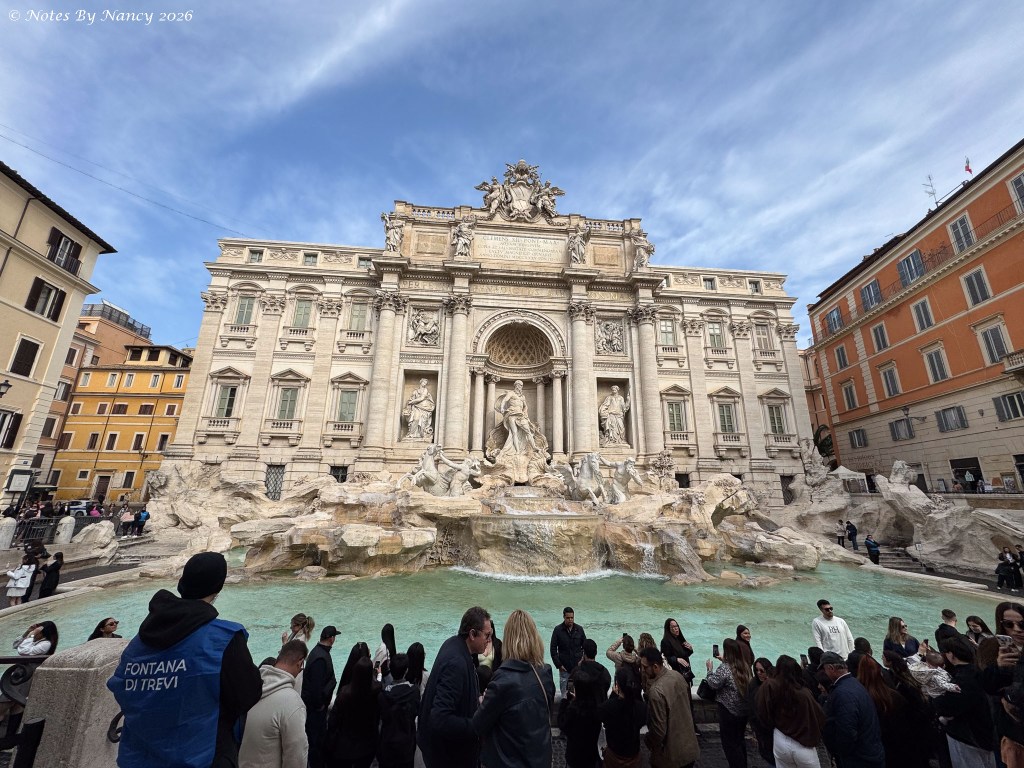
The site is the terminus of one of Rome’s ancient aqueducts providing pure water here since 19 BC. The Bernini-inspired work was designed by Nicola Salvi for a contest in 1730 organized by Pope Clement XII. Work began in 1732 incorporating the fountain into the edifice of the rear of the Palazzo Poli. It stretches over 160 feet (49 meters) wide and reaches 86 feet (26 meters) high. Salvi died in 1751 and Giuseppe Pannini took over, finishing the project in 1762.
To control the crowds desiring to throw coins into the fountain to ensure their return to Rome, effective early February 2026 you now must pay 2 Euros to enter the barricaded area in front of the fountain. It is estimated that the equivalent of over $1.6 million USD per year is thrown into the fountain. The proceeds are donated to the Catholic charity, Caritas.
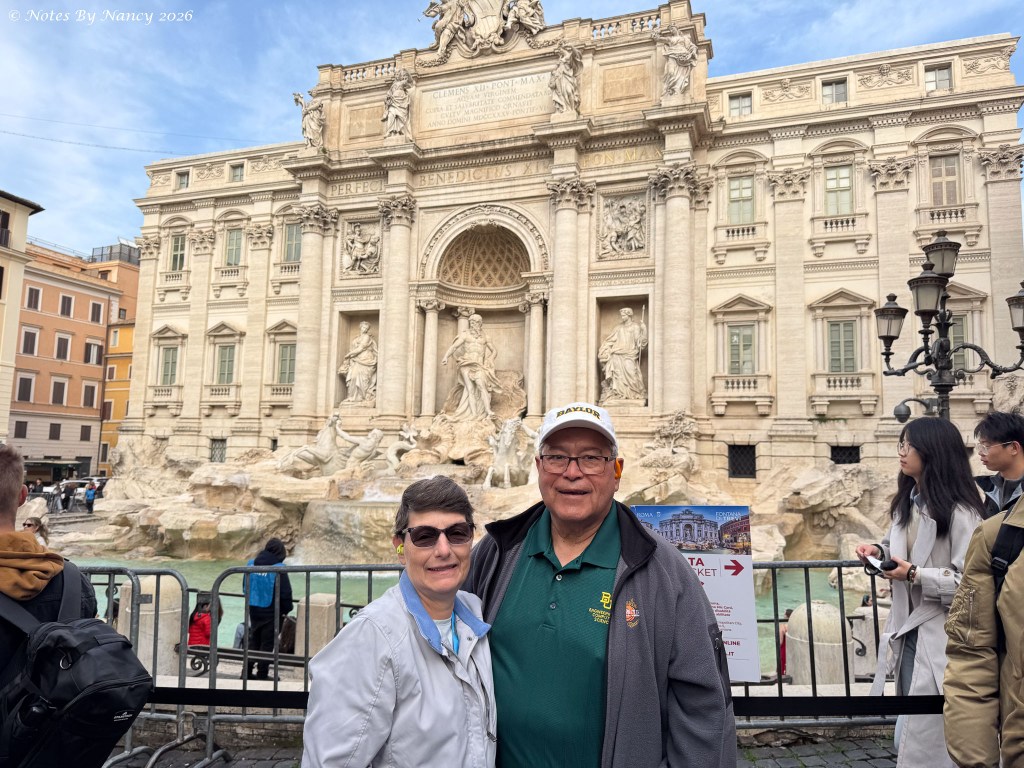
We didn’t make a “donation”, so we may be at risk of ever returning to Rome – there is still so much here that we could see on a return visit!
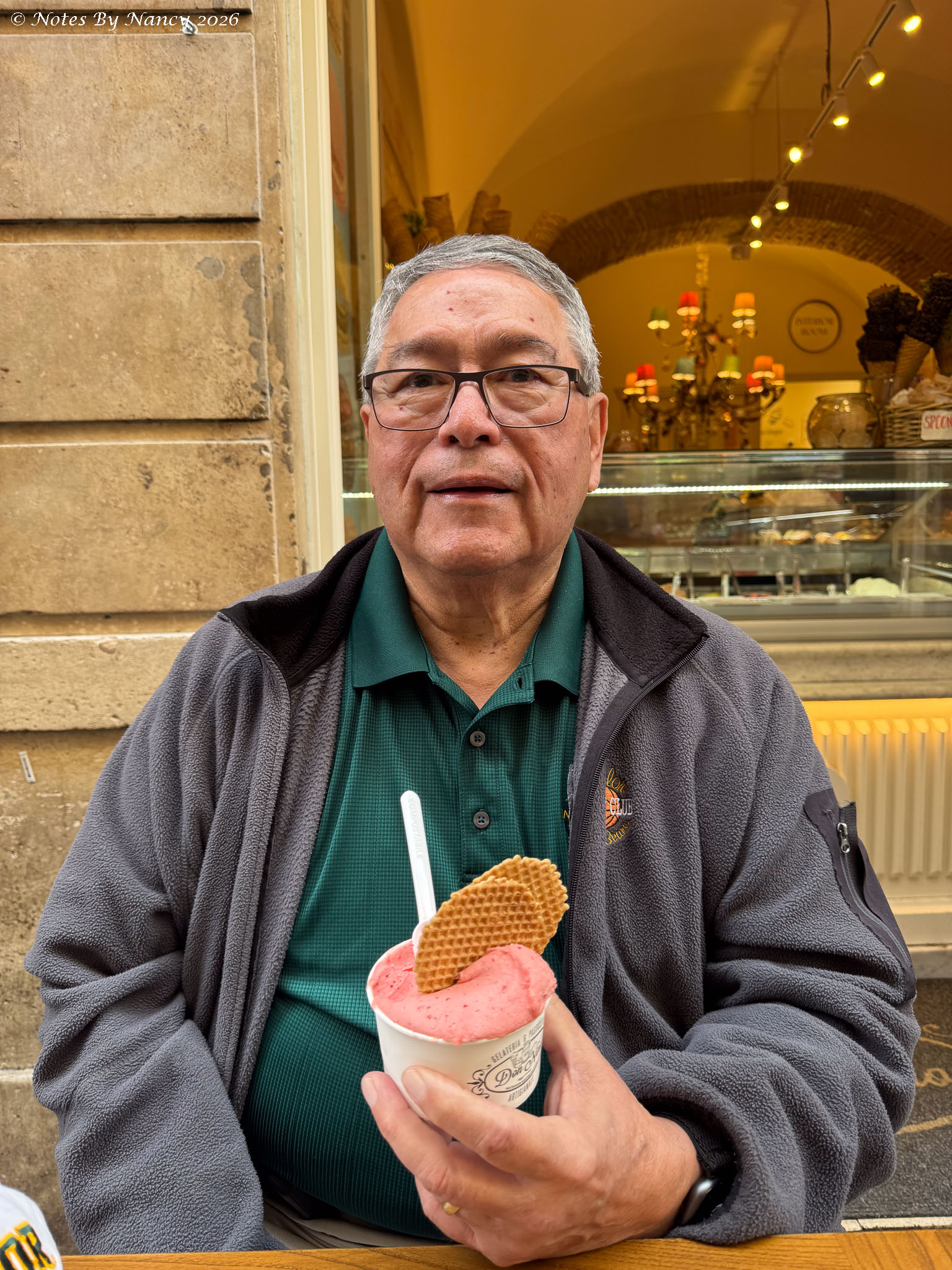
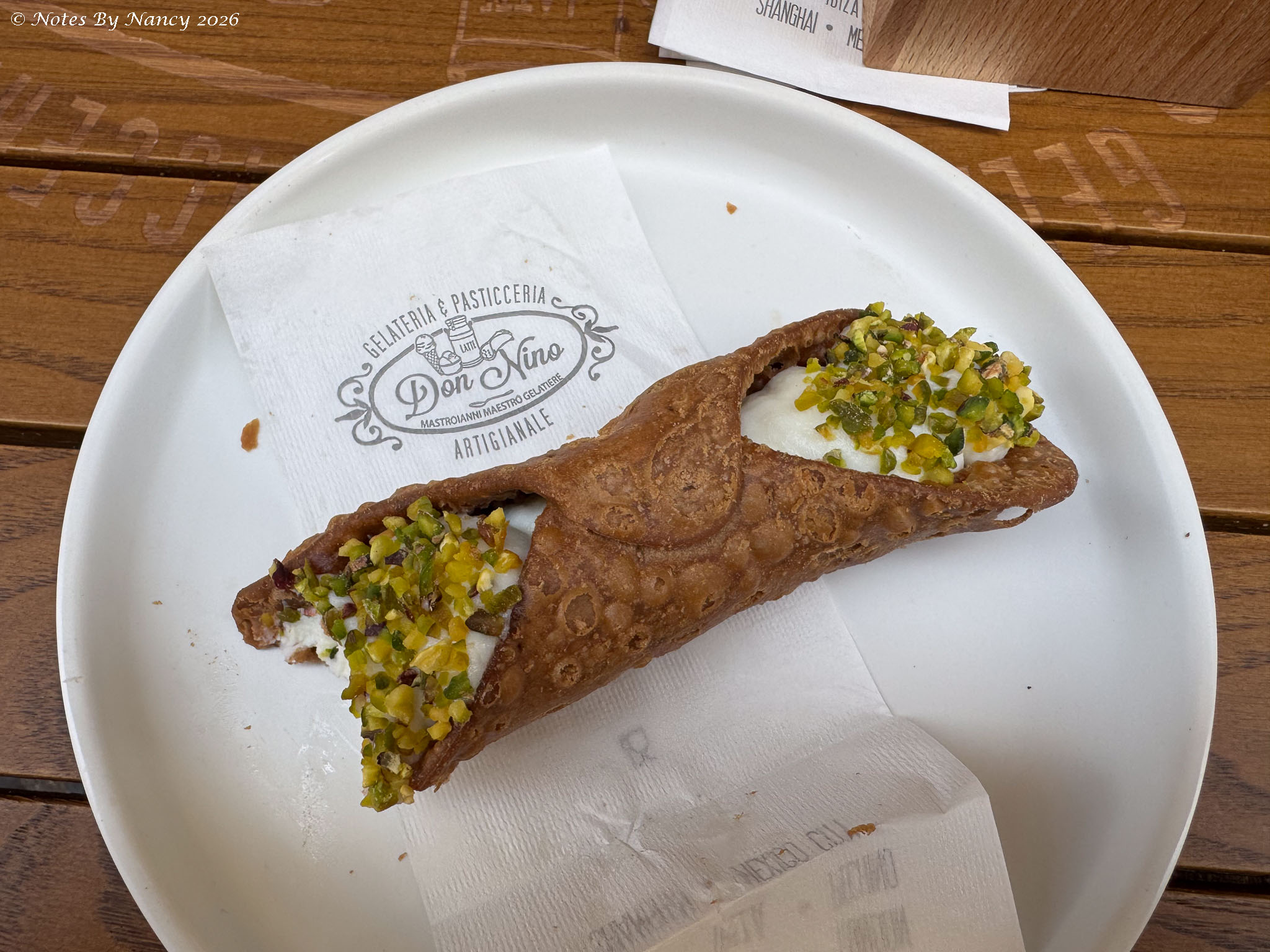
Instead of waiting in the queue to throw our money away, we donated towards the local economy in the form of a strawberry gelato and pistachio cannoli purchase! Yes, I’d already taken a yummy bite of the cannoli!
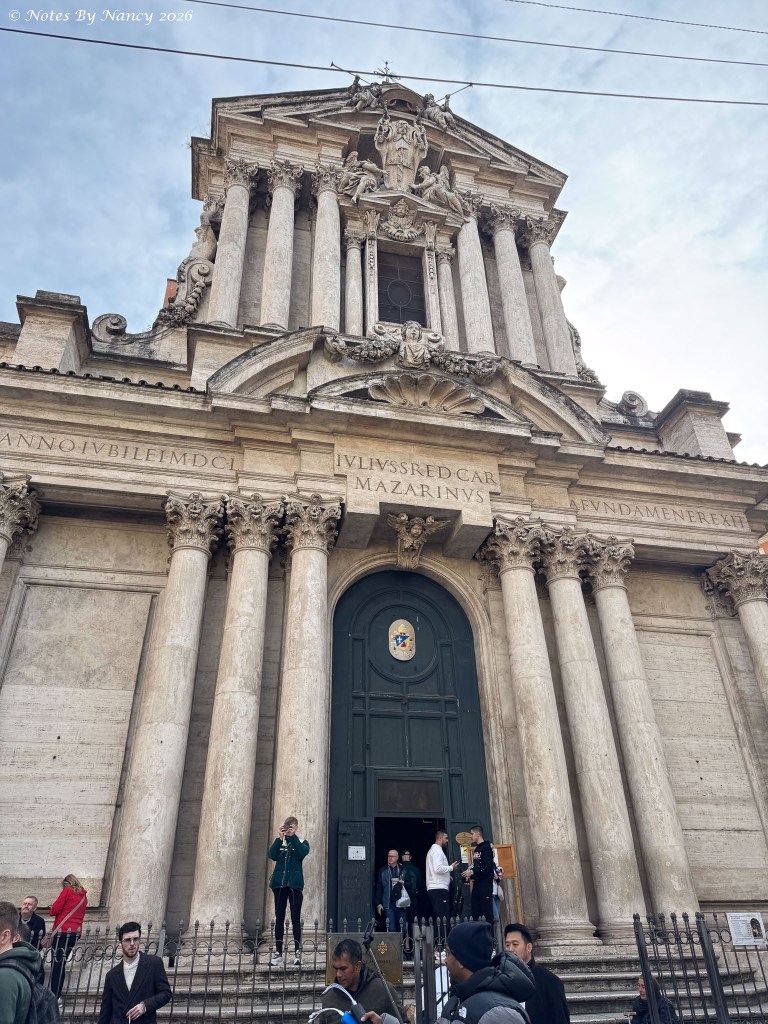
As we waited for everyone to rejoin the group, we learned that while it was the site of an earlier medieval church, this Baroque church on the corner, Church of Saints Vincent and Anastasius, contains the embalmed hearts of 22 popes – Sixtus V (died 1590) through Leo XIII (died 1903)!
I’m not quite sure what to think about that.
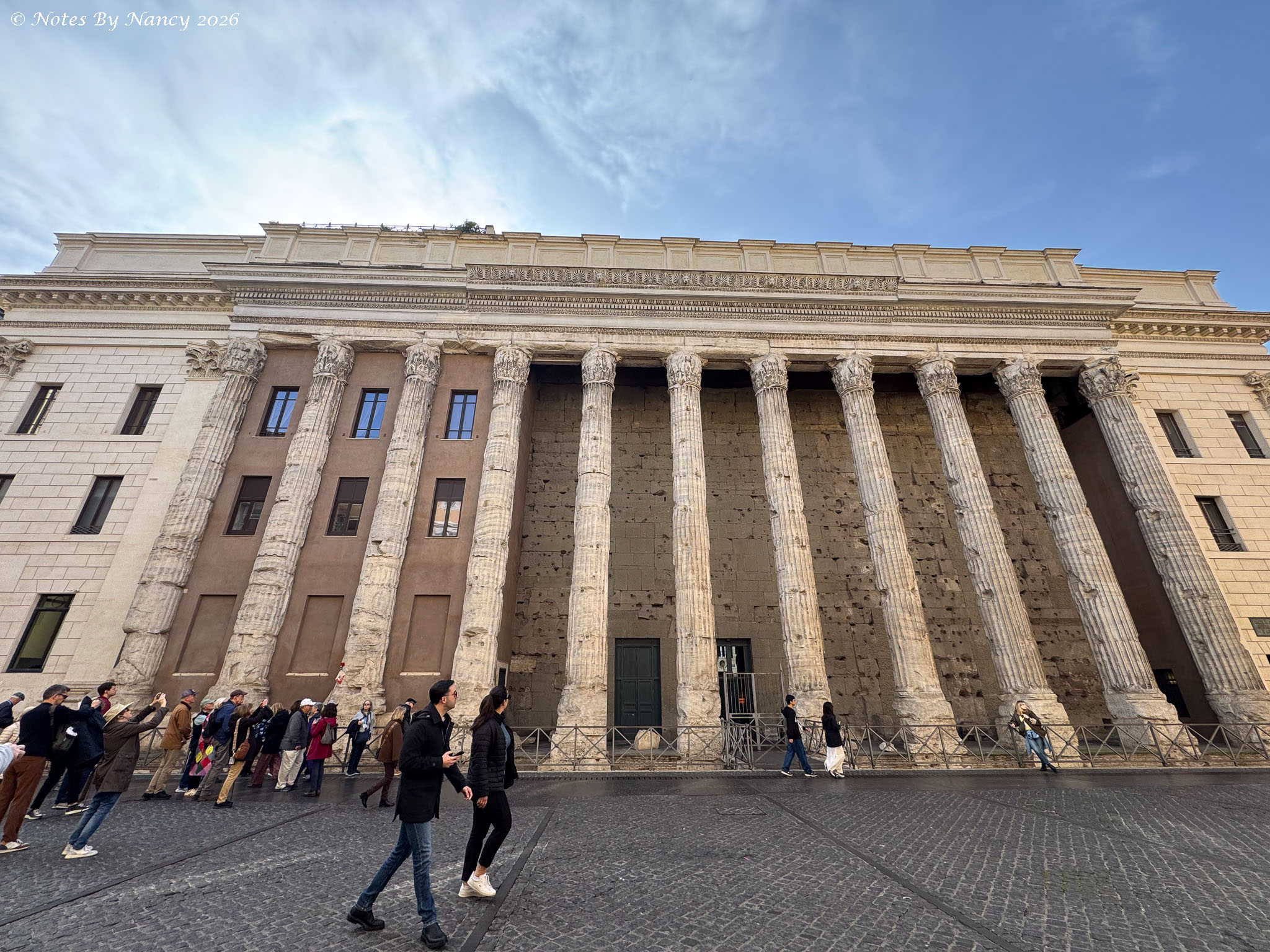
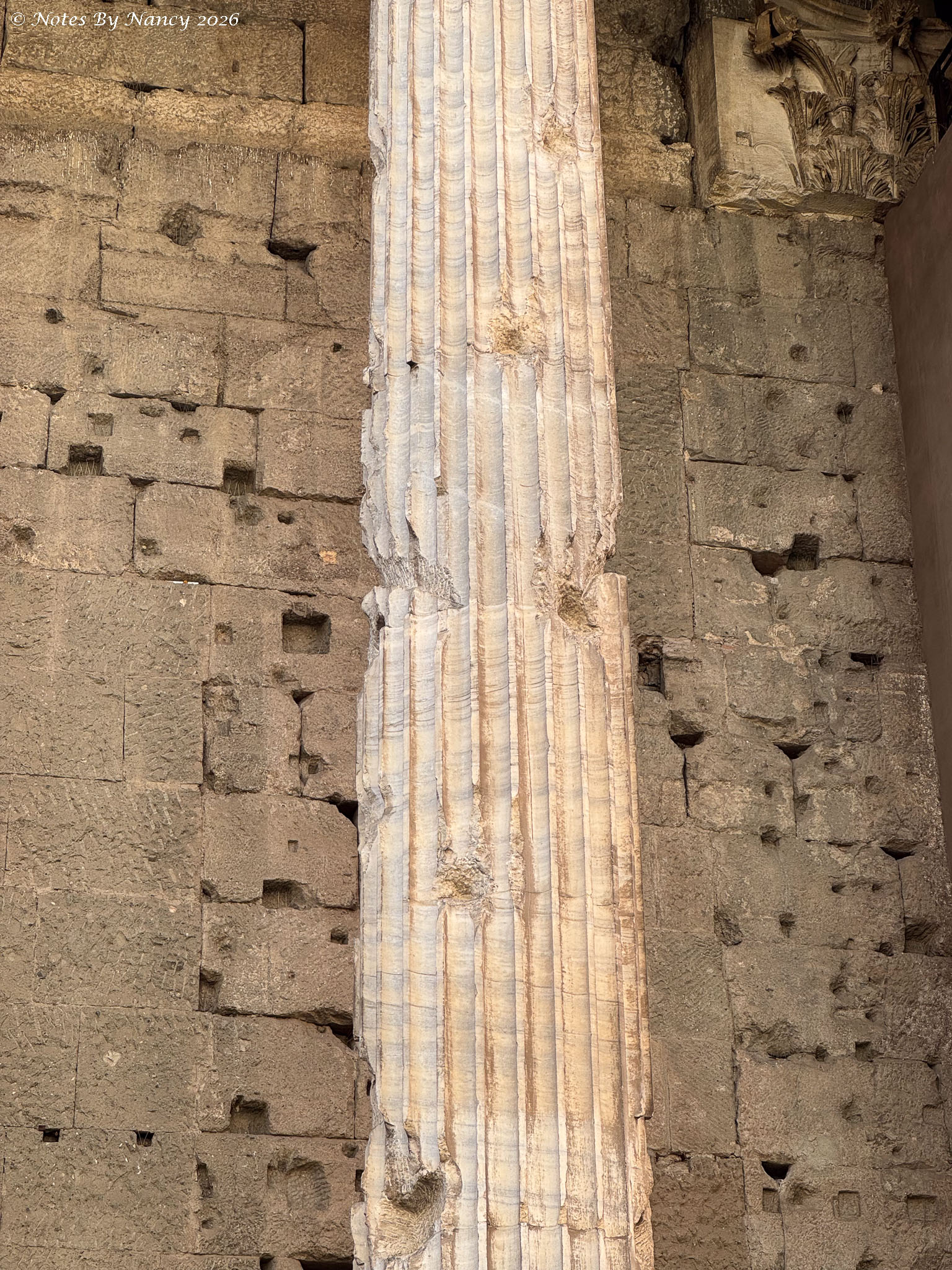
The group then made our way towards another iconic ancient Roman building. Along the way, we passed the current Rome stock exchange. The façade with its 11 Corinthian columns was the Temple of Hadrian from 145 AD. Yes! Nearly 1,900 years ago!
The Pantheon
As we maneuvered along the narrow alley dodging delivery vans and small cars, another piazza opened before us with the 2nd-century architectural wonder we were seeking looming beyond – The Pantheon. Tickets (5 Euros) are required and entries are timed.
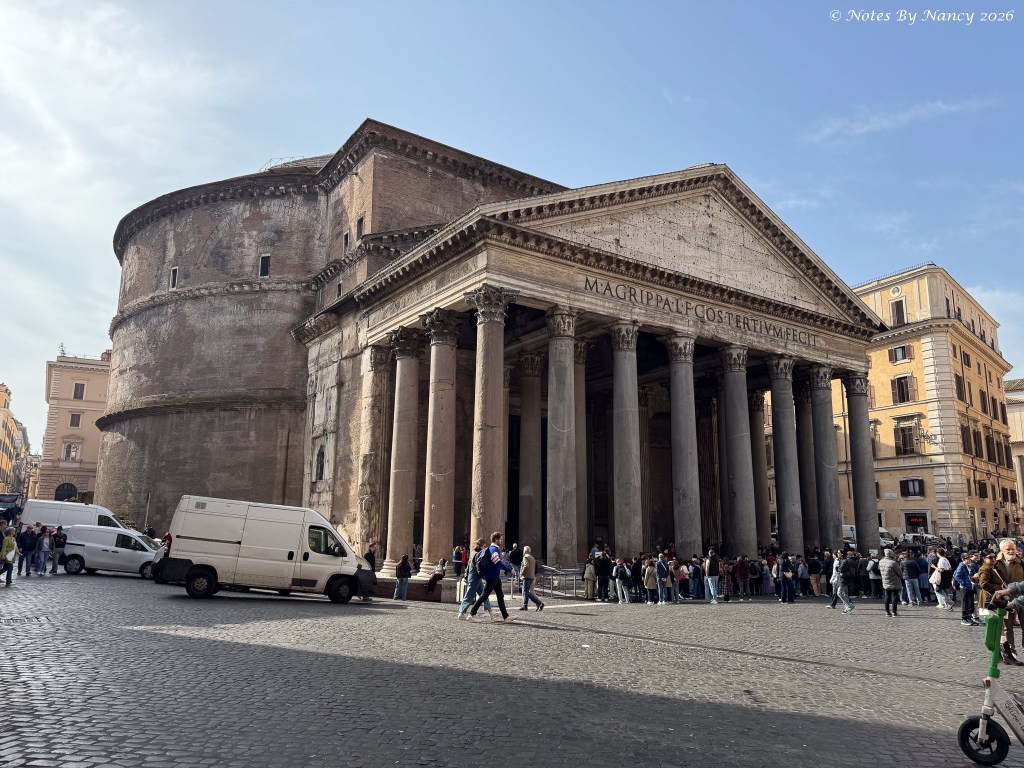
Originally a temple to all the gods constructed under Hadrian around 126 AD, since 609 AD it has been a Catholic church known as the Basilica of St. Mary and the Martyrs.
So, another 1900-year-old building!
The entrance is via a huge portico supported by 16 Corinthian columns made of Egyptian marble then into a vestibule connecting the portico and rotunda.
Entry View and Exit View
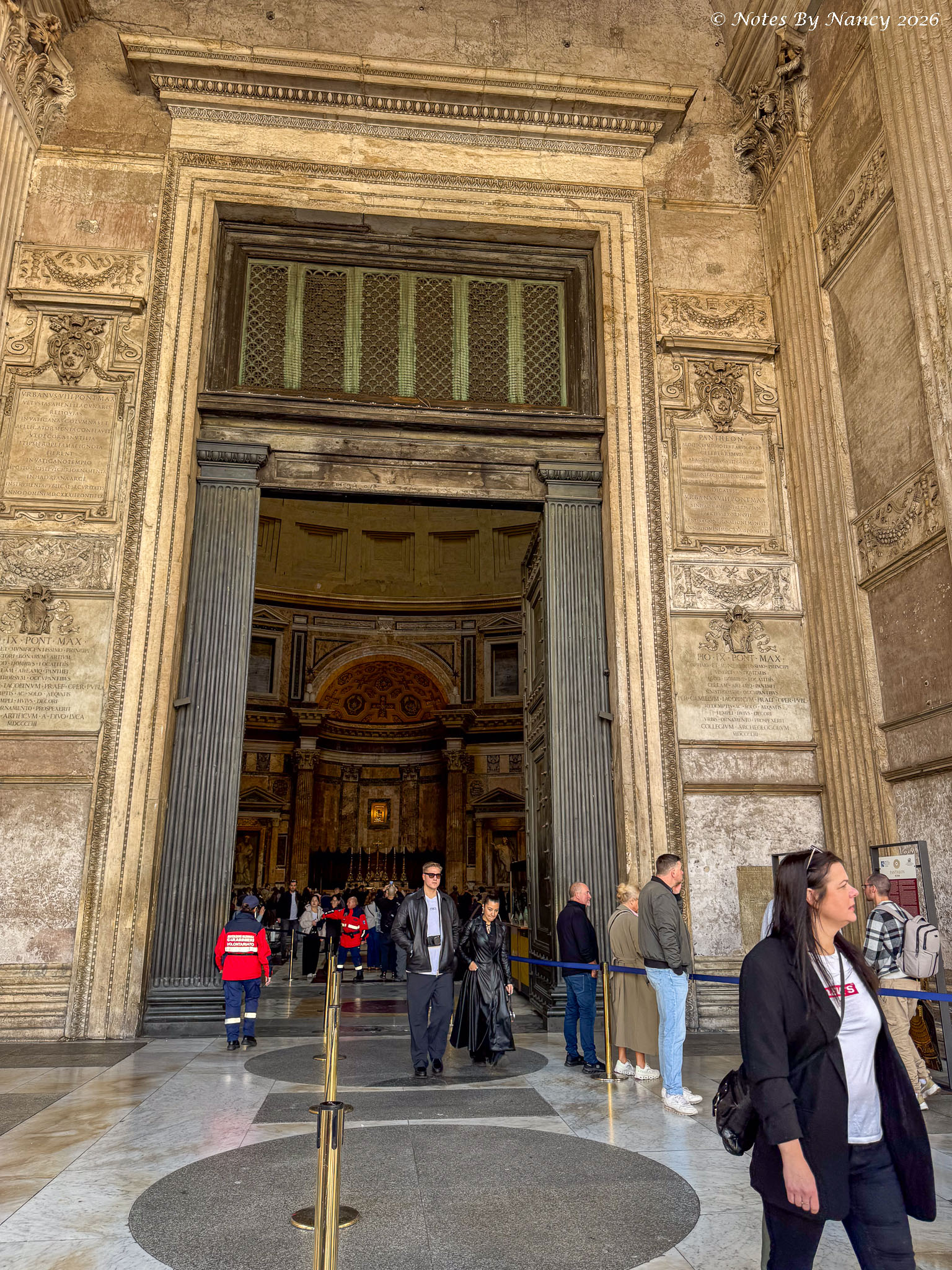
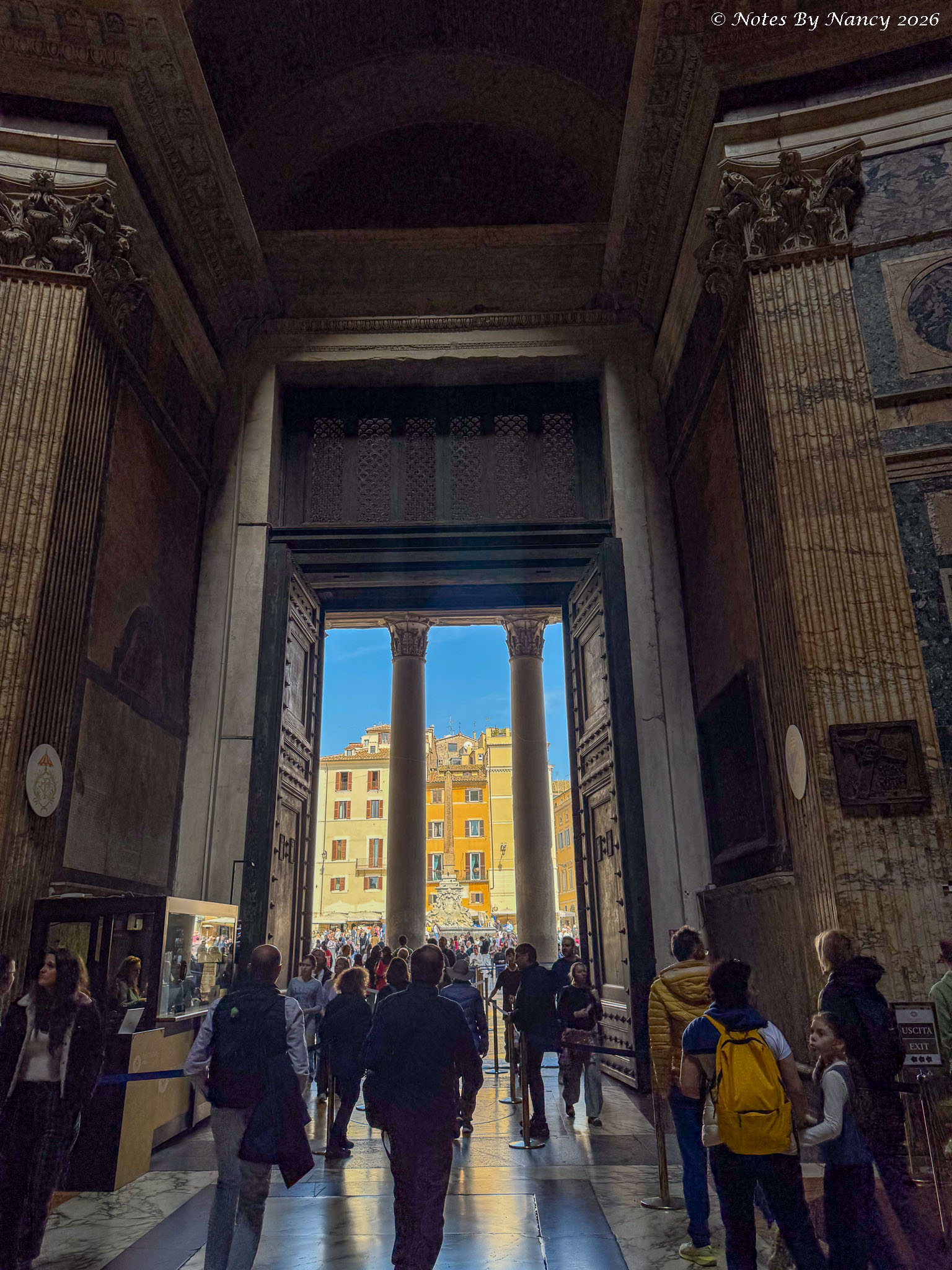
The rotunda with its impressive dome – still the largest unreinforced concrete dome – is stunning.
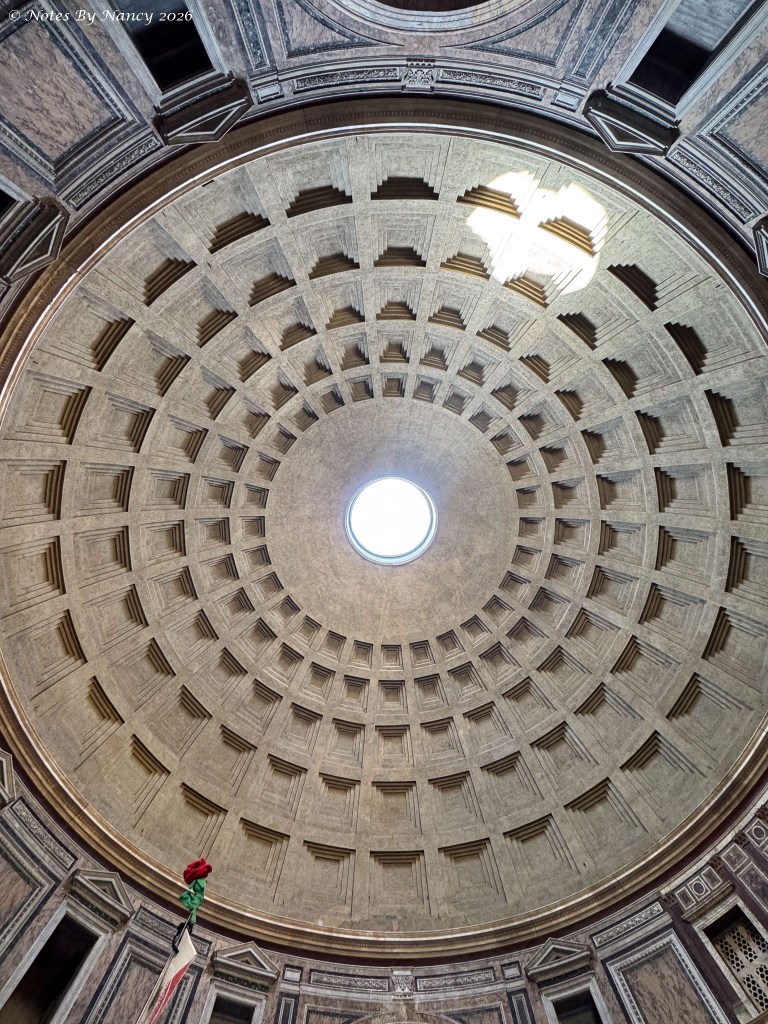
The oculus in the center of the dome is approximately 30 feet (9 meters) in diameter and sits 142 feet (43.3 meters) above the floor.
The oculus provides the only natural light in the building. When it rains, there are 22 hidden drains to remove the water.
The interior diameter of the rotunda is also 142 feet, creating space for a perfect sphere.
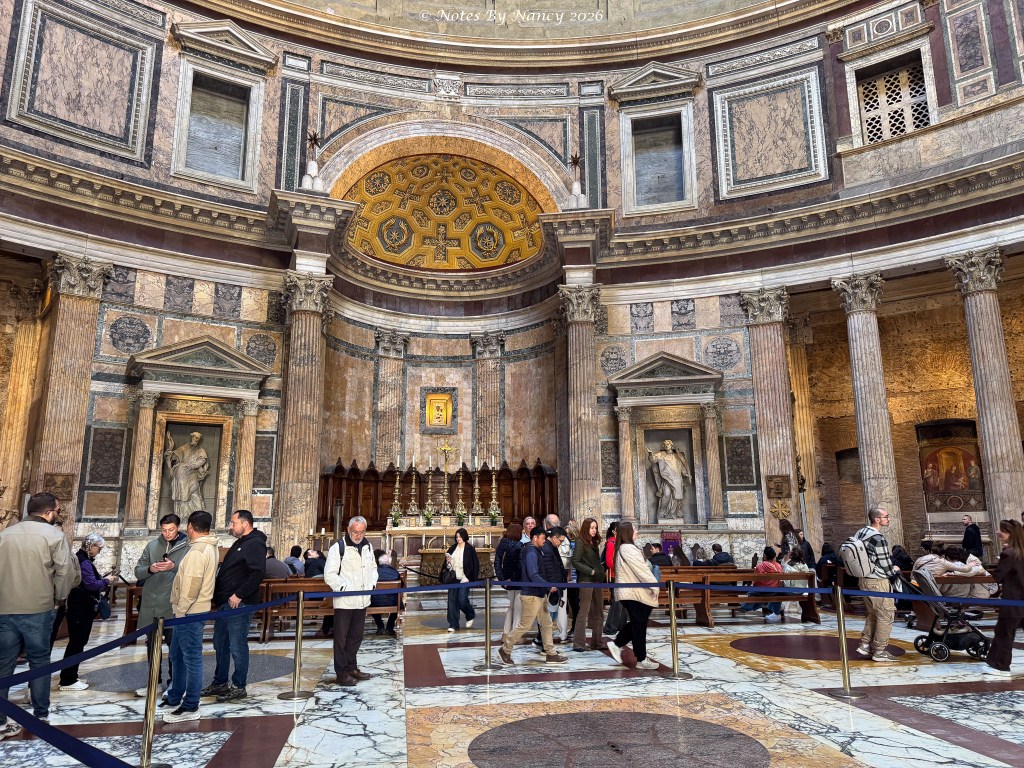
The polychrome marble floors come from Egypt (red), Asia Minor (white blotched with blue), and Numidia (red-veined yellow) – showing off the wealth and power of the Roman Empire.
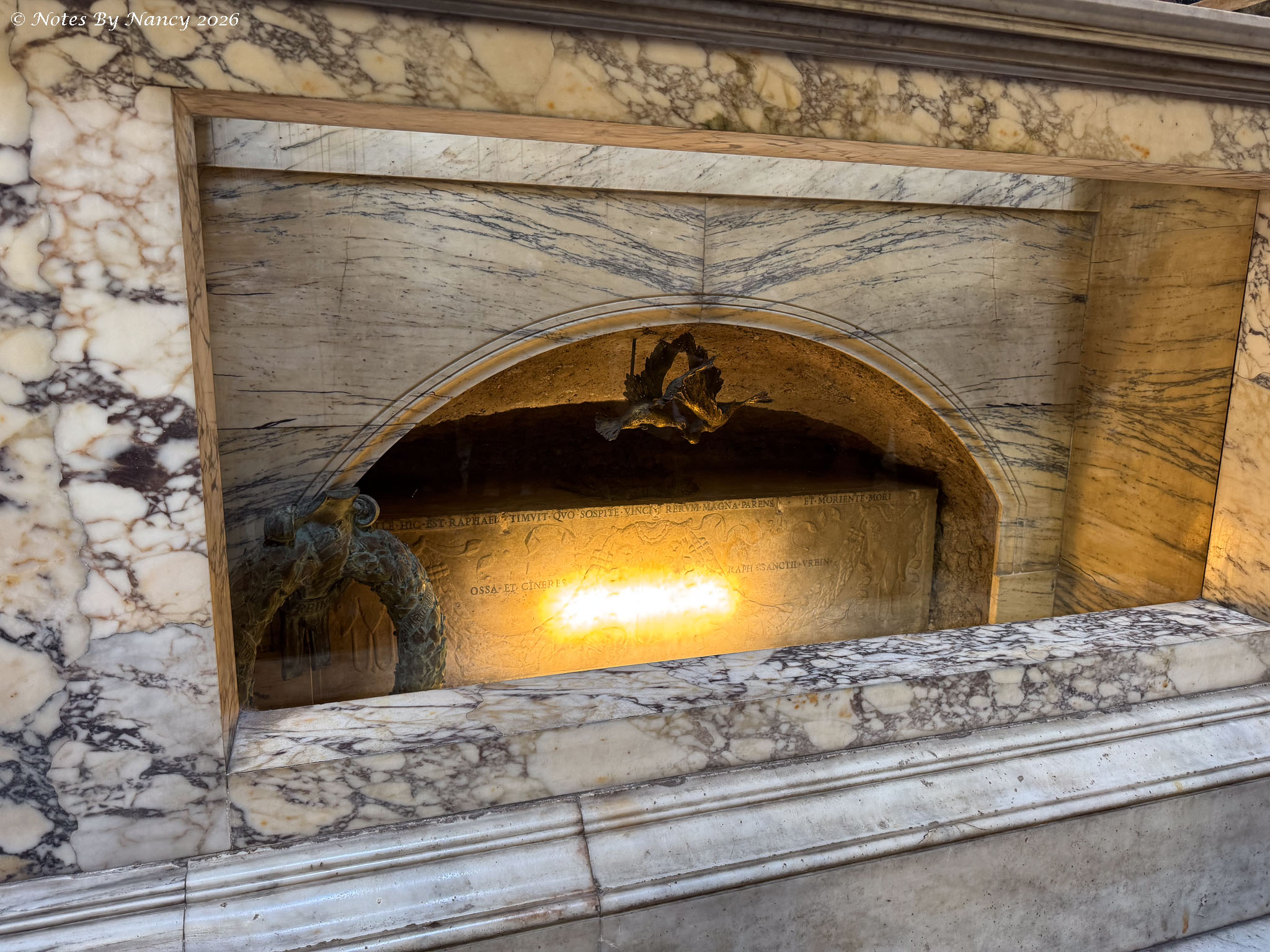
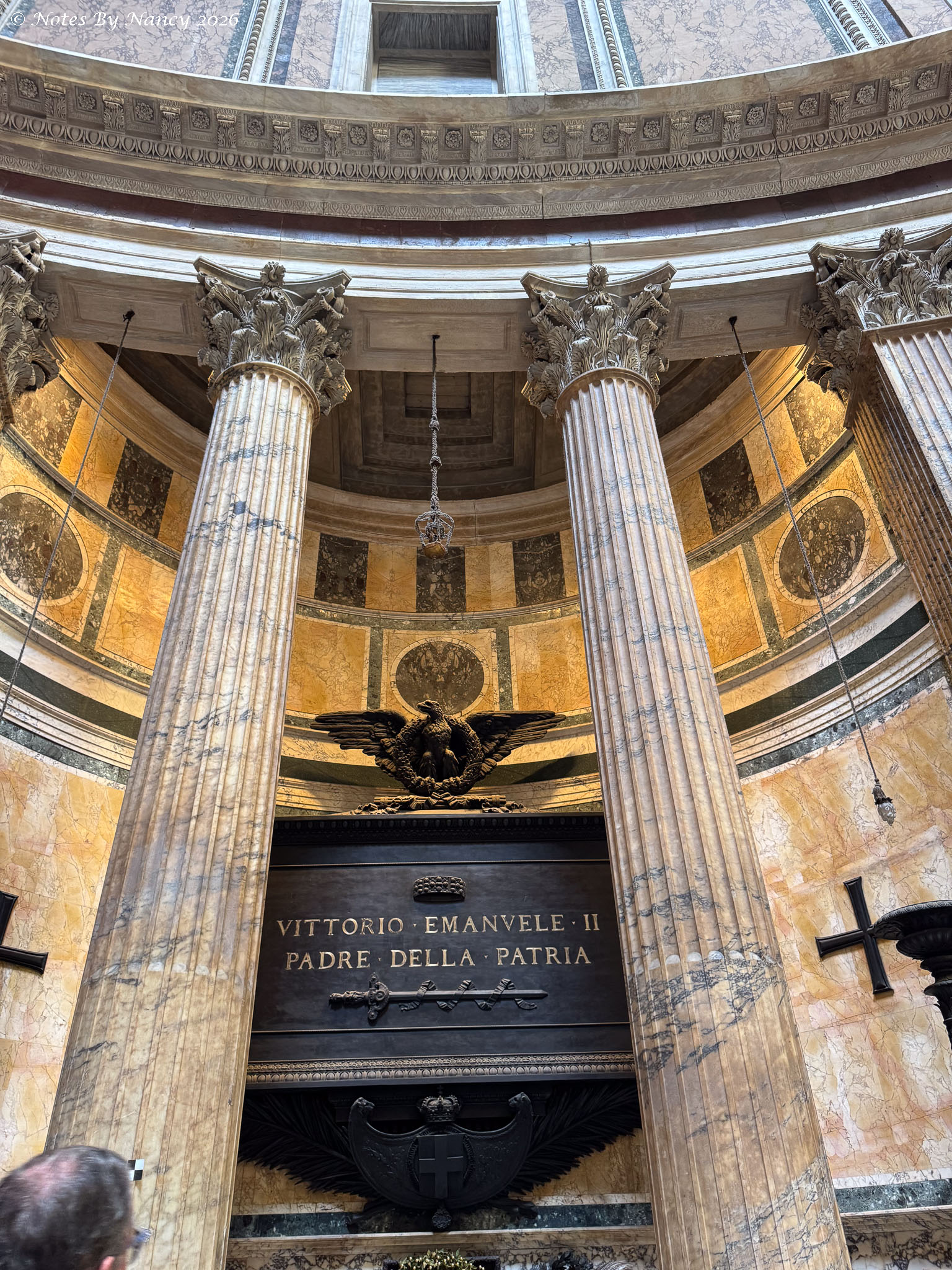
Entombed here are the Renaissance painter Raphael and his fiancée who died before they could marry. Additionally, the tomb of the first king of the united Italy (in 1861), Victor Emmanuel II, is here.
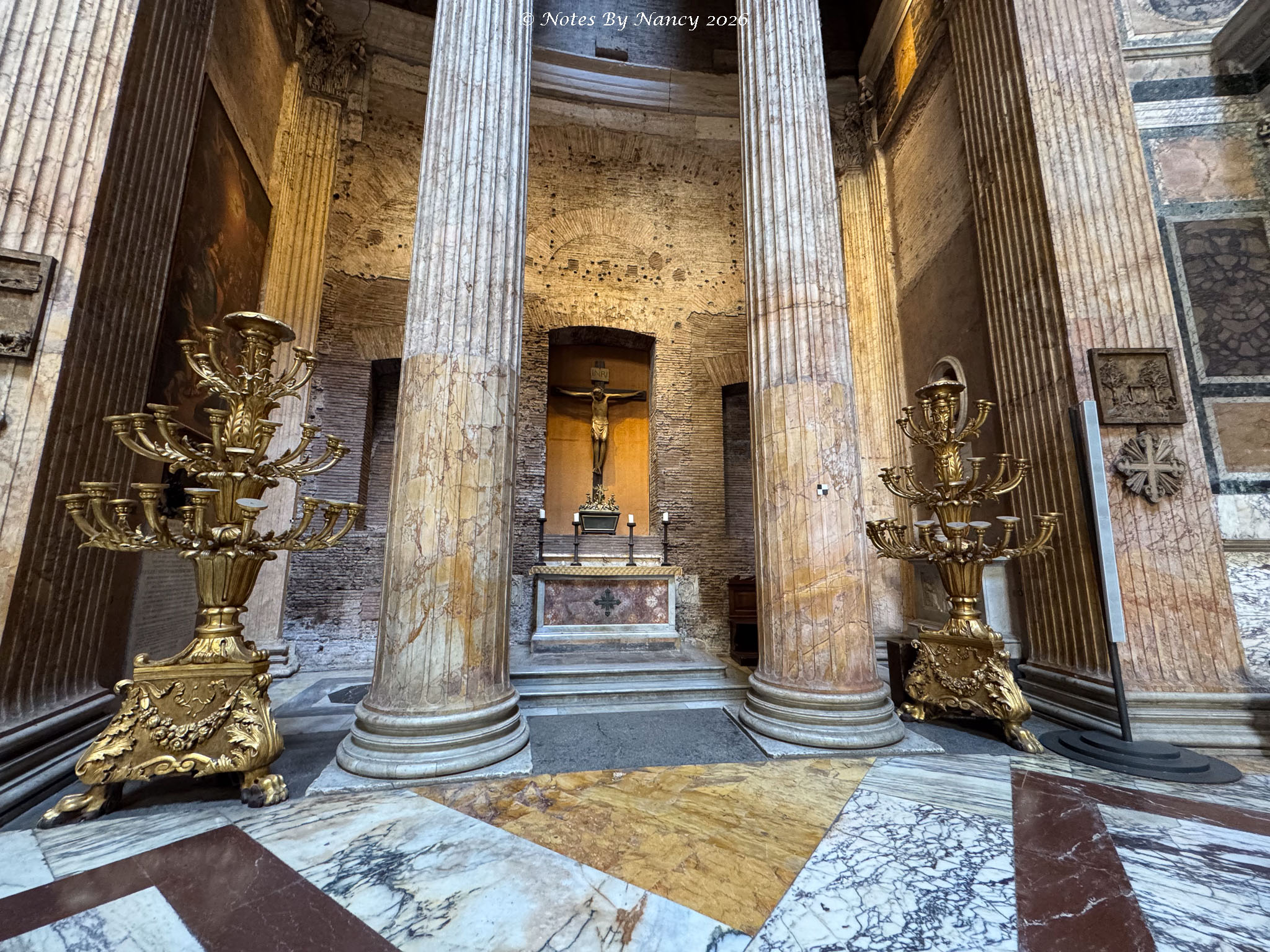
As the building is now a Catholic church, there is a high altar and several side chapels with the usual iconography spanning several centuries.
High altar and pulpit
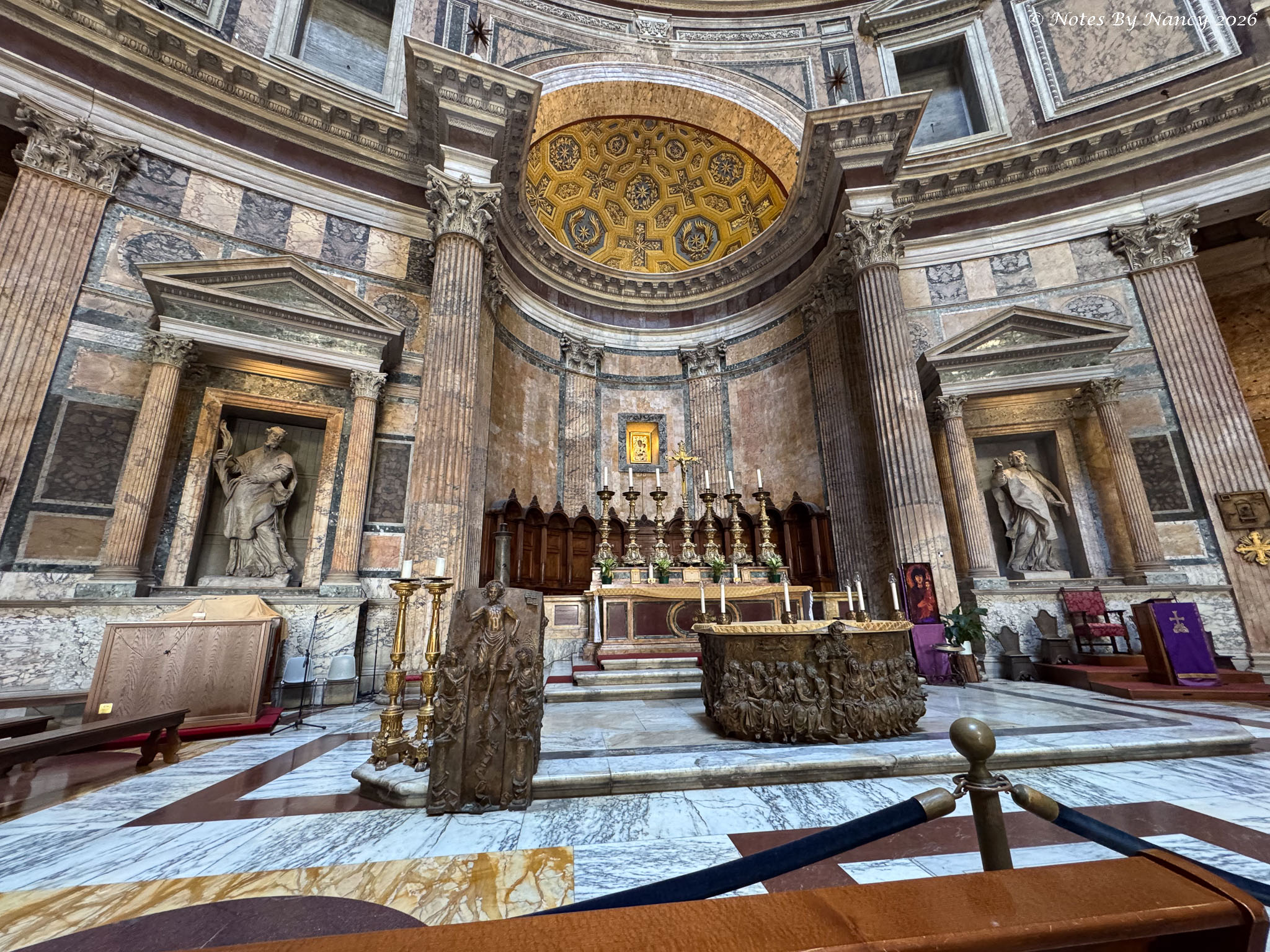
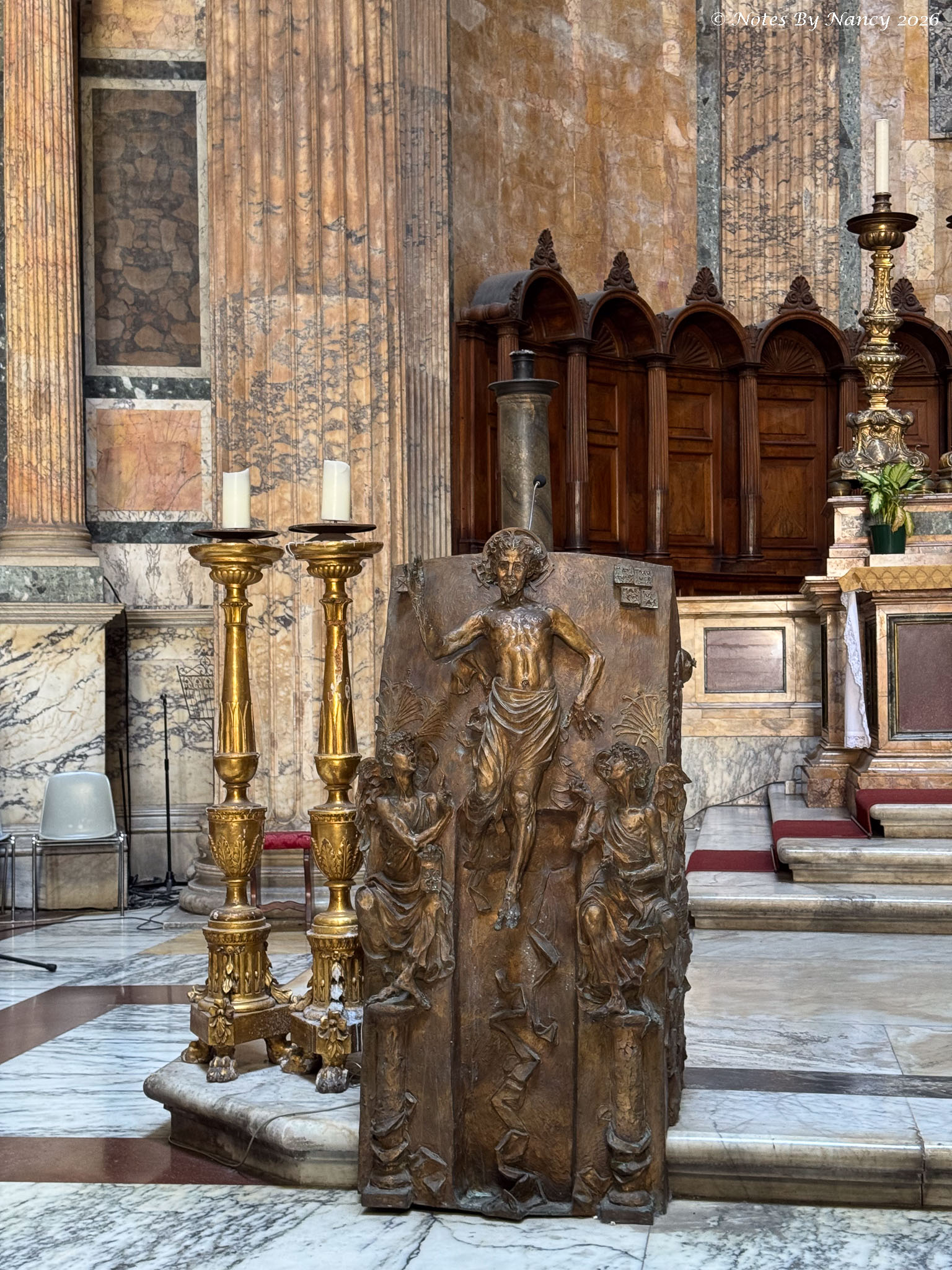
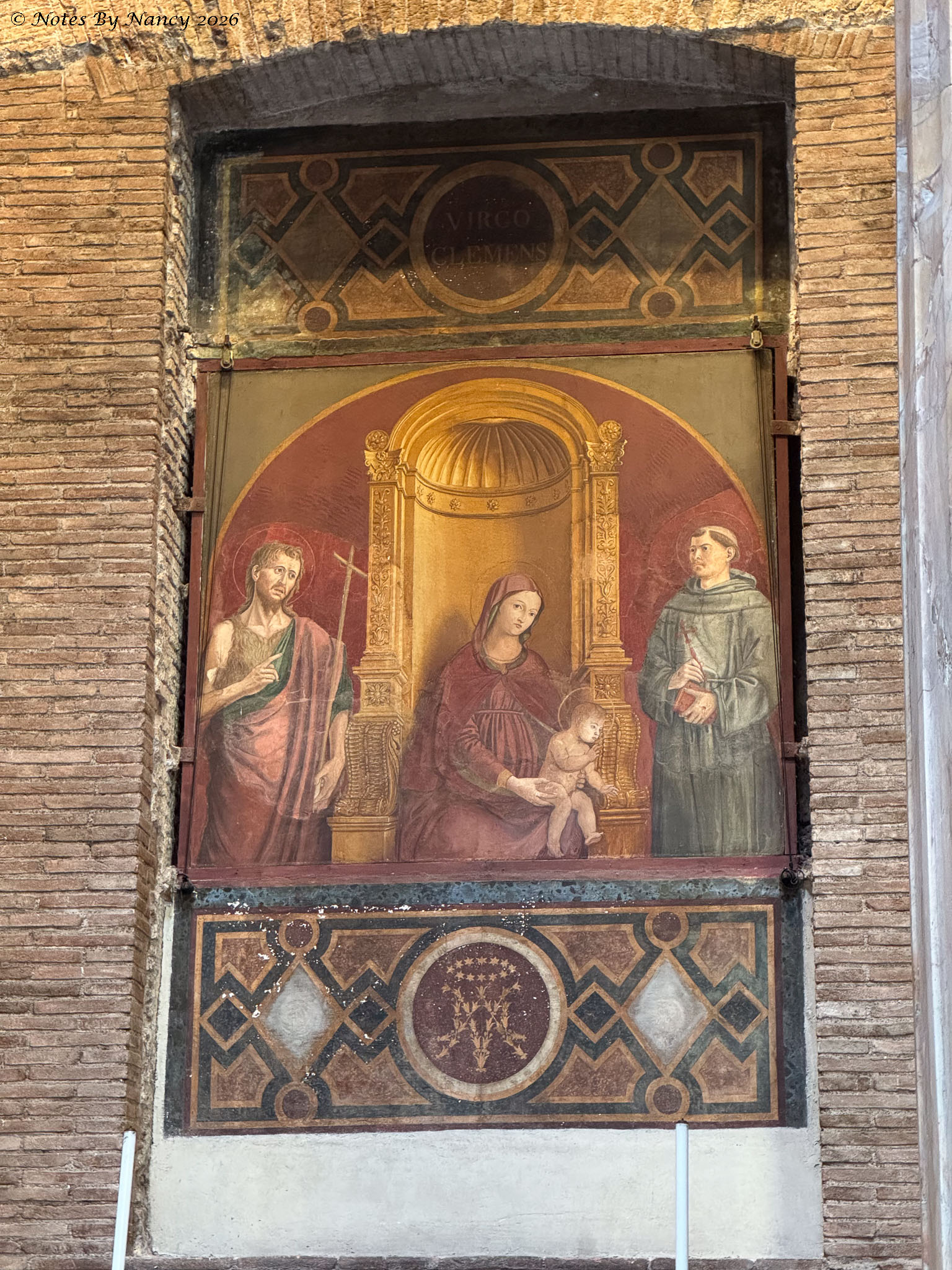
Chapel of the Crucifix and Chapel of the Madonna of the Clemency (15th century painting with St. John the Baptist and St. Francis)
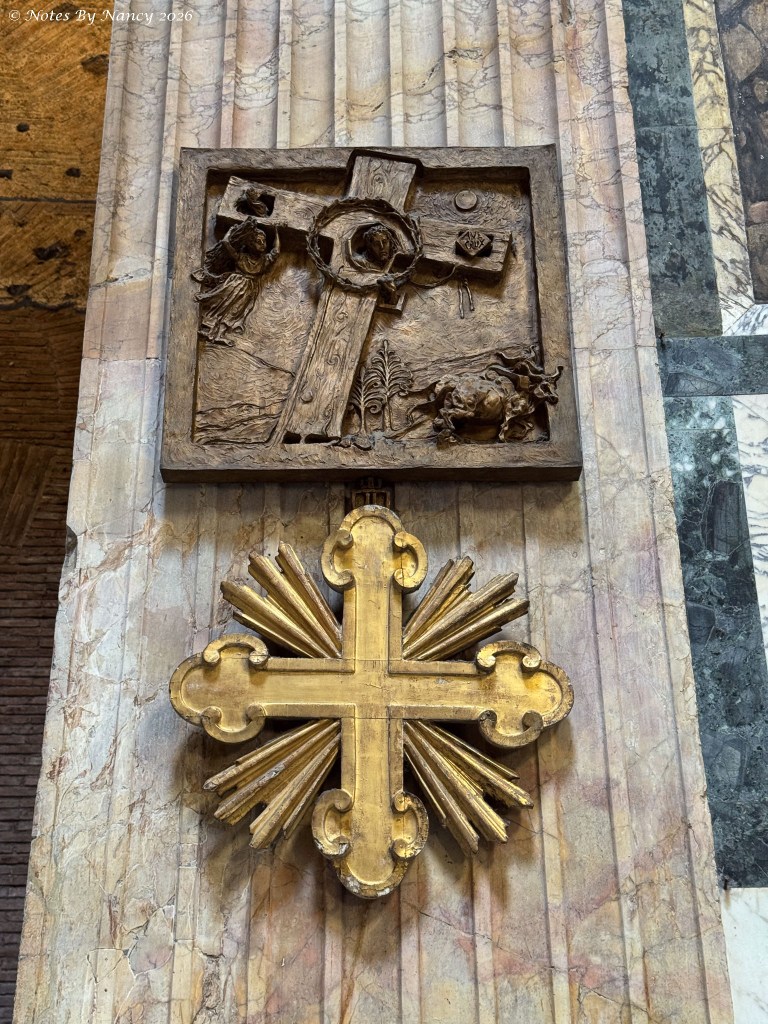
Federico Severino (b. 1953) created 14 bronze reliefs in 2009 depicting the traditional Stations of the Cross – this is #2 Jesus carrying his cross.
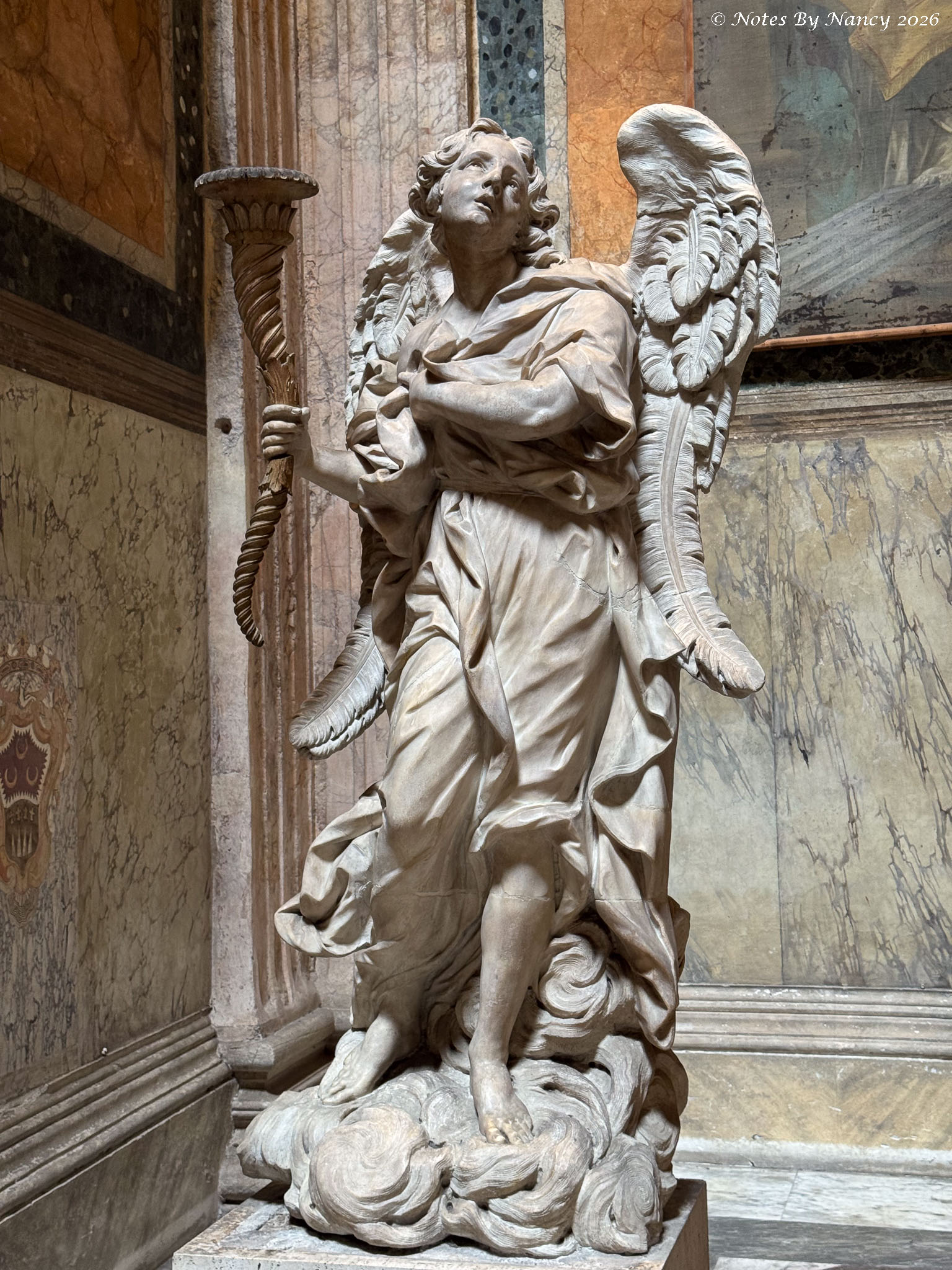
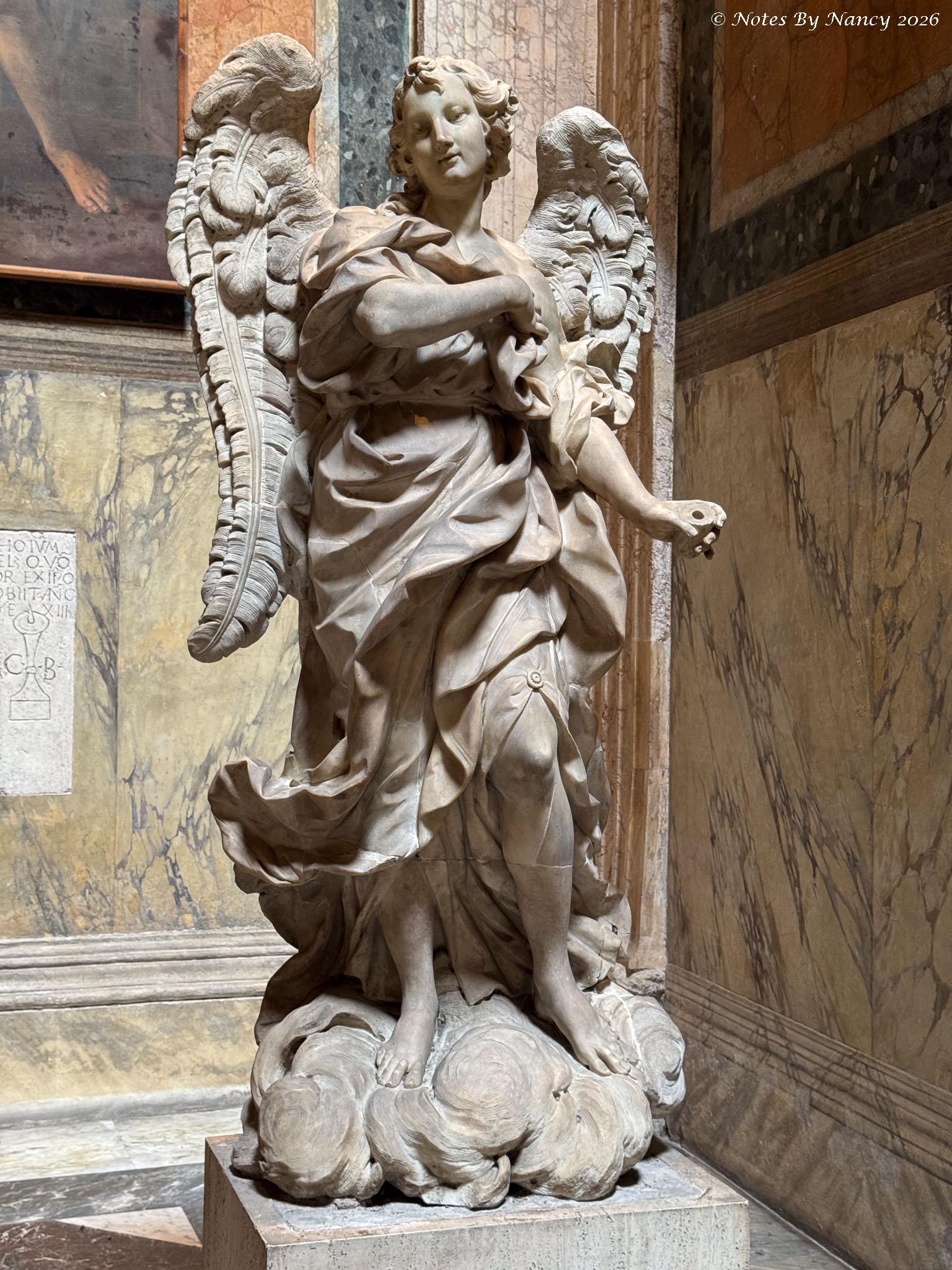
Angel sculptures by Gian Lorenzo Bernini (1598-1680)
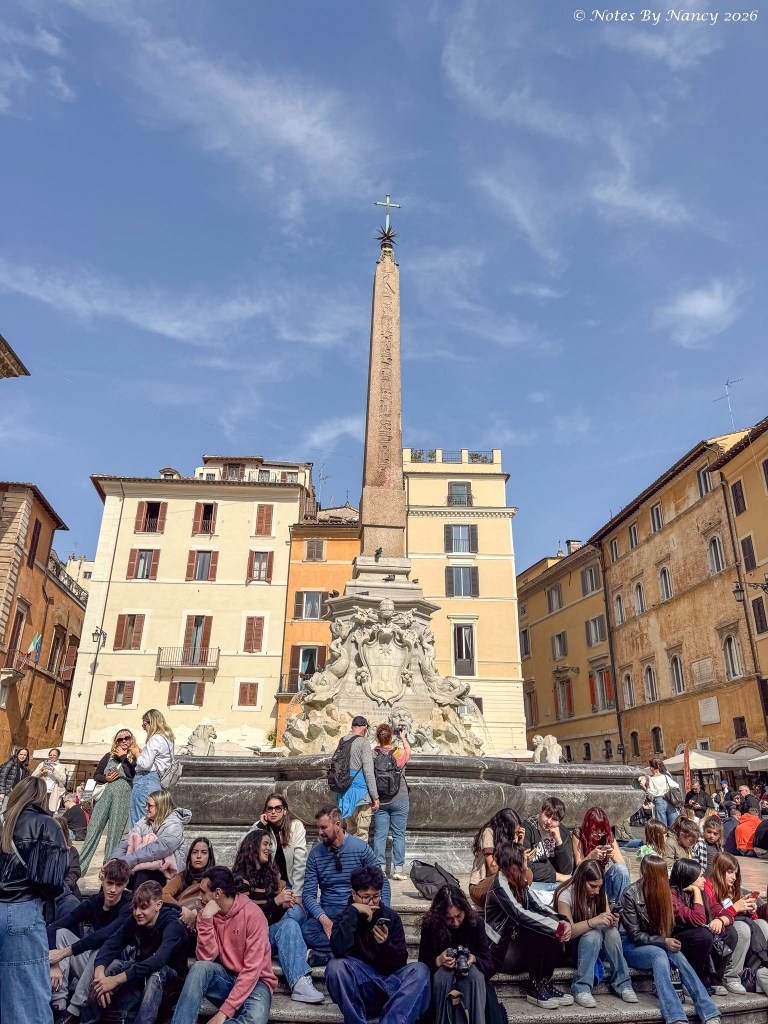
Back in the Piazza della Rotunda, tour groups, school groups, and general tourists enjoy the early March sunshine beside one of the 8 ancient Egyptian obelisks. Brought to Rome by Emperor Domitian, it was located in this vicinity in the Sanctuary of Isis. In 1711, it was placed here with the fountain and topped with a Christian cross and Pope Clement XI’s herald (star and mountains).
More Piazzas and Paintings
A few blocks away from the Pantheon, Noon bells were peeling as we stood in the Piazza Navona facing Sant’Agnese in Agone (also called Sant’Agnese in Piazza Navona). From Wikipedia: it is a 17th-century Baroque church in Rome, Italy. It faces onto the Piazza Navona, one of the main urban spaces in the historic center of the city and the site where the early Christian Saint Agnes was martyred in the ancient Stadium of Domitian aka Circus Agonalis.
This is where our wonderful guide left us for further exploration on our own and lunch. I quickly made Dave retrace our steps a couple of blocks to the Church of Saint Louis of the French (Chiesa di San Luigi dei Francesi). It is known for its Caravaggio (1571-1610) paintings of the apostle Matthew, which one of the people in our group visited during the free day on Sunday and highly recommended. Since I had missed seeing any of his works at the Uffizi Gallery in Florence (Note 120), I didn’t want to pass up this opportunity.
Caravaggio pioneered the technique known as tenebrism – a form of chiaroscuro (contrasts of light and dark). Tenebrism is marked by extreme contrasts between light and dark, dominant shadows, spotlight effects, and dramatic focus.
There are 10 side chapels in the church – all dedicated to and featuring paintings of various saints. Number 6 at the front on the left is the Contarelli Chapel containing the Saint Matthew paintings. Painted between 1599-1602, these are Caravaggio’s first commissioned works.
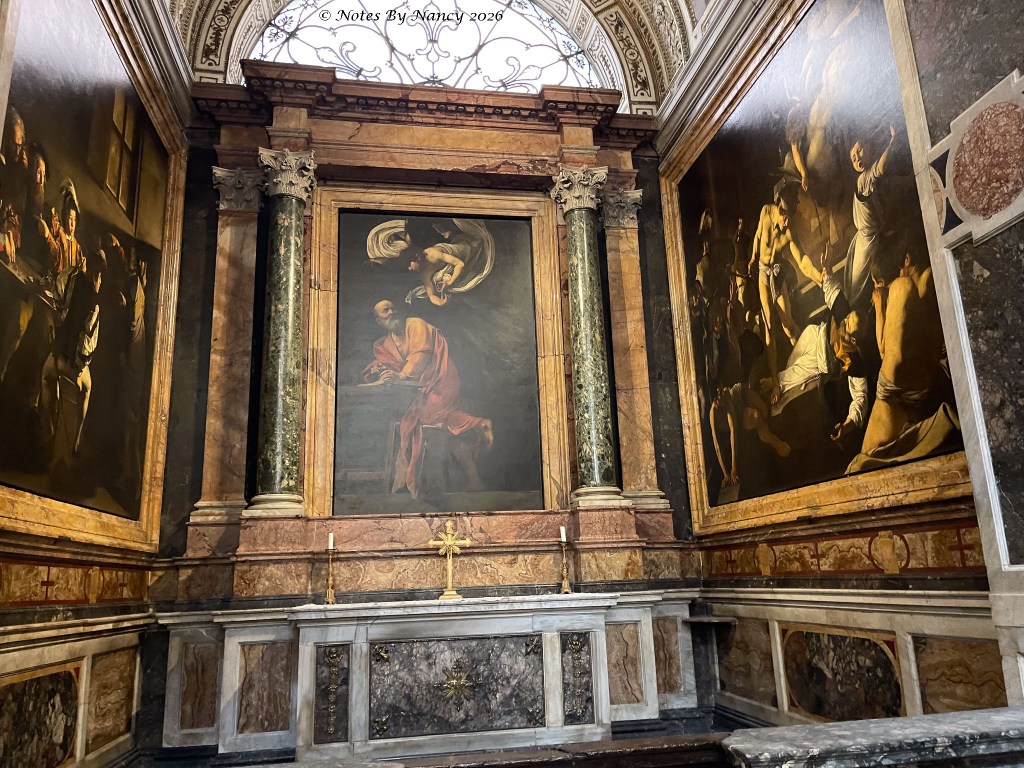
Left – The Calling of Saint Matthew,
Center – The Inspiration of Saint Matthew),
Right – The Martyrdom of Saint Matthew.
The links above will take you to better images in Wikipedia, but here are my efforts:
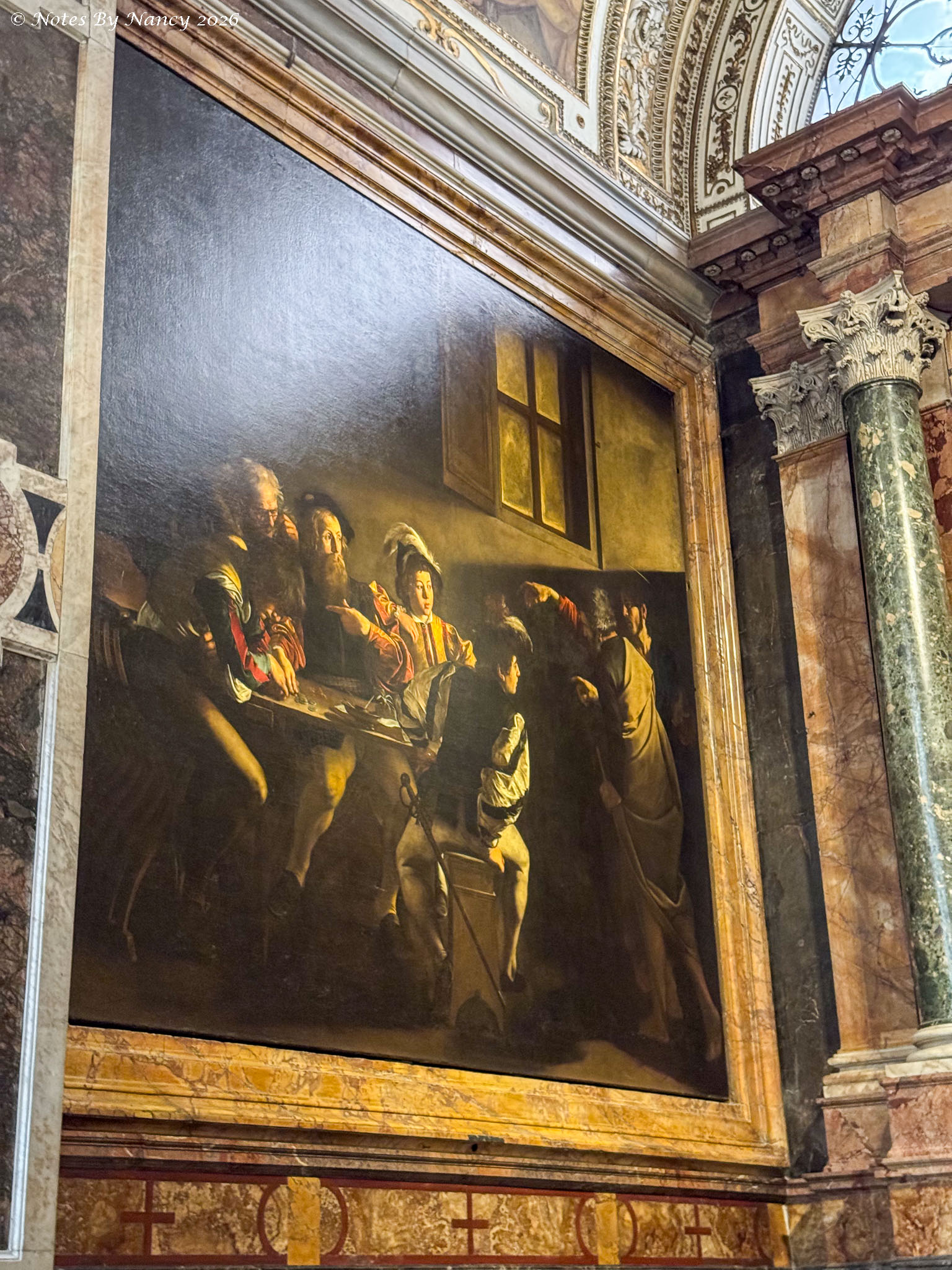
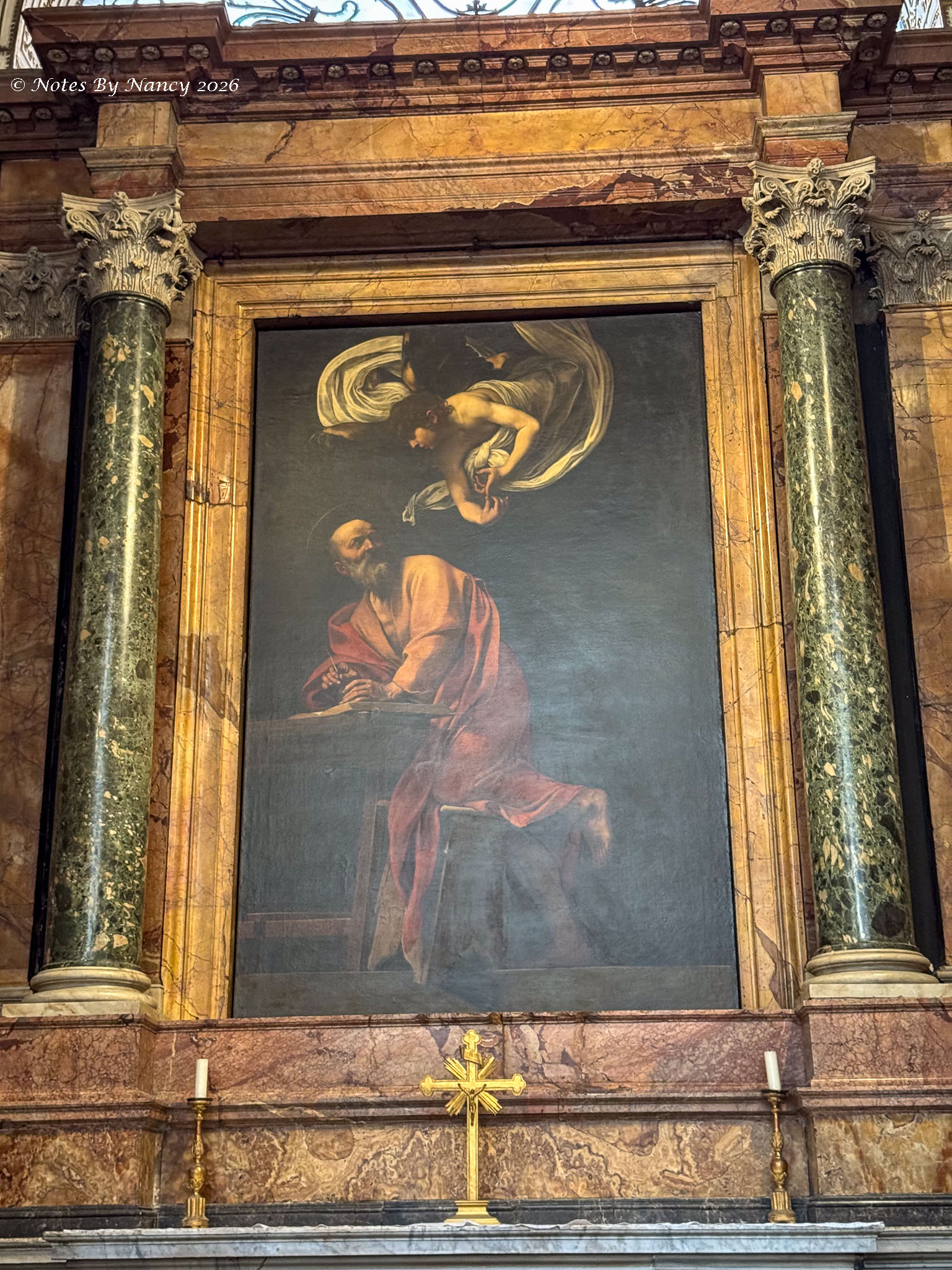
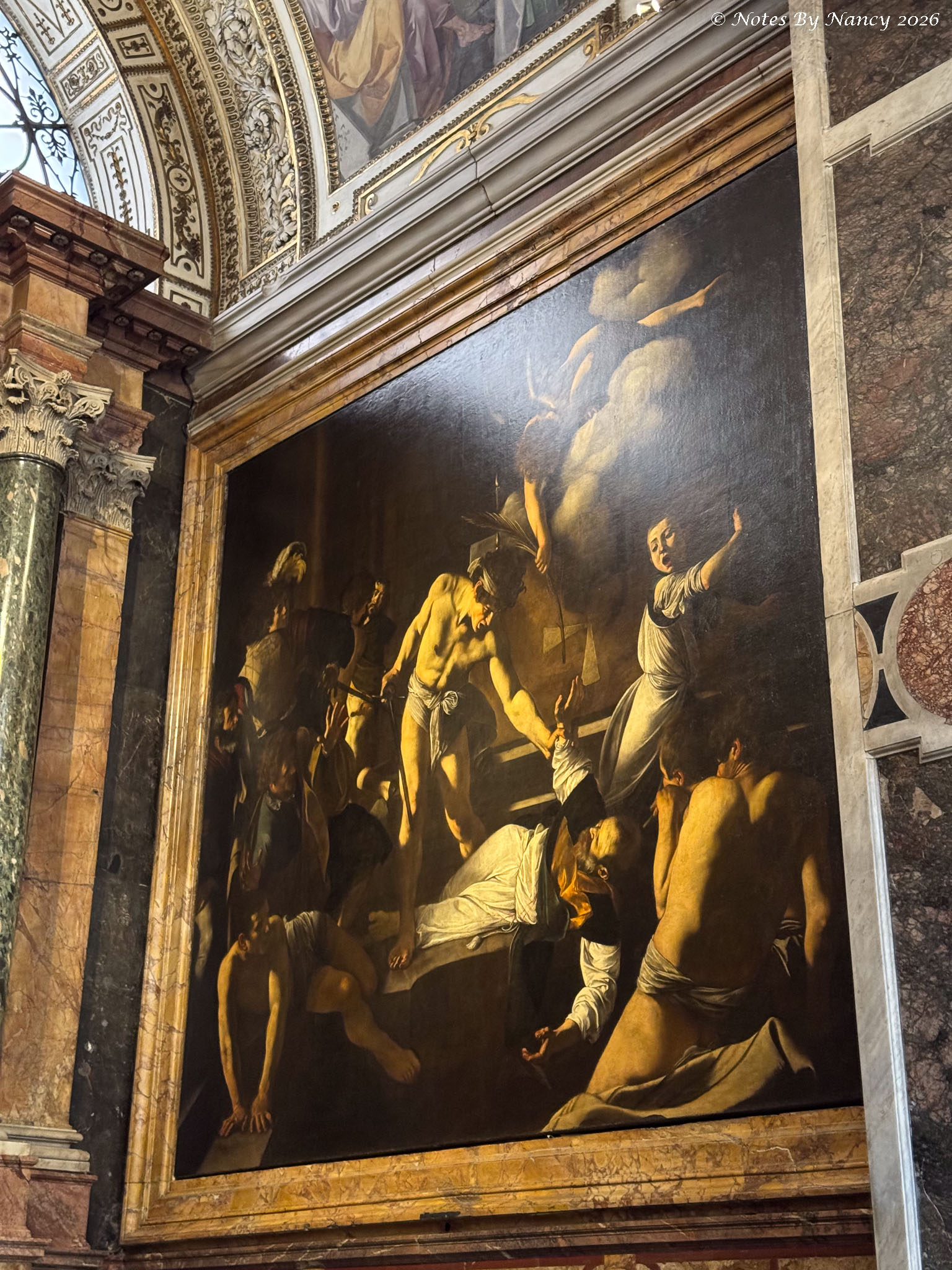
You can definitely see the stylistic differences between the Caravaggio paintings and the paintings by other artists in other chapels and the main altar (far right).
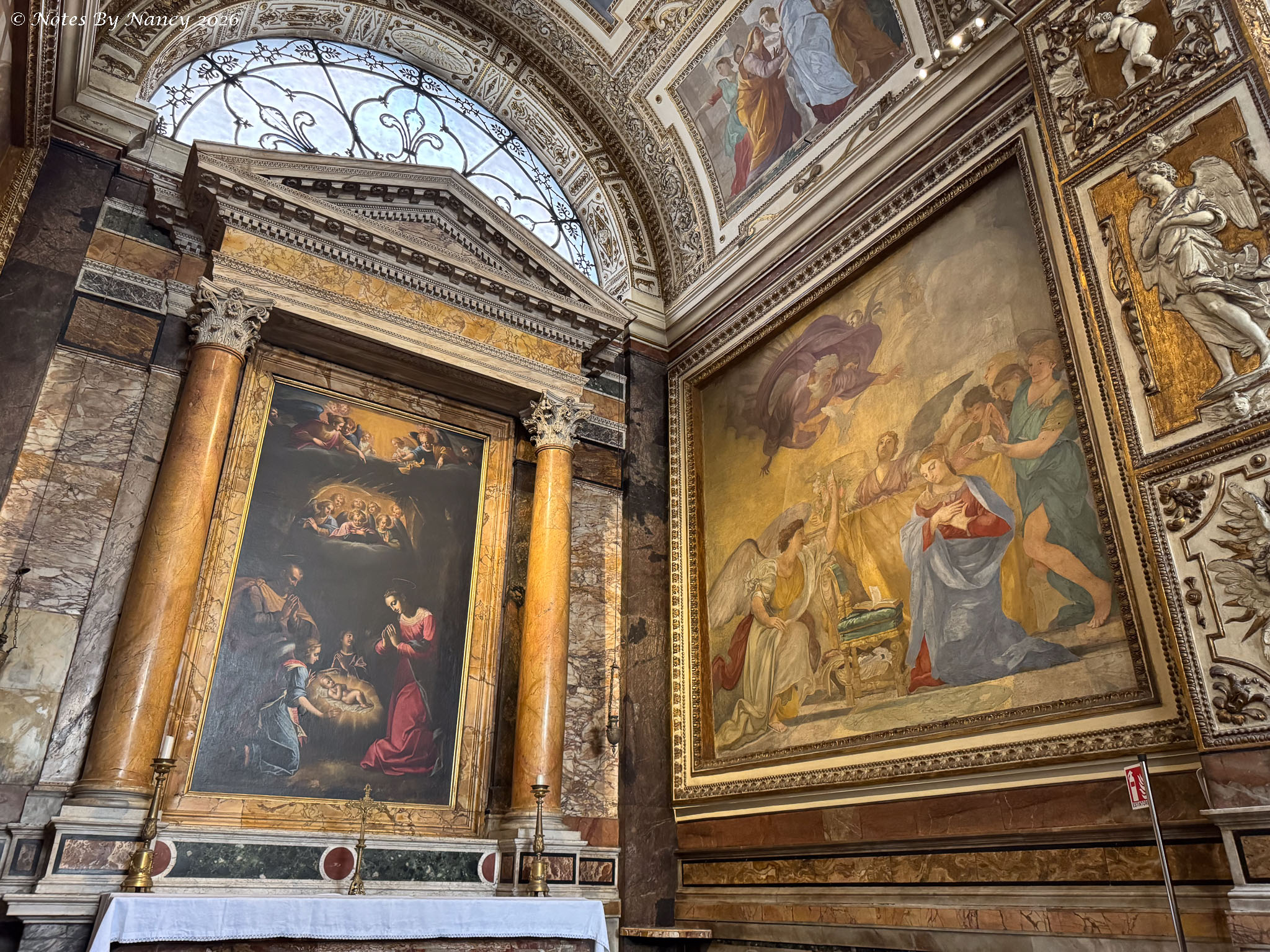
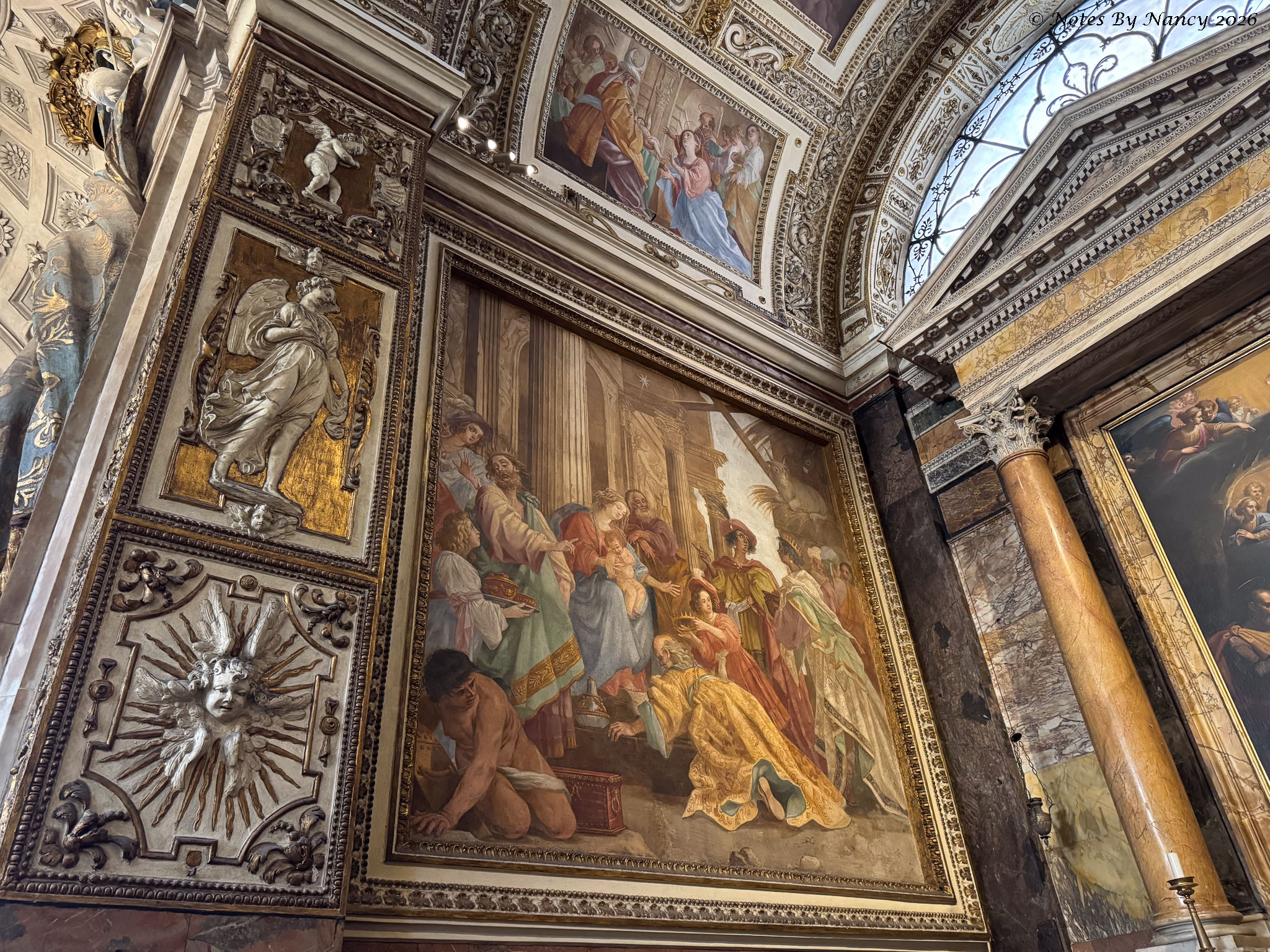
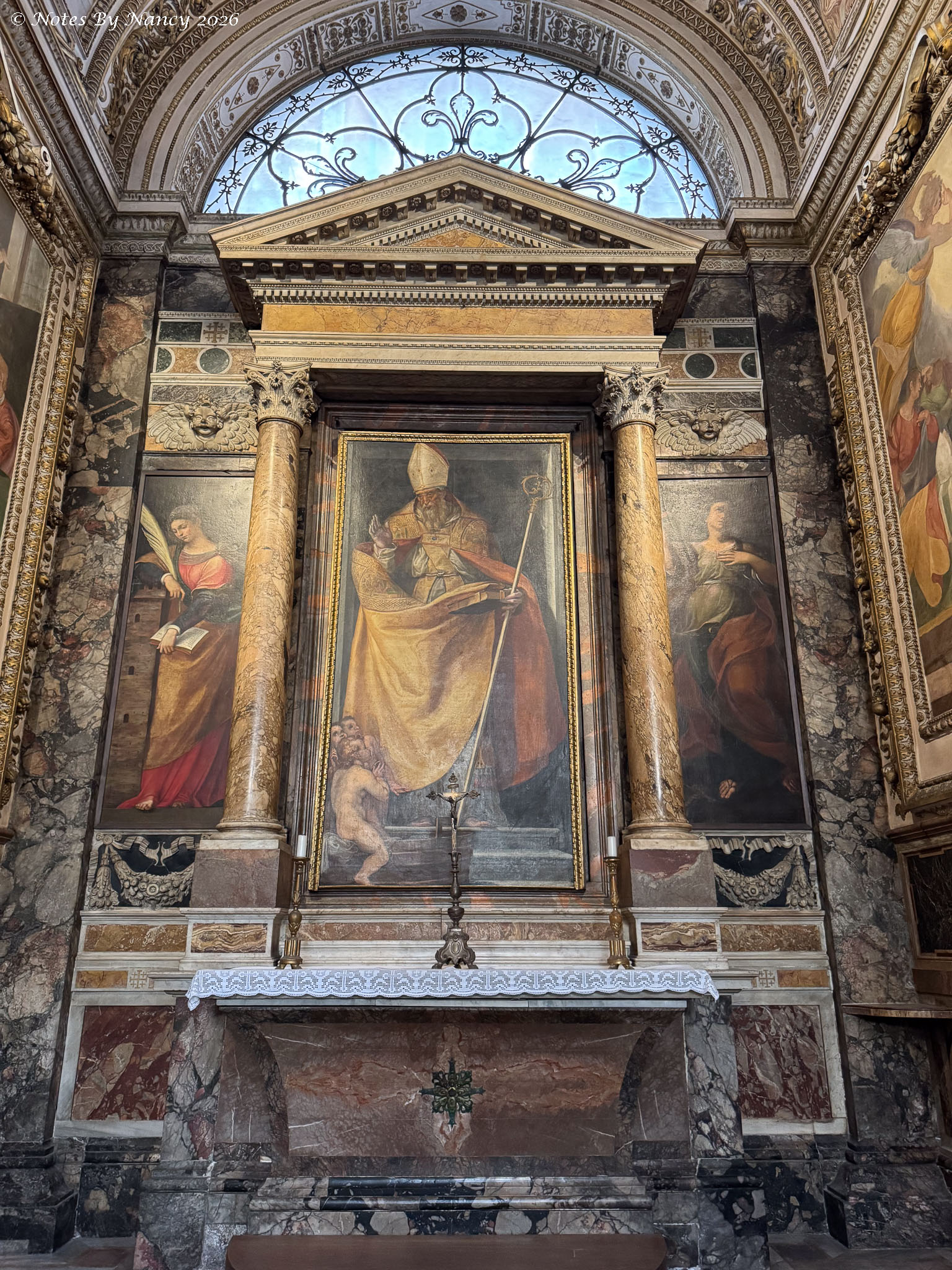
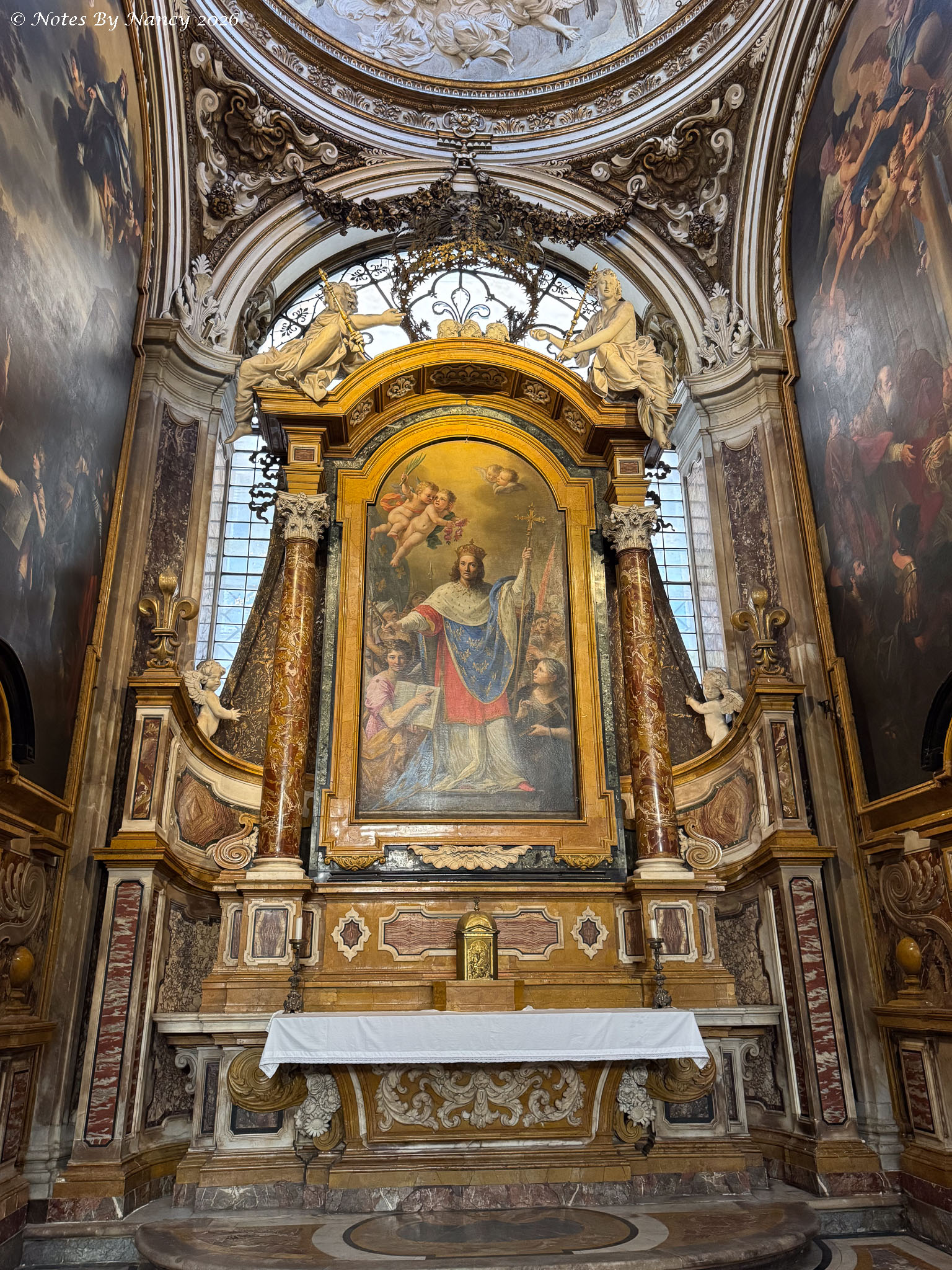
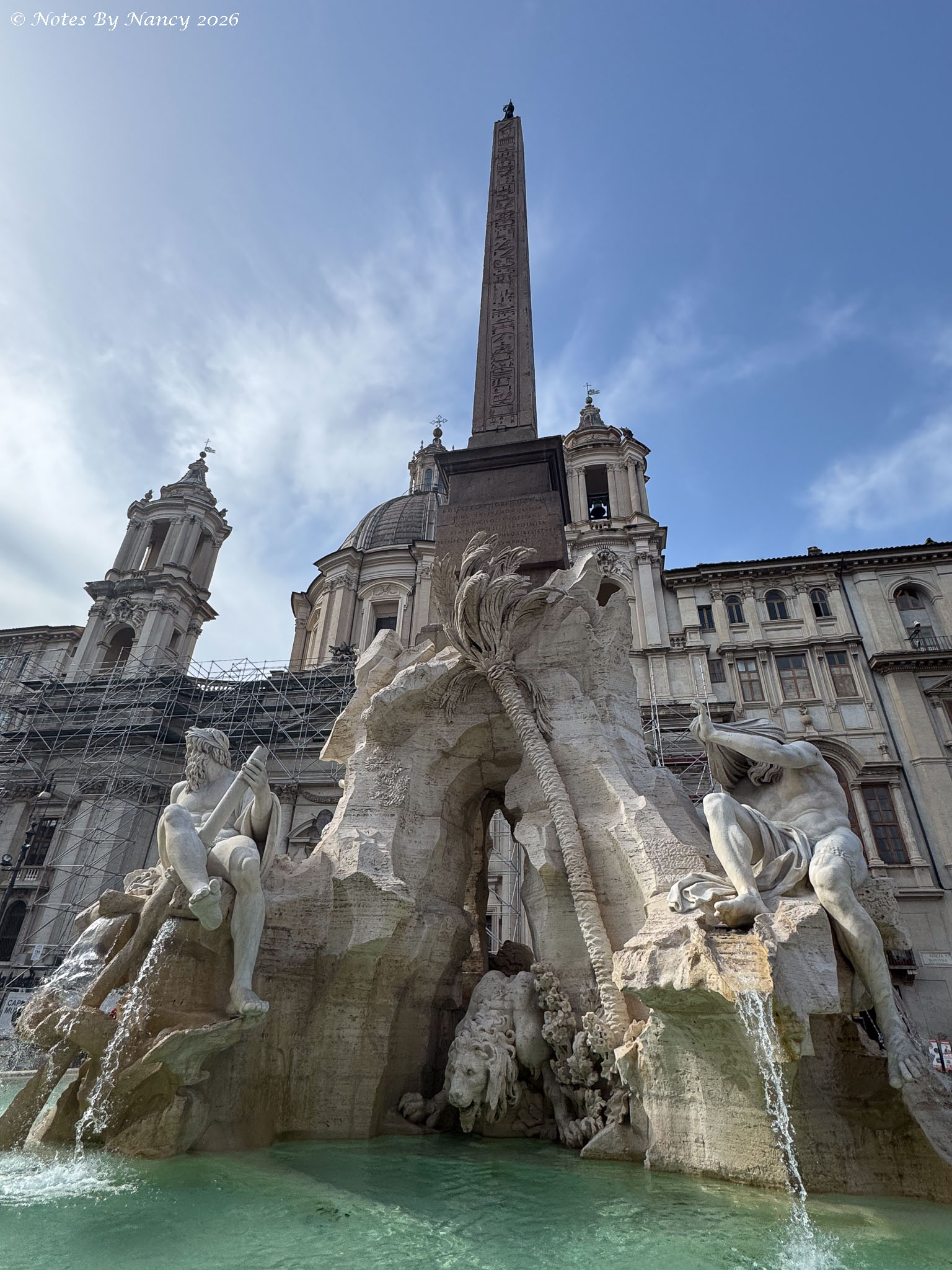
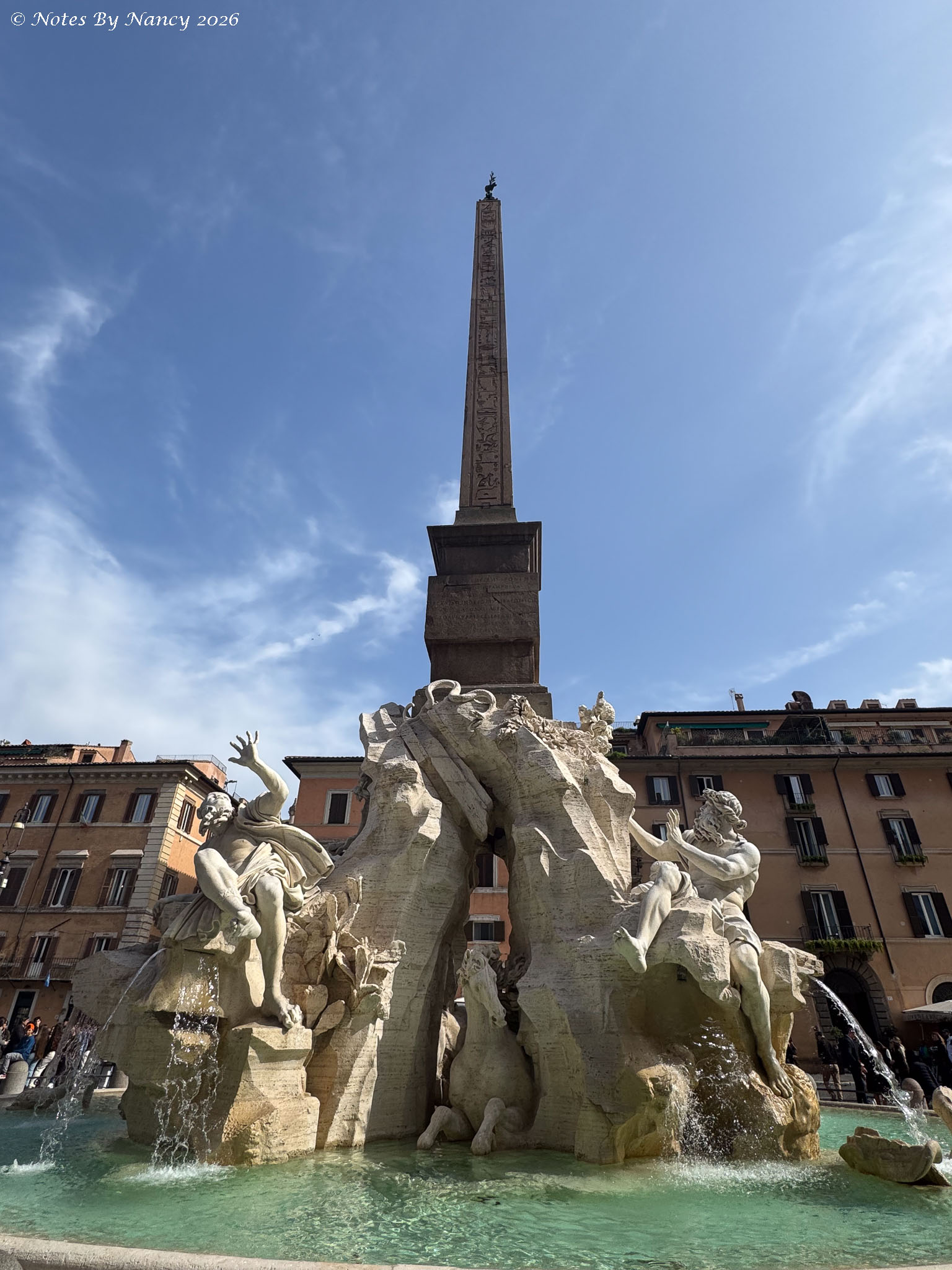
We returned to the Piazza Navona and examined another Bernini fountain – Fontana dei Quattro Fiumi (Fountain of the Four Rivers) from 1651. The four rivers are representative of the four continents under papal authority – the Nile (Africa), the Danube (Europe), the Ganges (Asia), and Río de la Plata (the Americas). This time we have a Roman copy of an Egyptian obelisk at the center. If you read or watched Dan Brown’s Angels & Demons – this and other Bernini works figure prominently in the story.
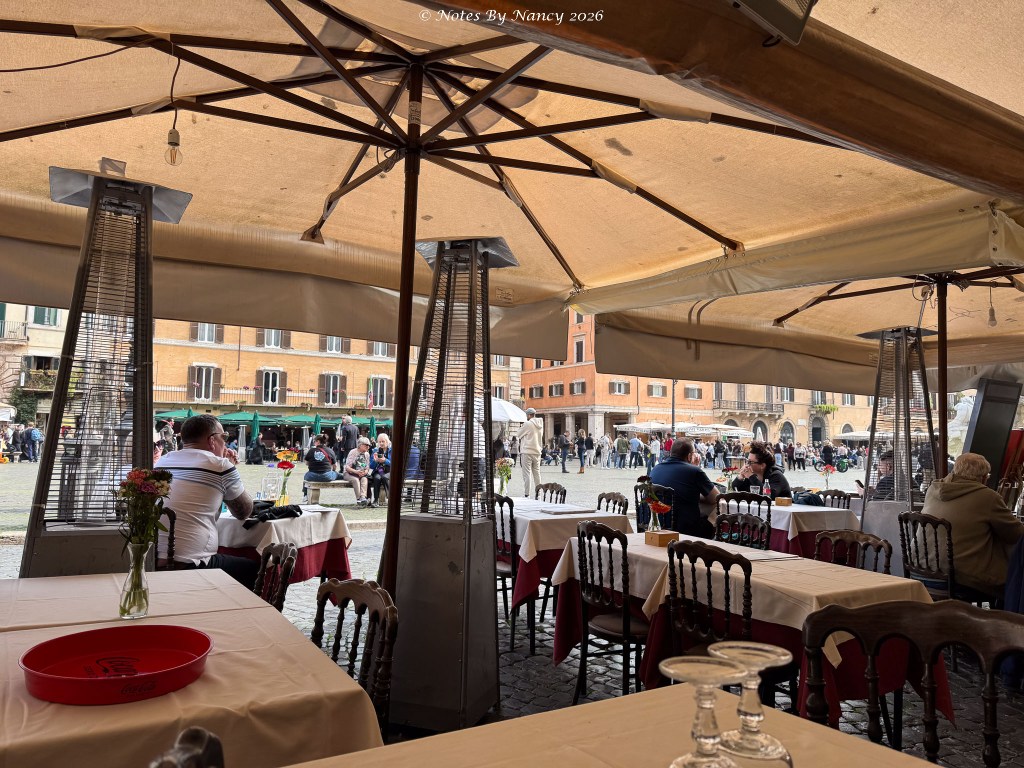
Finally, we took advantage of another beautiful day to eat outside and people-watch. We shared a salad and calamari and our neighbors (a couple from our group) talked us into ordering a luscious dessert! But, alas, no pictures!
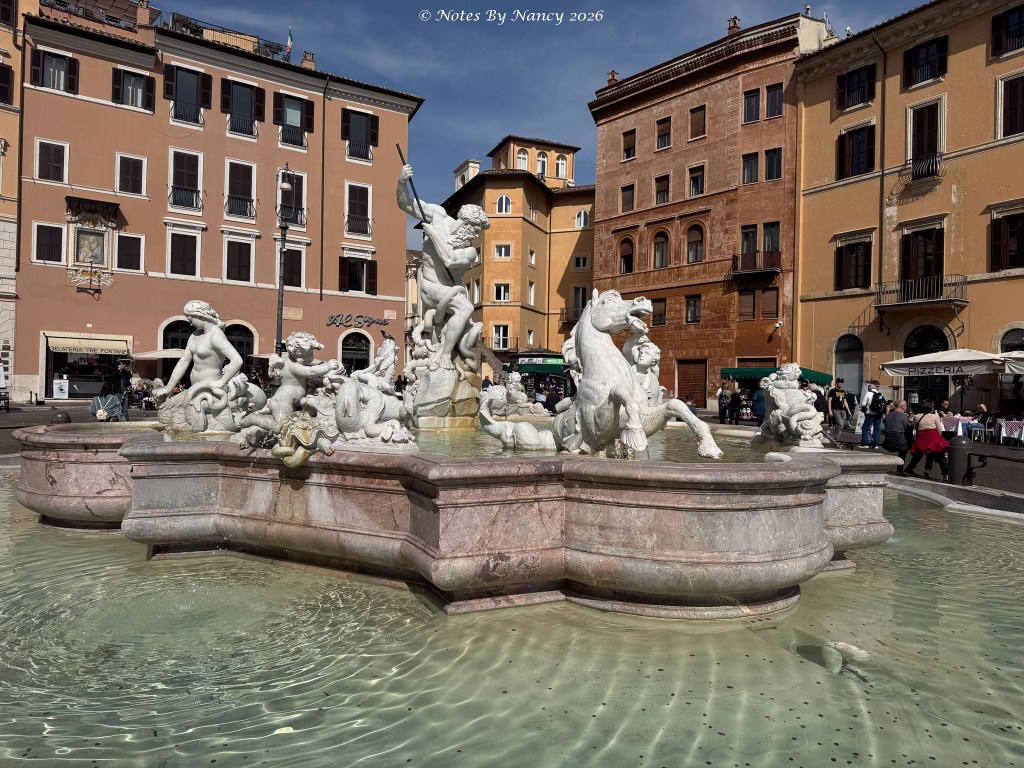
The group met by the Neptune Fountain in the north end of Piazza Navona to continue our afternoon touring – but that will have to be the next post!






Leave a Reply