
Itinerary
Day 6 – Today, after your breakfast at the hotel, you will start the day with the visit to the Vatican Museums and Sistine Chapel. Then, you will proceed with the visit of St. Peter’s Basilica. Lunch on your own.
In the afternoon, you will go to the Coliseum, Rome’s greatest amphitheater, commissioned by Emperor Vespasian in 72 AD. It was here that the Romans watched as the early Christians suffered and died as they were thrown in the arena with lions and other wild animals. You will proceed through the Roman Forum where you will see several ruined temples, triumphal arches, and basilicas. The Arch of Titus was erected in 81 AD to commemorate the destruction of Jerusalem in 70 AD. After your visit to the Forum, you will be on your own for a free afternoon of shopping or additional sightseeing and dinner on your own. Overnight at your hotel in Rome.
This post will only cover the first half of the day – our visit to Vatican City. In the initial itinerary when we signed up for this trip, this morning’s activities were scheduled for tomorrow (Sunday) and today’s plan was Imperial Rome (the Forum, Coliseum, etc.) with a free afternoon. Based on ticket and local guide availability – the tour company ended up combining the two days of sightseeing into one day with tomorrow a free day to do whatever we want.
Vatican City
Before I begin reflecting on the day, here are a few brief facts about Vatican City provided by Google Gemini and Wikipedia.
- It was created in 1929 via the Lateran Treaty with the Kingdom of Italy and signed by Prime Minister Benito Mussolini on behalf of King Victor Emmanuel III and by Cardinal Secretary of State Pietro Gasparri on behalf of Pope Pius XI. This resolved the “Roman Question” of the pope’s ruling status following the unification of Italy in 1861 when the Papal States (most of central Italy) were taken over by the Kingdom of Italy.
- It is an absolute elective monarchy with the Pope holding all legislative, executive, and judicial powers.
- It is the smallest country in the world at 0.49 square kilometers (121 acres) by area and also by population at 882 (in 2024).
- The entire state is a UNESCO World Heritage Site.
The Vatican Museums
Surprisingly, we took the bus this morning to the Vatican Museums even though we could step outside our hotel and see the dome of St. Peter’s Basilica over the wall just a block away. The Vatican Museums however are on the far side of Vatican City from our hotel – since we had a very long day ahead of us, Flavio opted for a 7-minute bus trip versus a 25-minute walk.
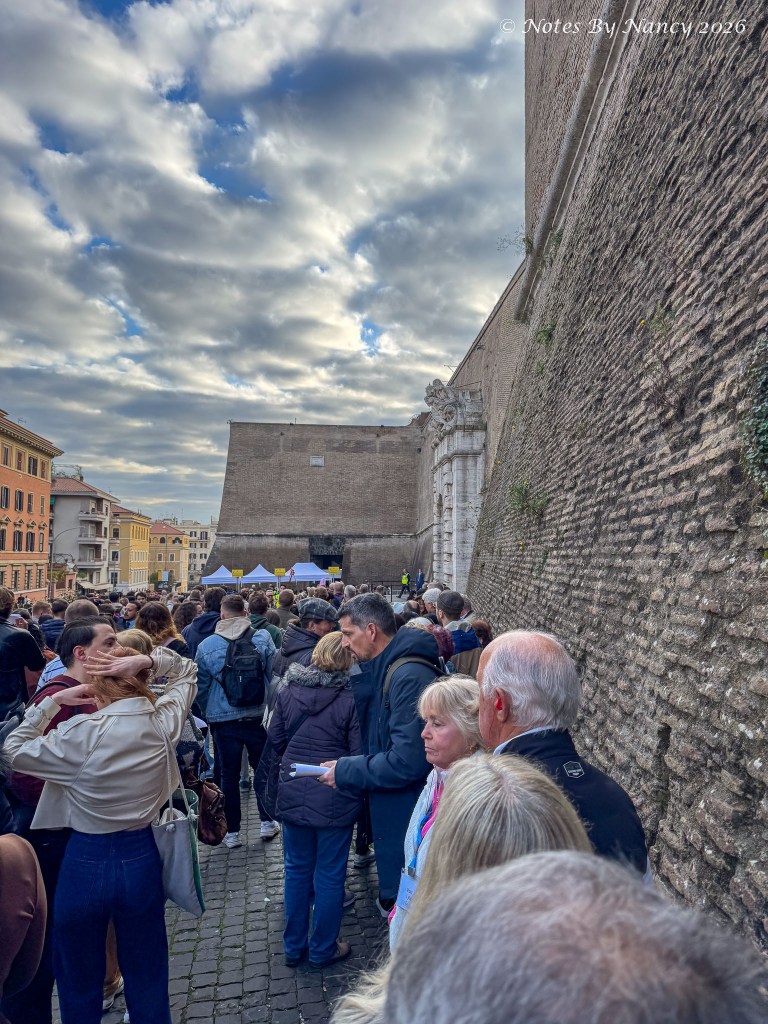
Shortly after 8am, we were lined up with the masses for our 8:30 timed entry into the second-most visited museum in the world (the Louvre is first).
The museums were begun in 1506 when Pope Julius II (yes, the same guy who wanted a massive tomb by Michelangelo, then commissioned the Sistine Chapel ceiling painting instead – see Note 120) put a recently discovered ancient statue on public display (we will see it).
You will notice that it isn’t the Vatican “Museum” but “Museums” – plural!
Per the official website, here’s the full list.
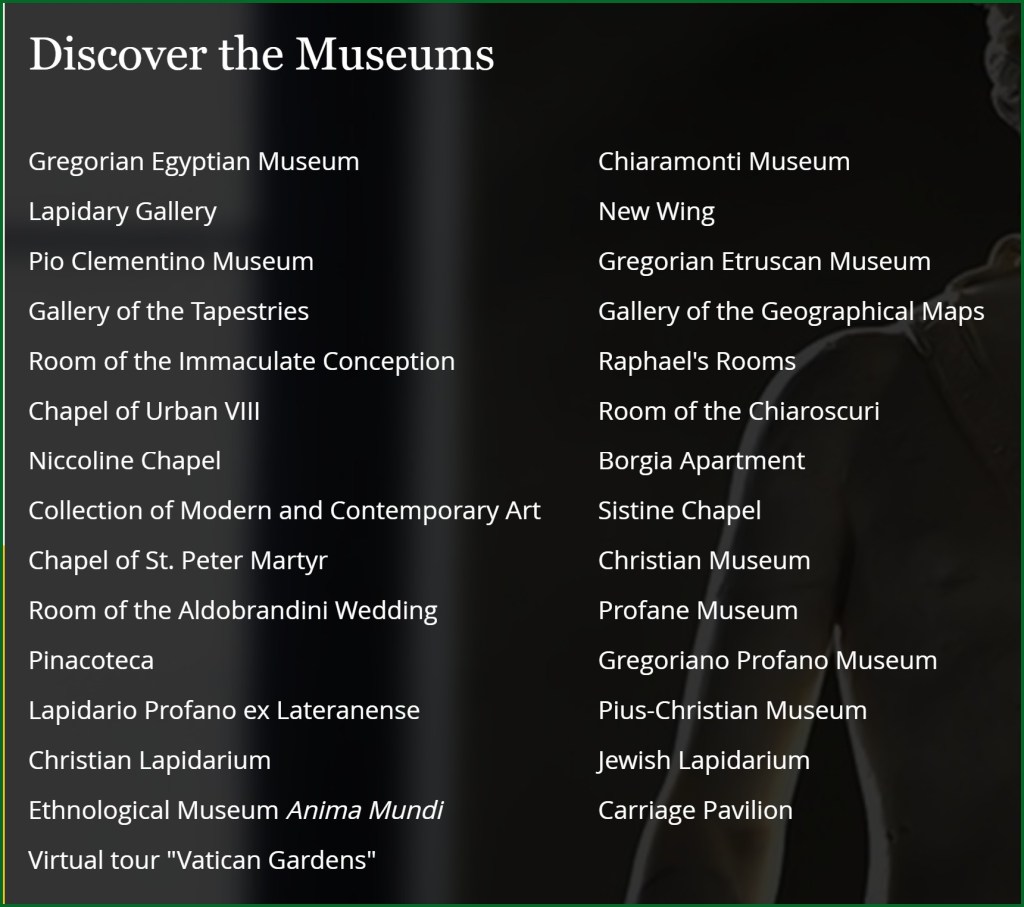
We were split into two groups with two guides who used the “whisperer” listening devices to lead us through the vast collections pointing out the highlights as there are over 70,000 items of which 20,000 are on display!
Yes, it is and was overwhelming!
The security process was just as intense as airport screening as the name on our tickets and our IDs had to match and of course there were metal detectors too! After the security checks, we regrouped and began our tour with a review of a model of Vatican City to get our bearings. The entrance to the museums can be seen in the top picture – there is a gate along the facing wall.
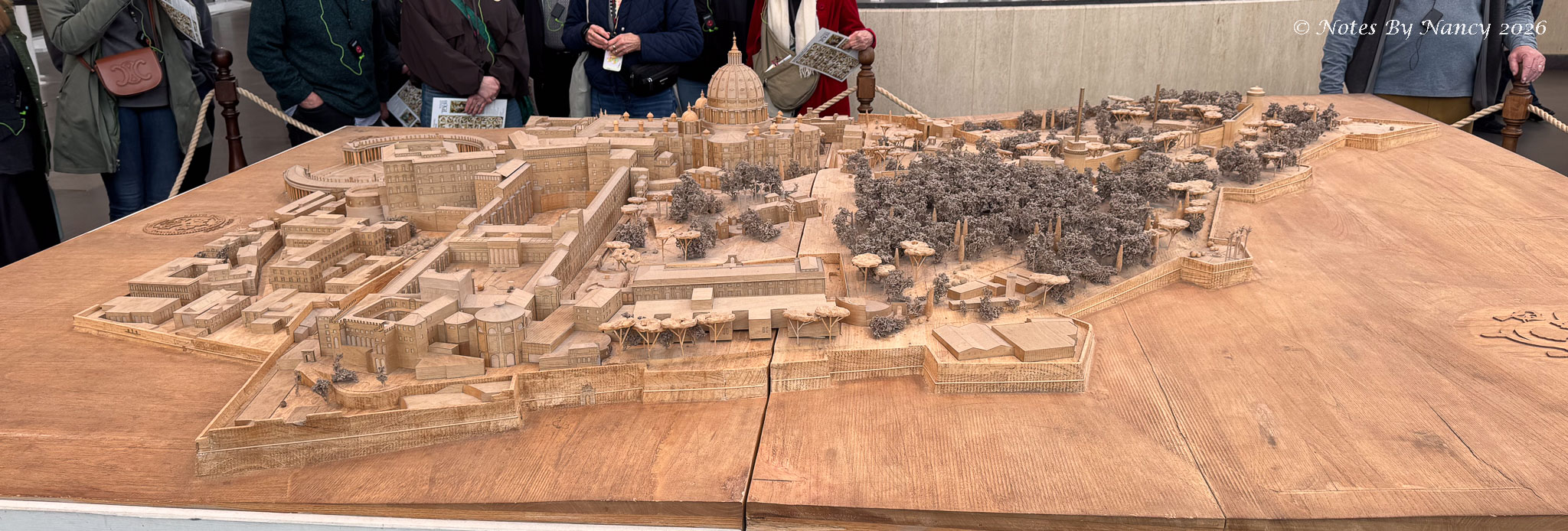
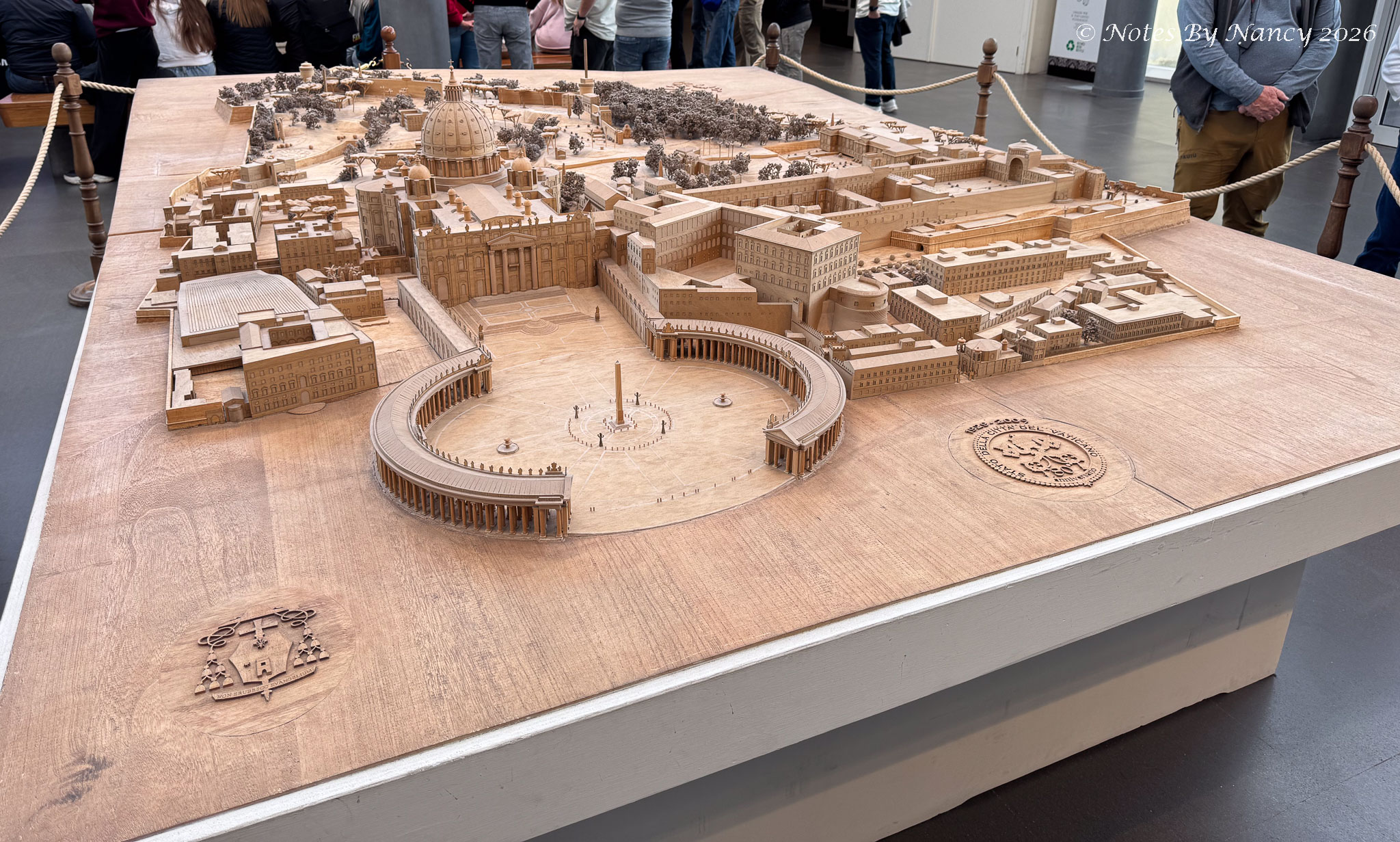
For a perspective on the location and size of the museums within Vatican City, this Wikipedia map link is helpful – the museums are the heavy black lines while Vatican City is outlined in gray surrounded by Rome (zoom out to fully appreciate the size of Rome).
Views from the Courtyard of the Art Gallery
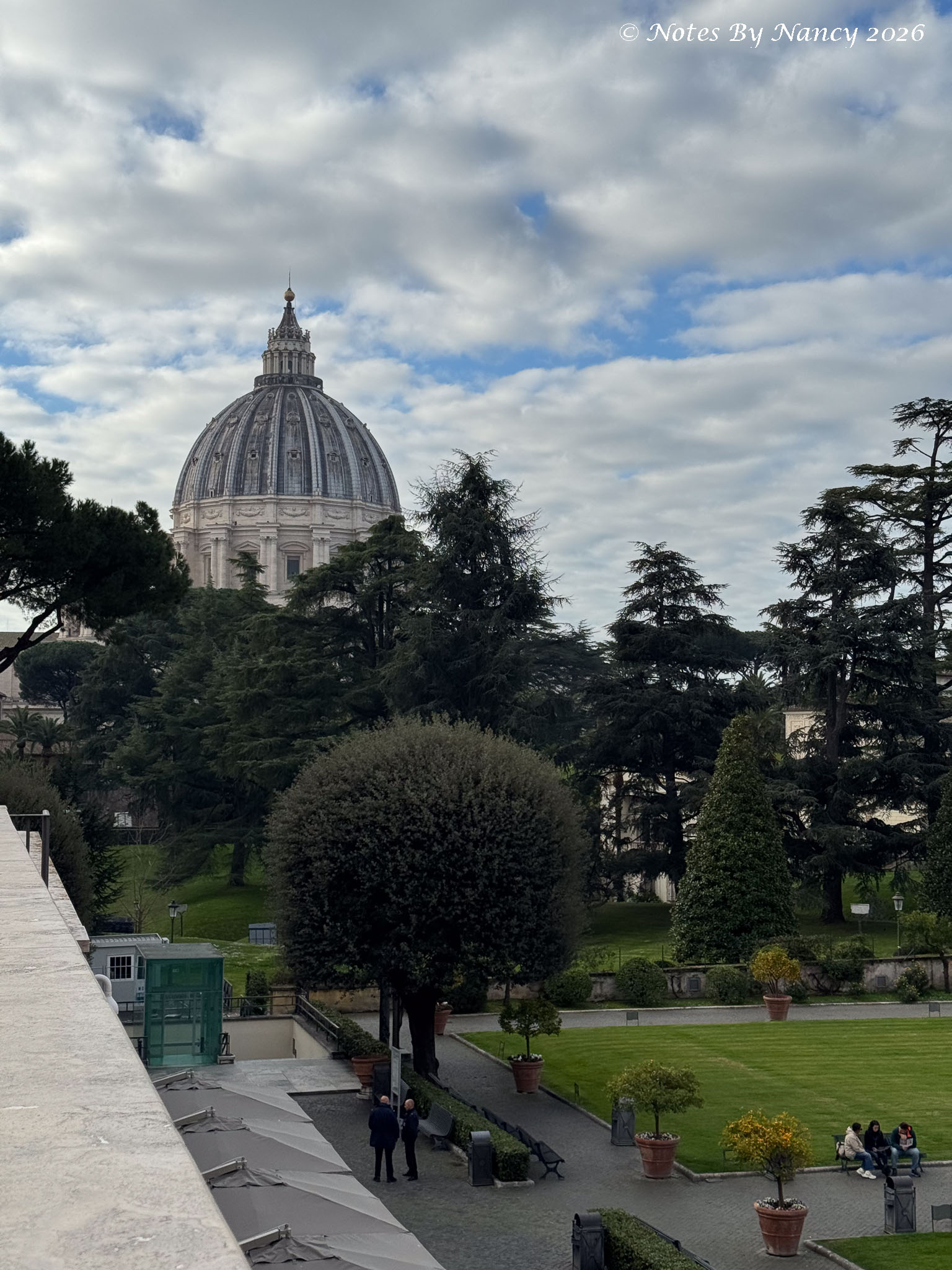
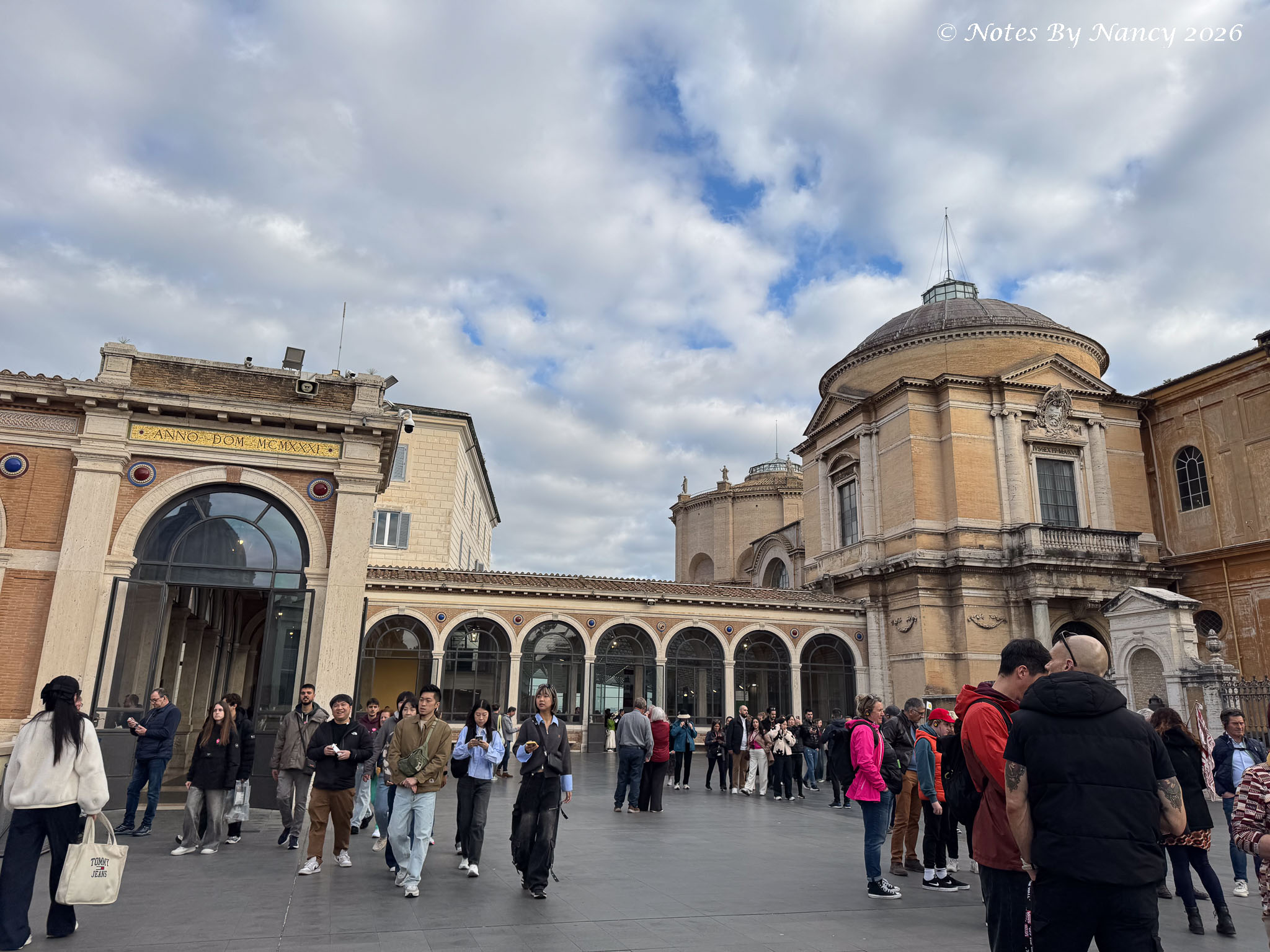
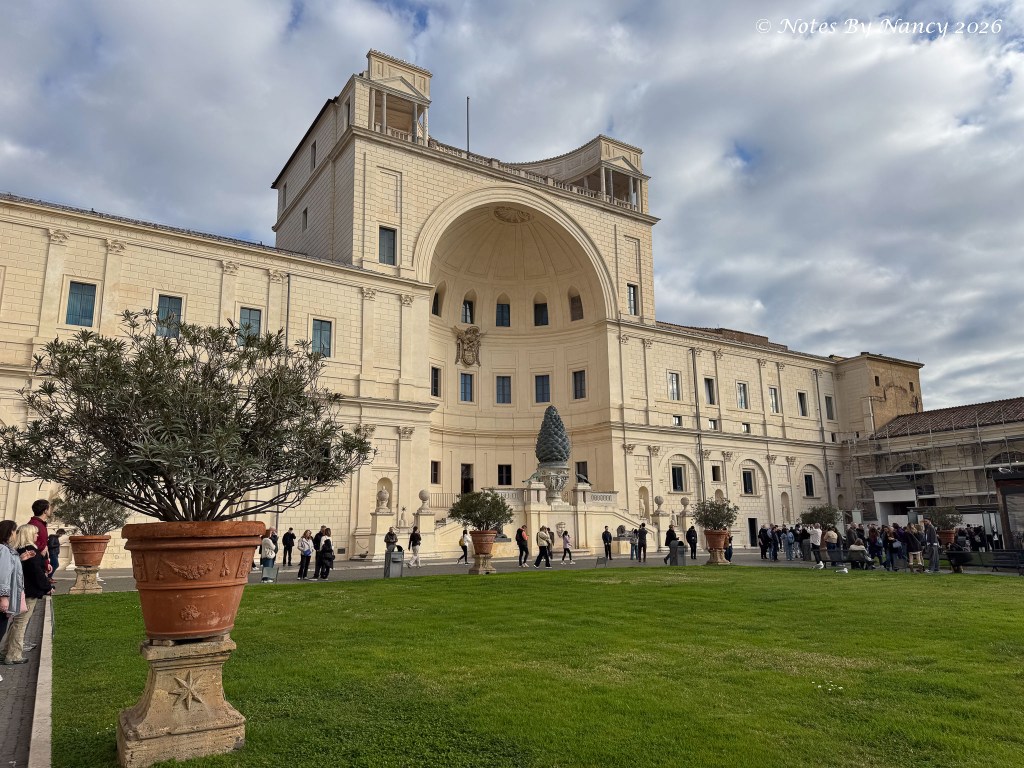
In the Pinecone Courtyard
The 4-meter high bronze pinecone giving the courtyard its name is from the 1st Century AD and was originally a fountain located near the Pantheon. It was relocated during the Middle Ages to the courtyard of the old St. Peter’s Basilica, then moved to its present location in 1608.
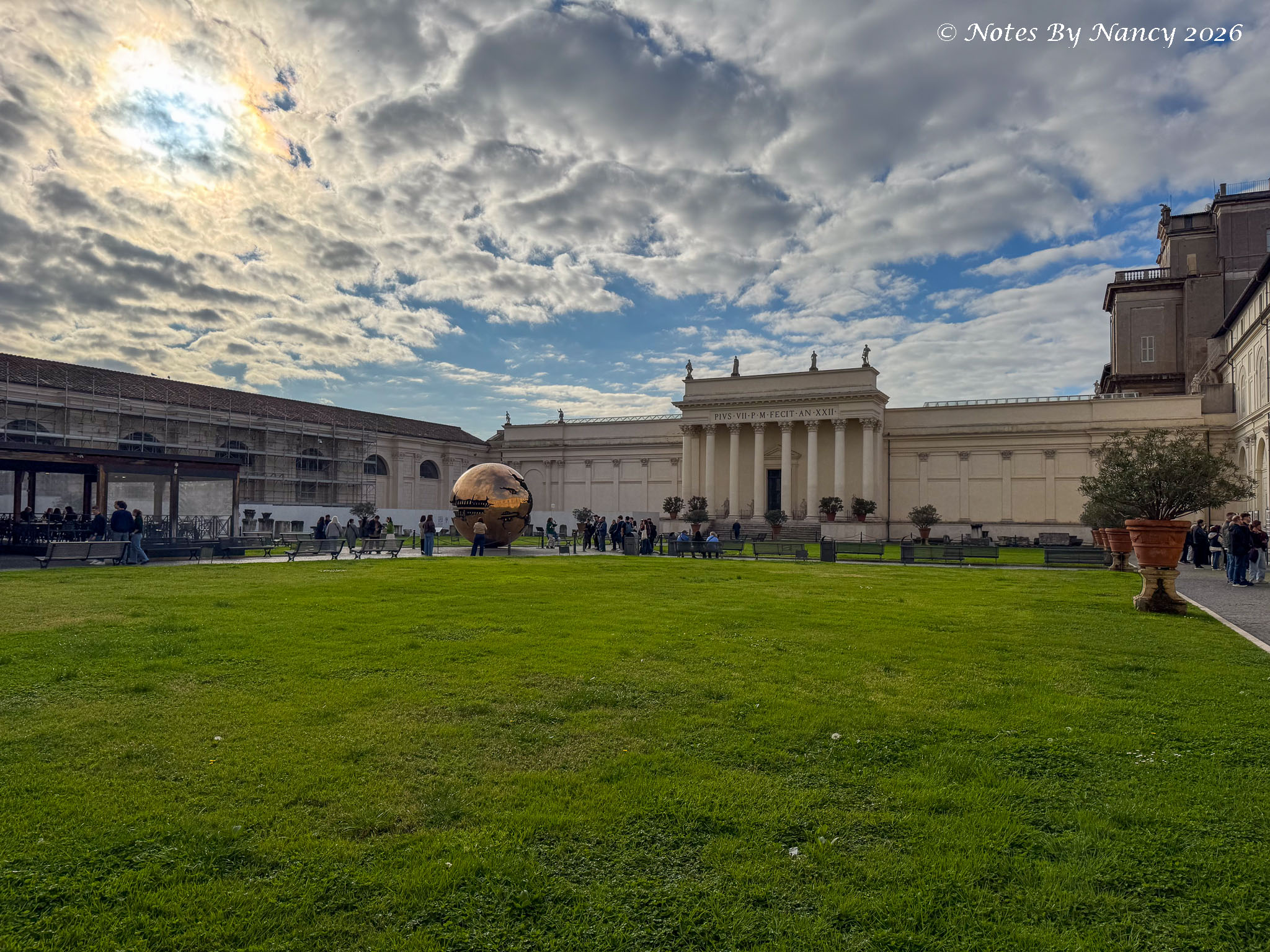
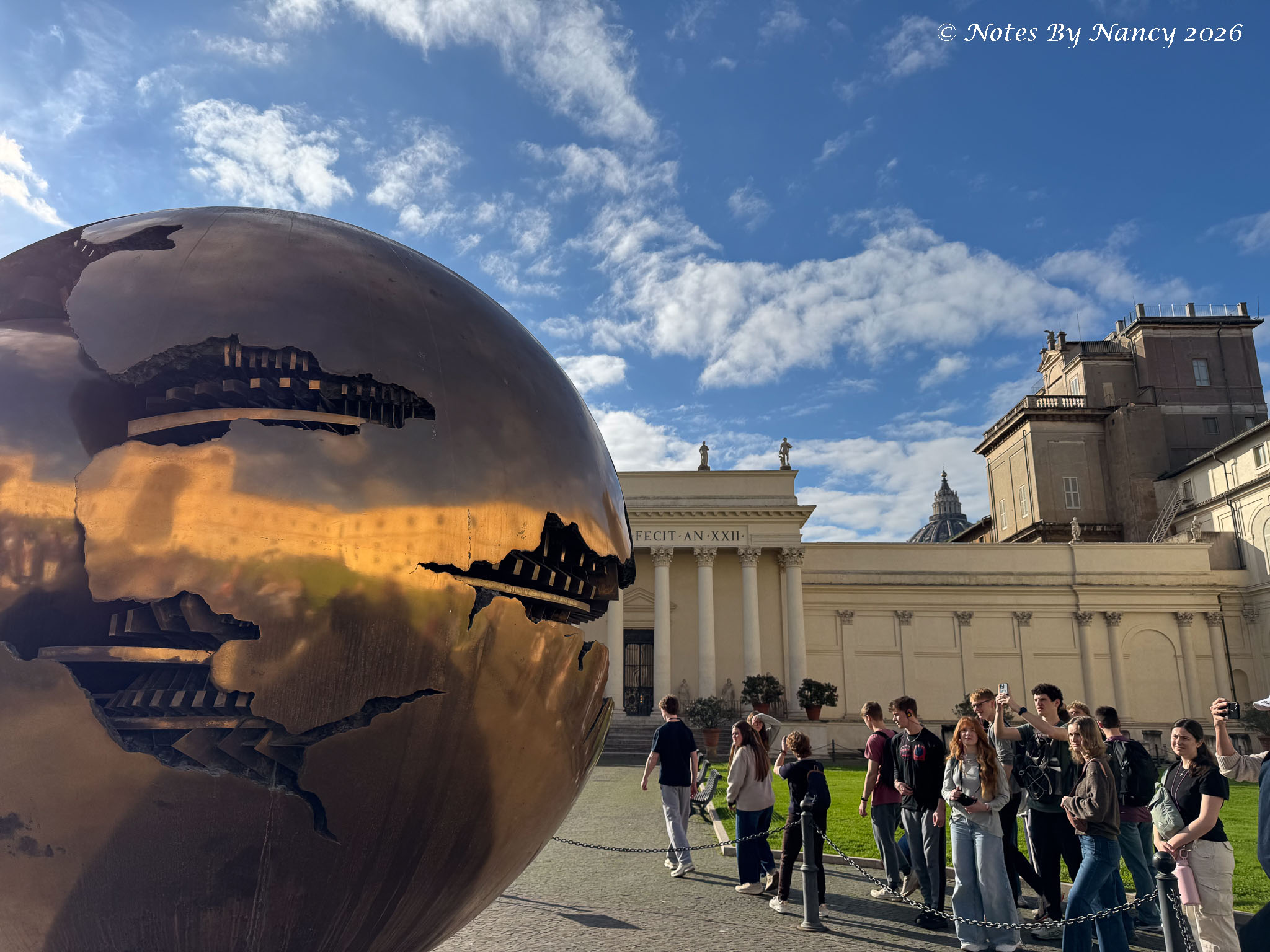
The Sphere within Sphere rotating bronze sculpture in the center of the courtyard was created in 1990 by Arnaldo Pomodoro to represent the “complexity and fragility of the modern world”. Similar spherical sculptures by Pomodoro are located all over the world – this one is the largest with a diameter of approximately 4 meters.
The Sistine Chapel
Although we won’t enter the Sistine Chapel until later in our tour, these signs in the Pinecone Courtyard provide guides with the opportunity to explain the history and meaning of Michelangelo’s famous ceiling frescoes (depicting the stories in Genesis) as well as The Last Judgement which covers the altar wall (and is currently under restoration). Pictures are not allowed inside the Sistine Chapel – so these will have to suffice.
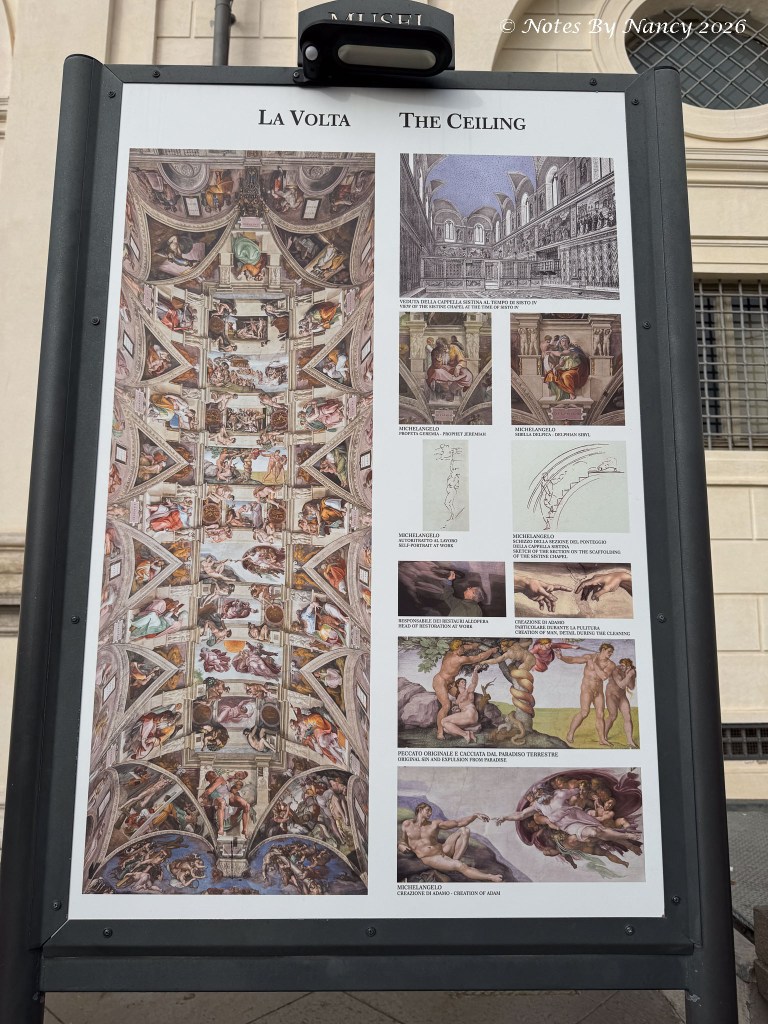
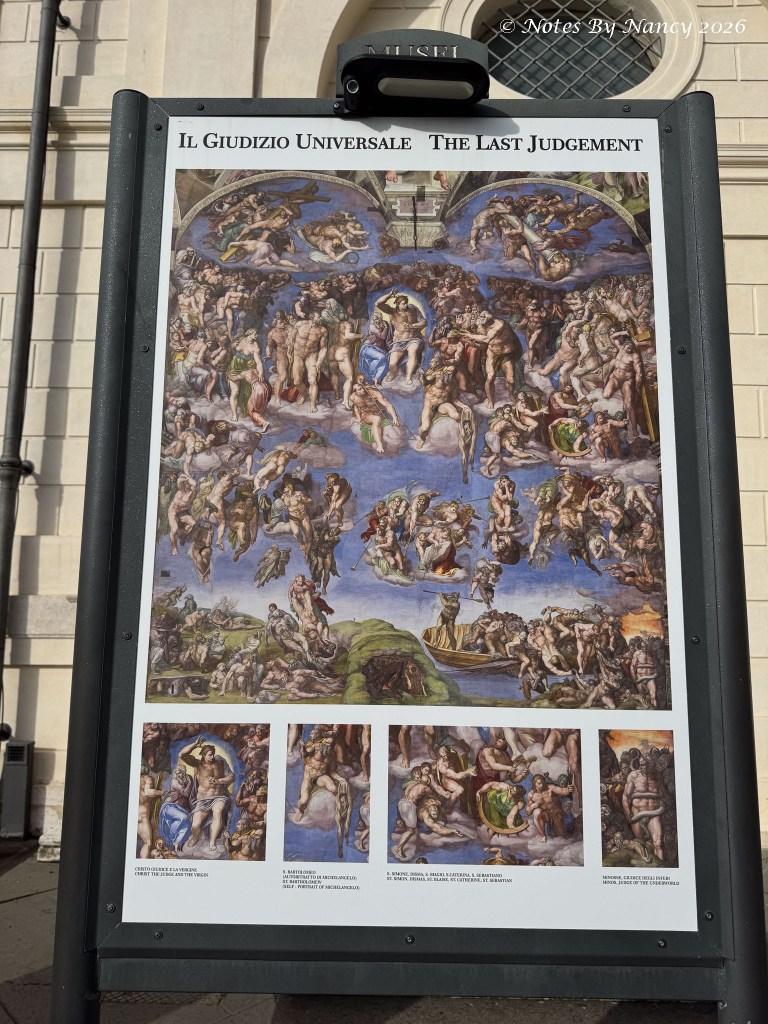
From hearing our guide’s account (and later research), it is surprising to me that the controversial The Last Judgement wasn’t just completely painted over and erased from history! Apparently, it has been discussed several times over the centuries. The controversy involved the nudity of the figures represented, the mixing of pagan and Christian symbols, and artistic license in representations such as trumpet-blowing angels in a single group instead of “from the four corners of the earth” as stated in Revelation, etc. Consequently, following a decree from the Council of Trent in 1563, revisions were eventually made to add “draperies” and change the position of some images. Some of these revisions remain and others have been restored during various renovations of the work. It will be interesting to learn what the current restoration work involves.
Since I’m on the topic, I’ll skip ahead in our tour to my reaction upon entering the famous chapel. First, our guide had indicated there was no talking allowed in the chapel. I was expecting a quiet reverence in which to study and appreciate the artistic masterpiece(s). Apparently, what our guide meant was that she wasn’t allowed to talk to us as a guide inside. It was the loudest place we entered! Second, it was somehow both a smaller and a larger space than I had envisioned. Third, it was crowded! Seriously. Crowded. Packed in like sardines crowded. The security/docents tried to keep a path clear for people to move through, but it was next to impossible.
We were given about 15 minutes to gawk absorb it all. That isn’t nearly enough time – especially since craning your neck to examine Michelangelo’s Genesis frescos on the ceiling needs frequent breaks. At least, I could skip focusing on The Last Judgement. The screenprint covering the restoration activities depicted the painting so that you got a feel for the immenseness and idea of it but didn’t lend itself to studying the work. In addition to the ceiling, the walls of the chapel contain frescos depicting the Life of Moses on one side and the Life of Christ on the other. These more traditional works were completed in 1482 by painters such as Botticelli and Rosselli, 25-30 years before Michelangelo started and finished the ceiling that is considered to have changed the course of Western art.
Ok – back to the Pinecone Courtyard… we left it to enter…
The Octagonal Courtyard
Originally called the Courtyard of Statues, this is where the ancient statue that started it all was placed after its discovery in 1506.
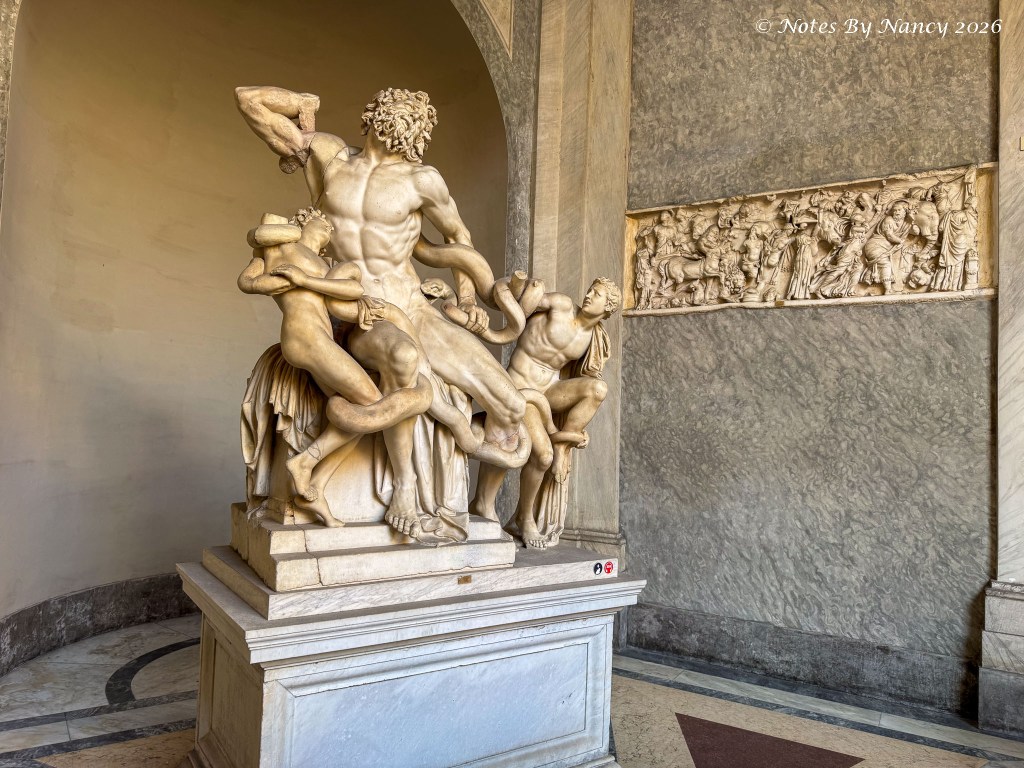
It is known as the Laocoön Group or Laocoön and His Sons and was described by 1st Century AD Roman writer Pliny the Elder.
Hall of Muses and Round Hall
Leaving the courtyards behind, we entered a group of halls and galleries containing more antiquities from Egypt, Greece, and early Roman times.
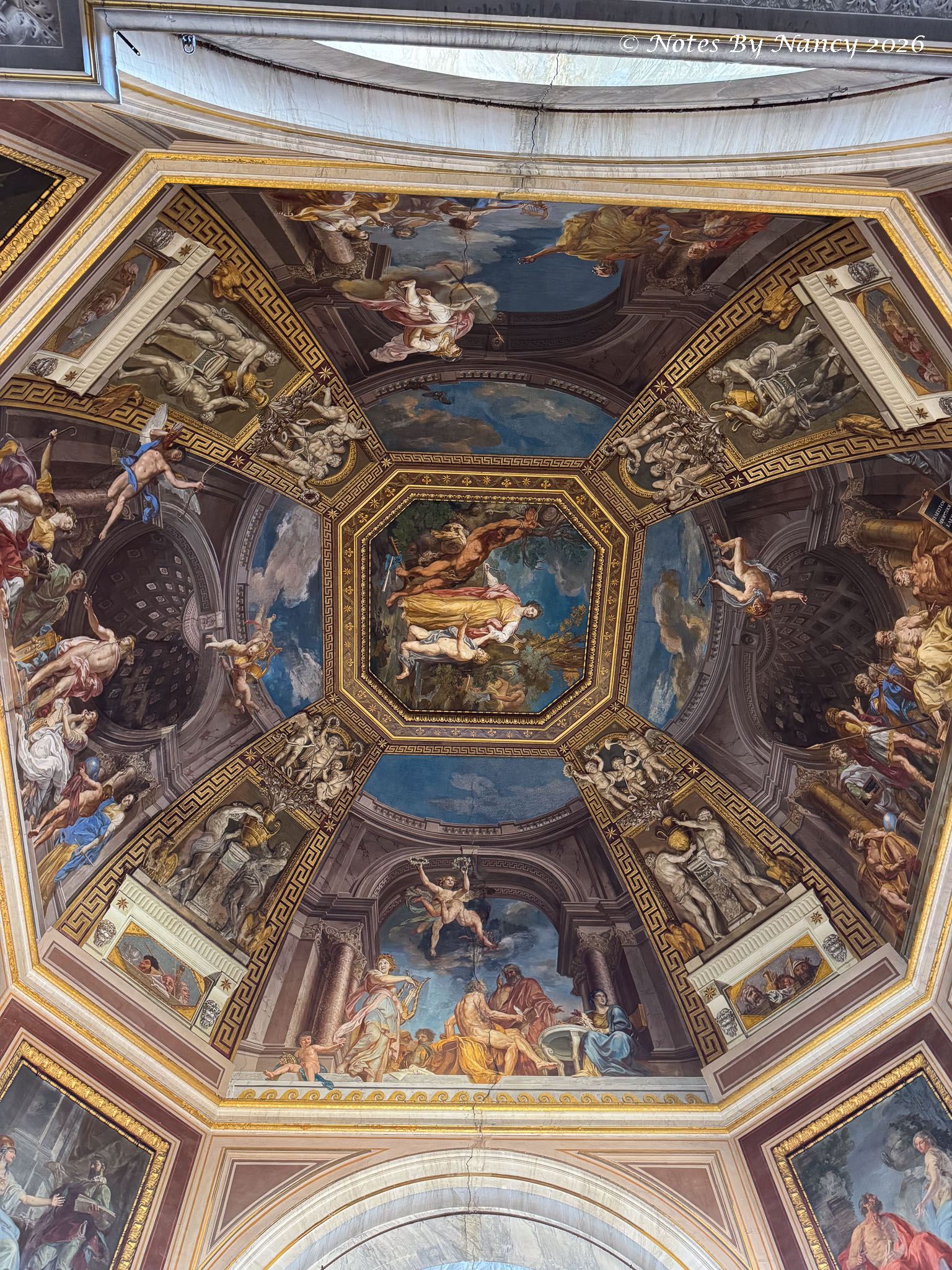
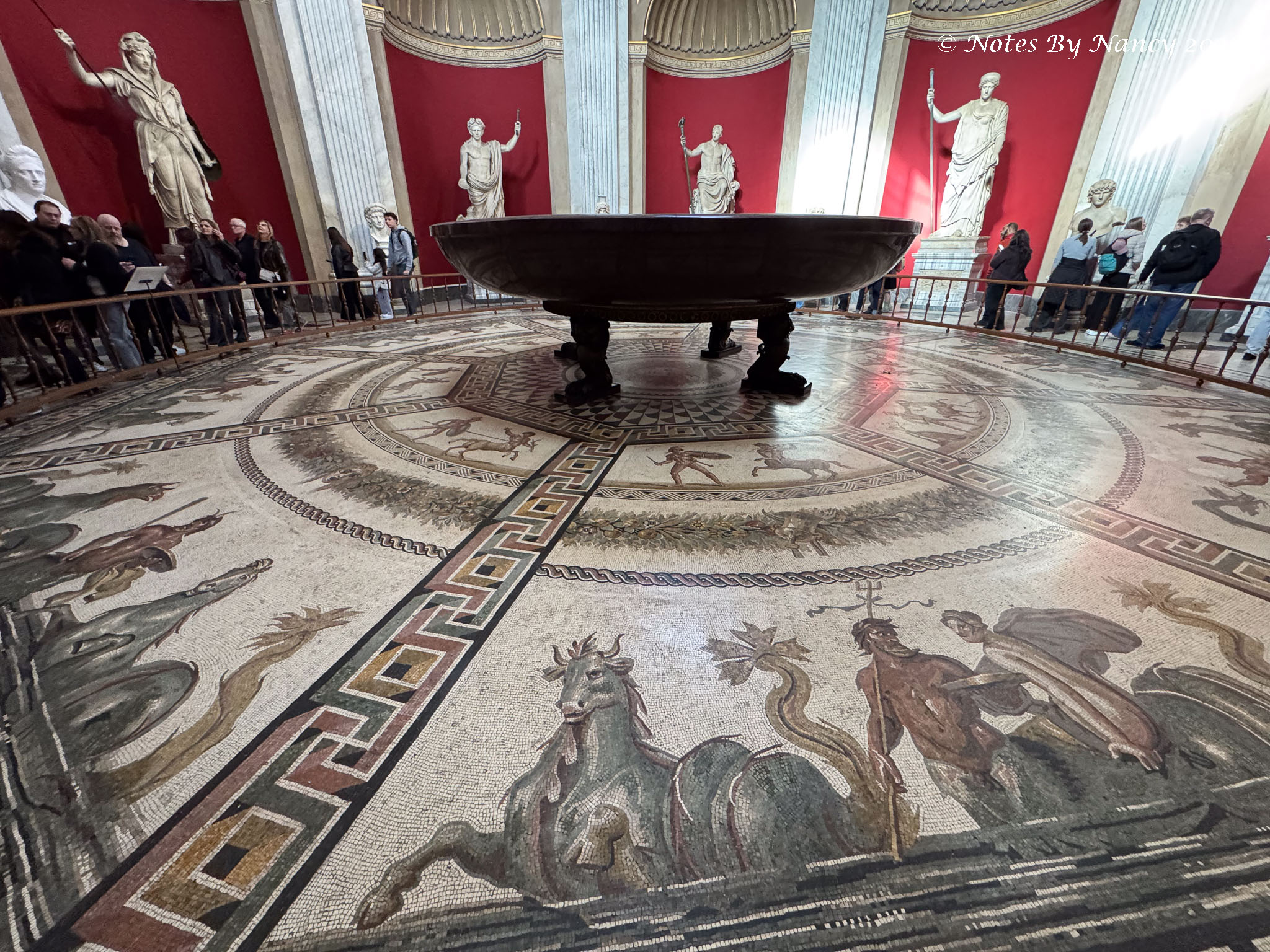
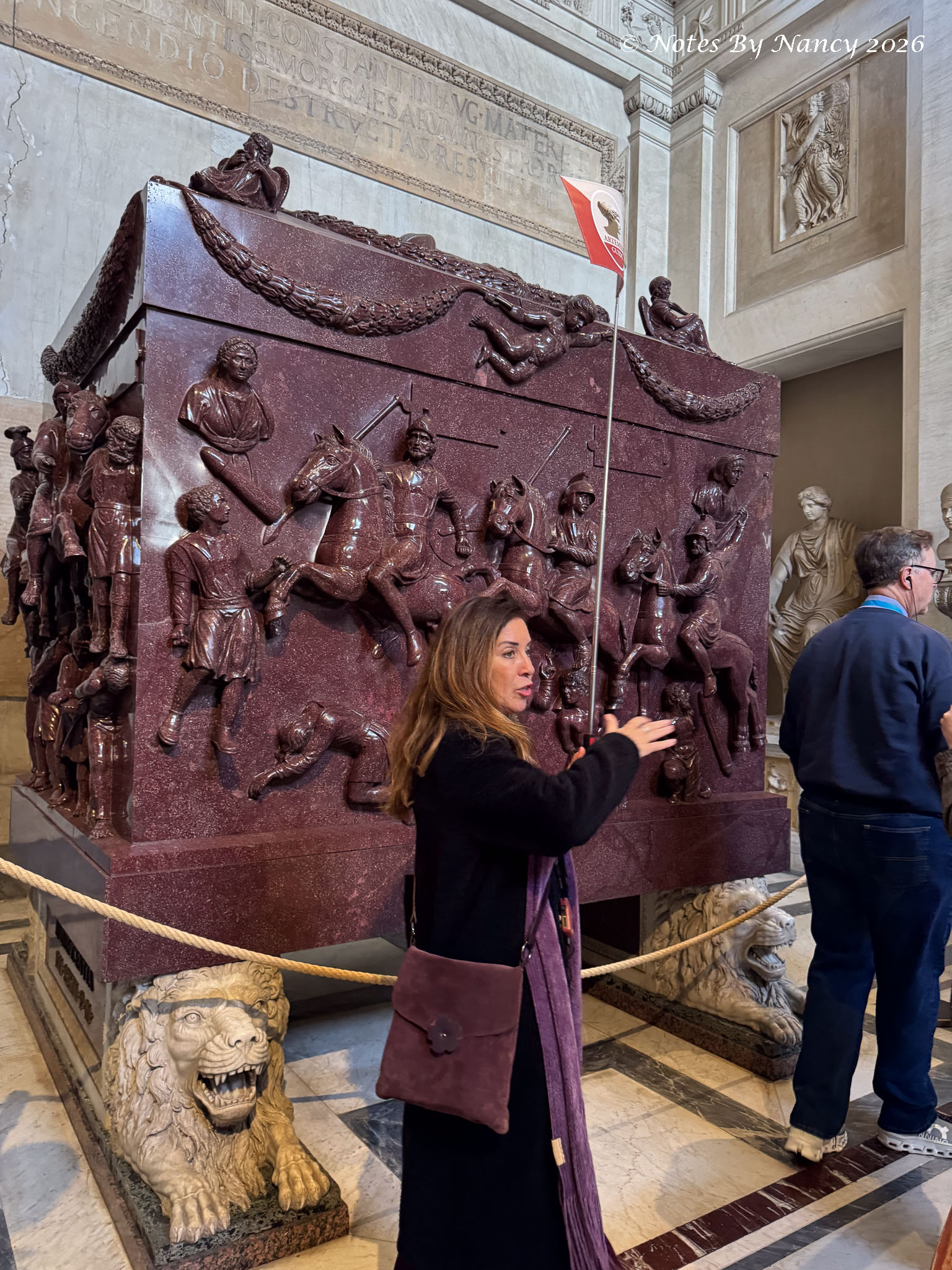
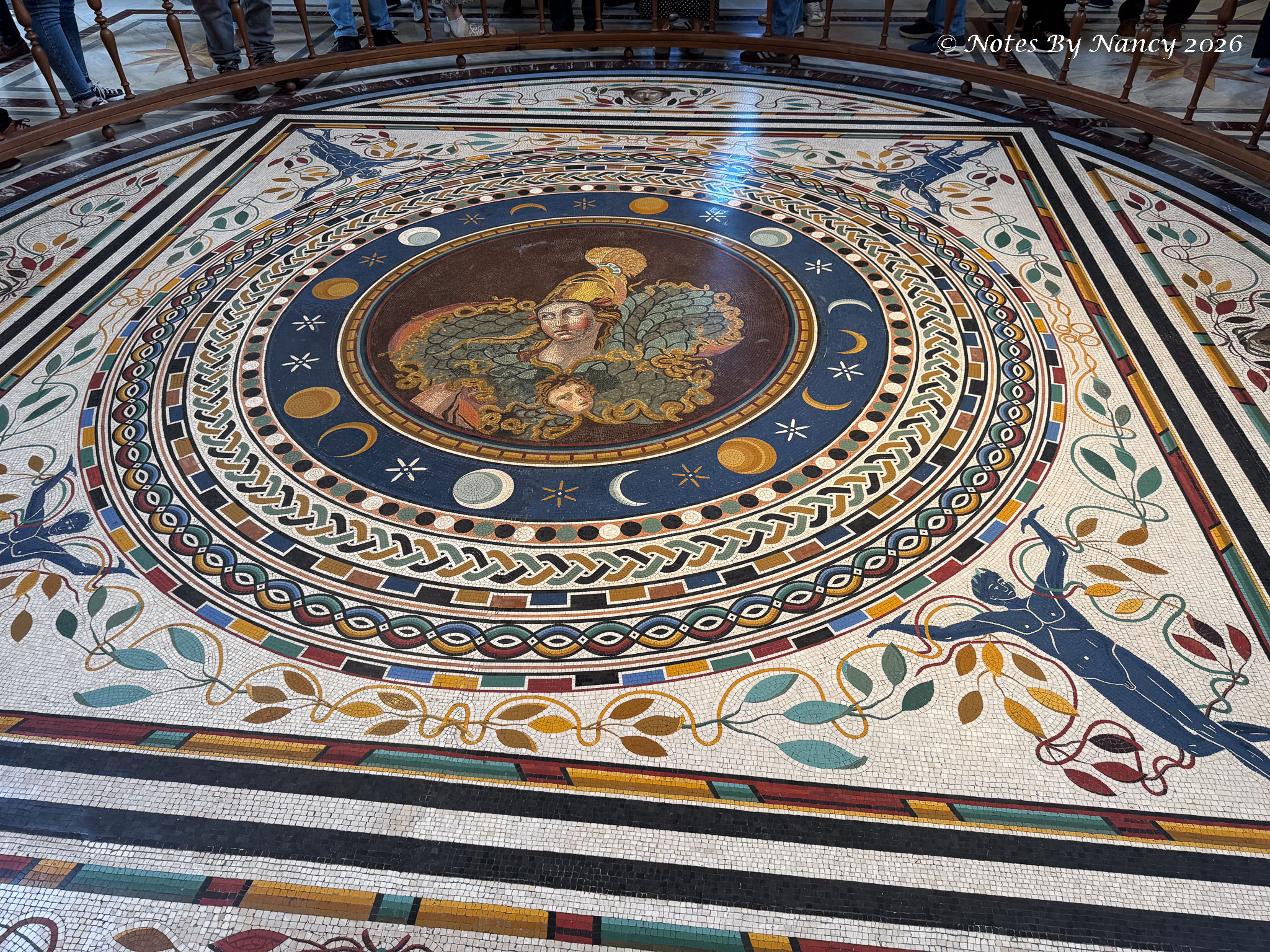
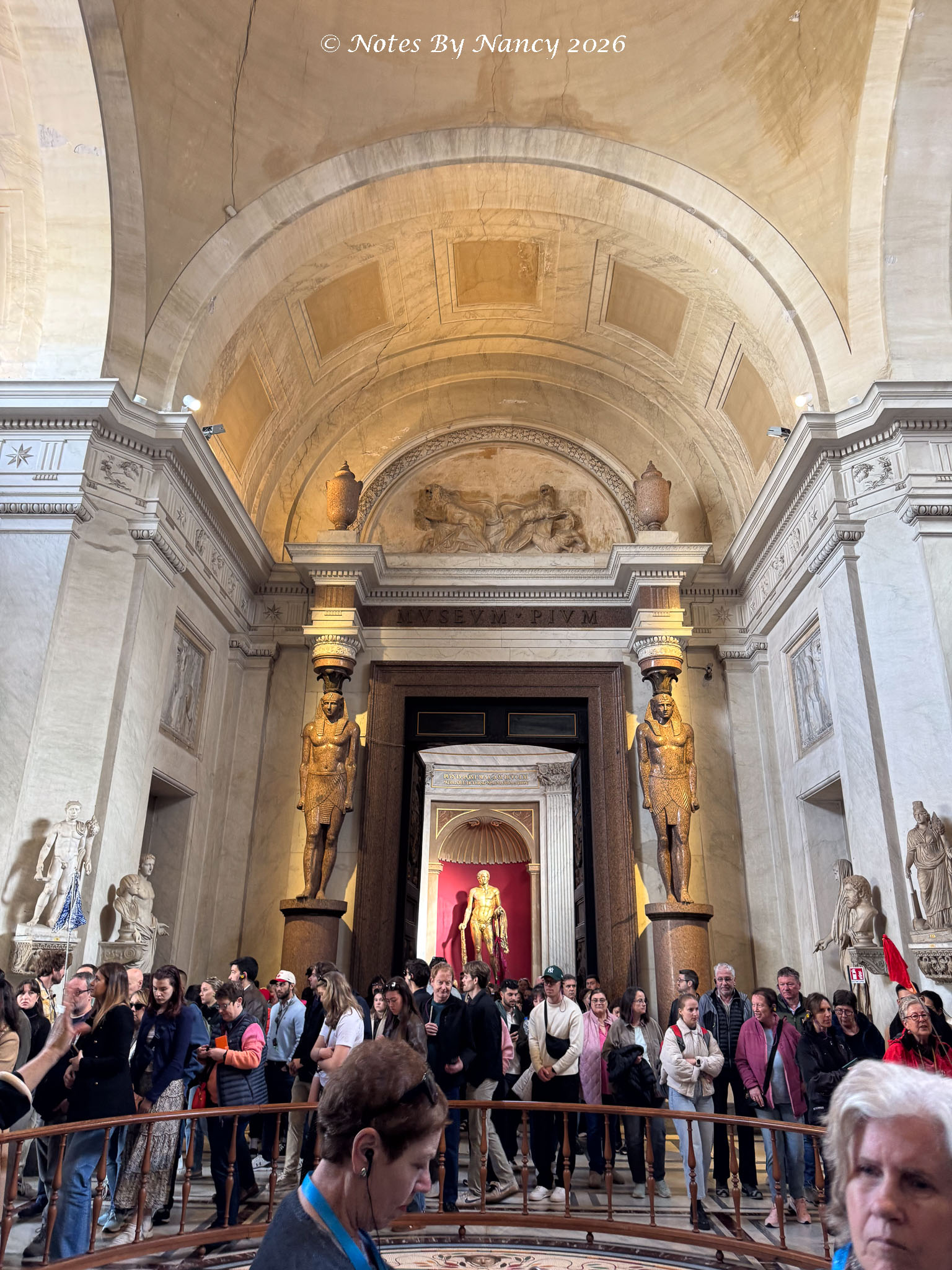
Gallery of the Candelabras
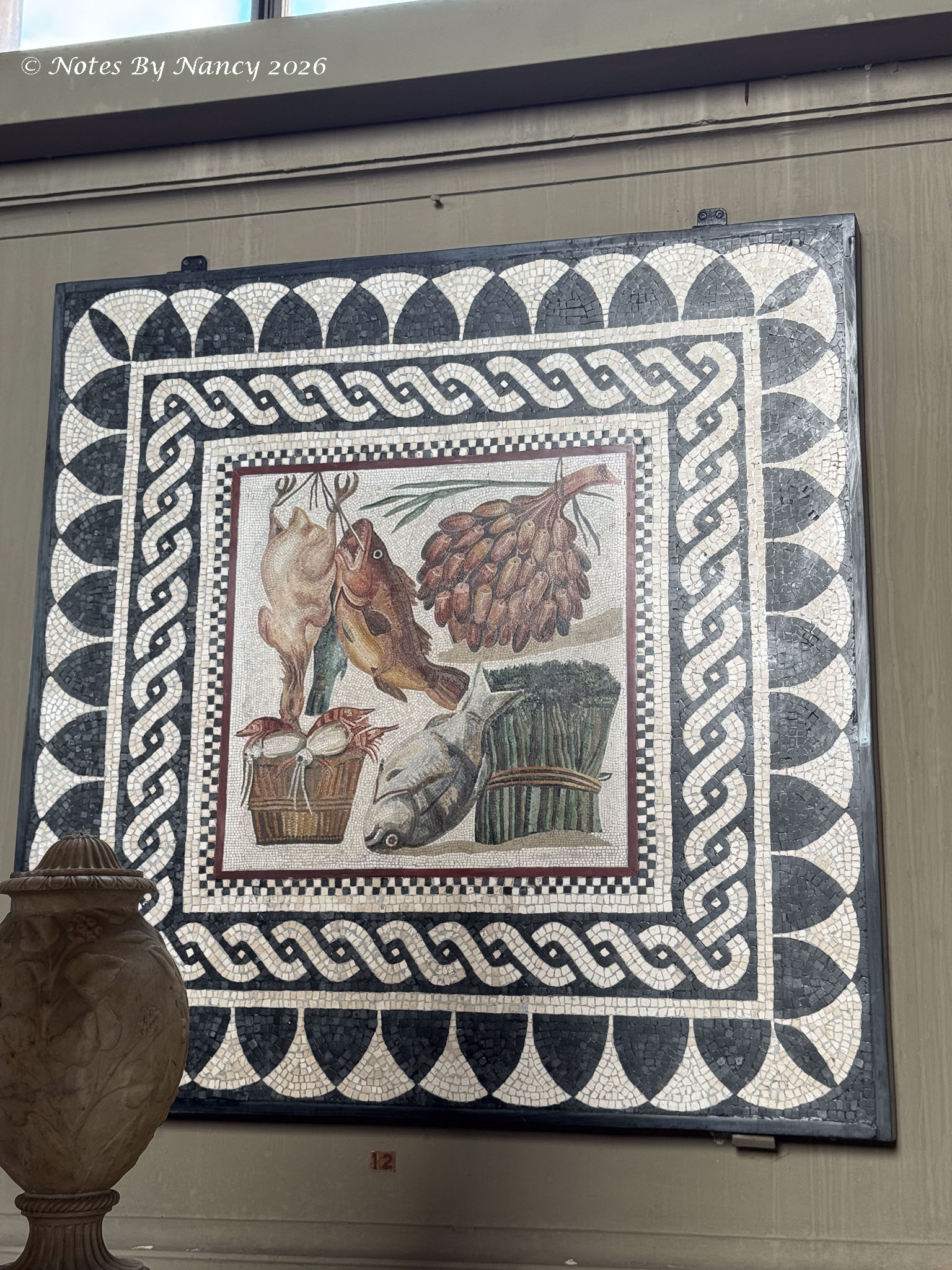
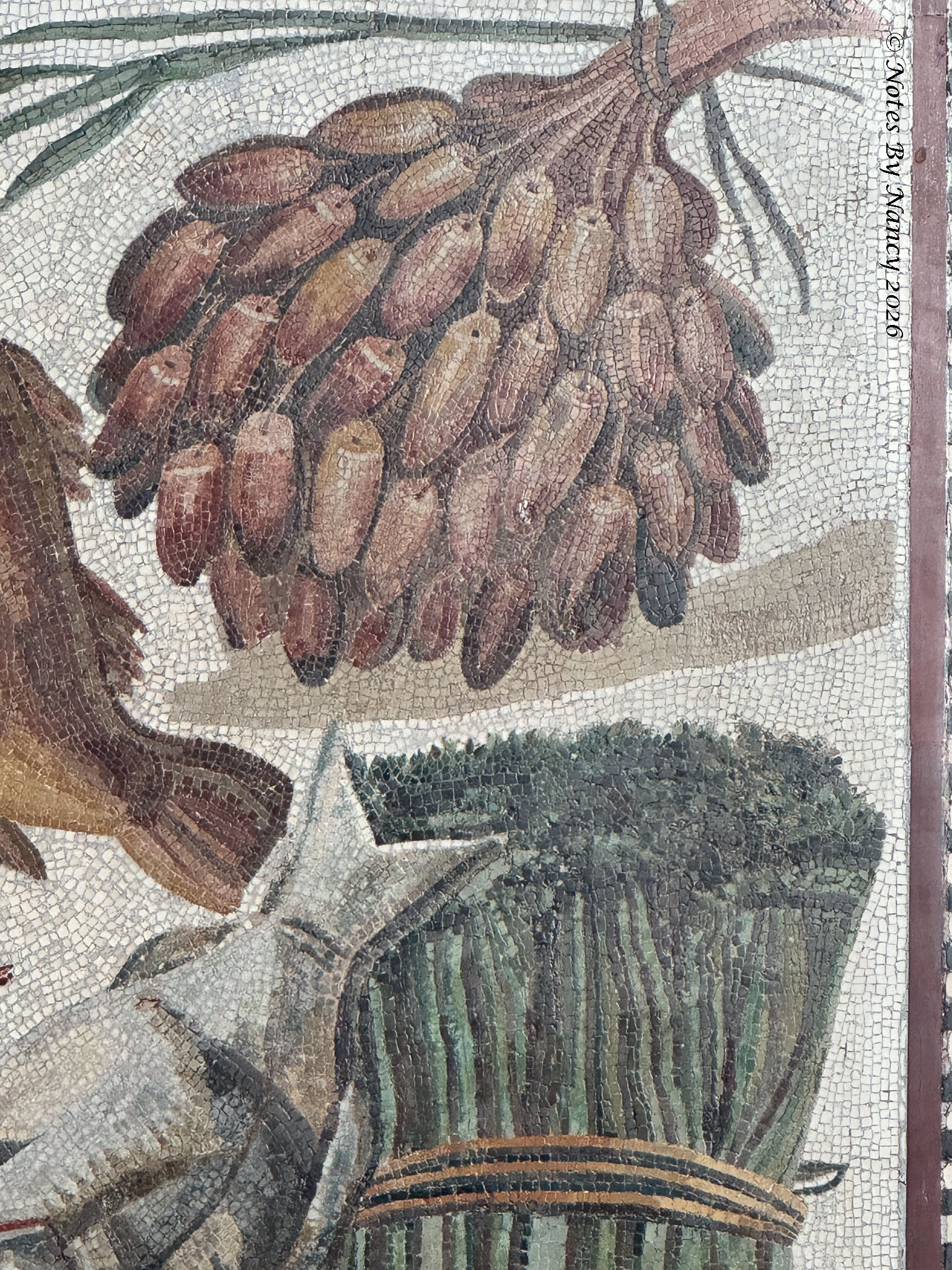
This mosaic looked like a painting from a distance, the tiles were so small!
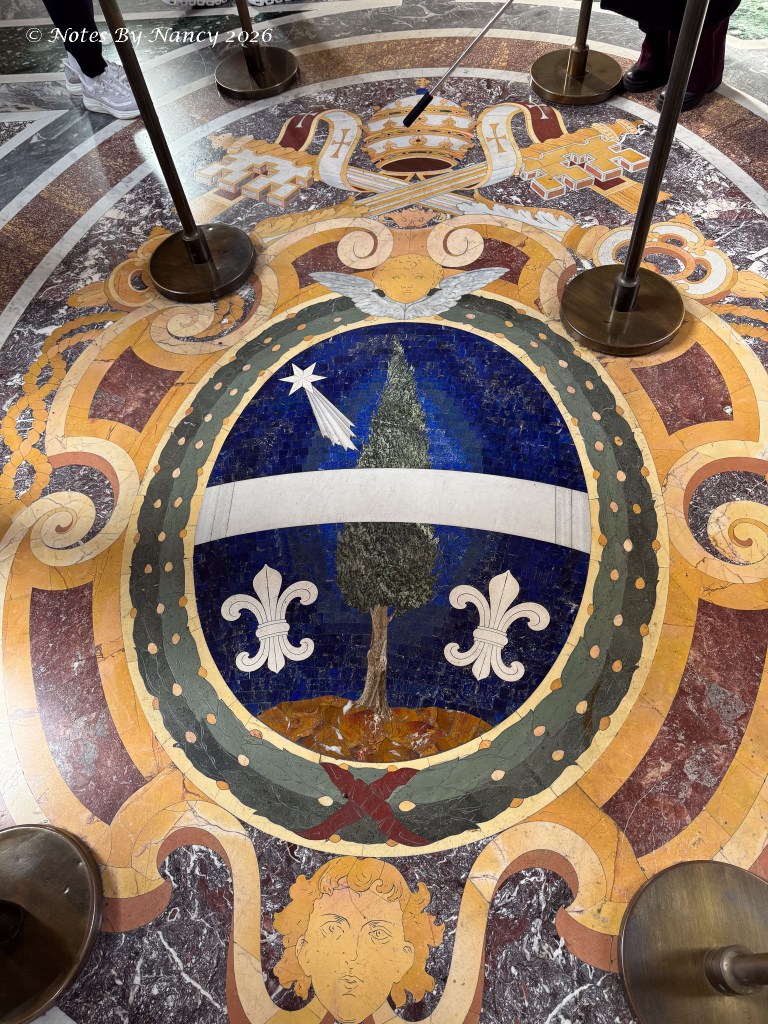
The coat of arms for Pope Leo XIII who renovated the Gallery of the Candelabras.
A rare chance to capture a gap between tour groups in the gallery.
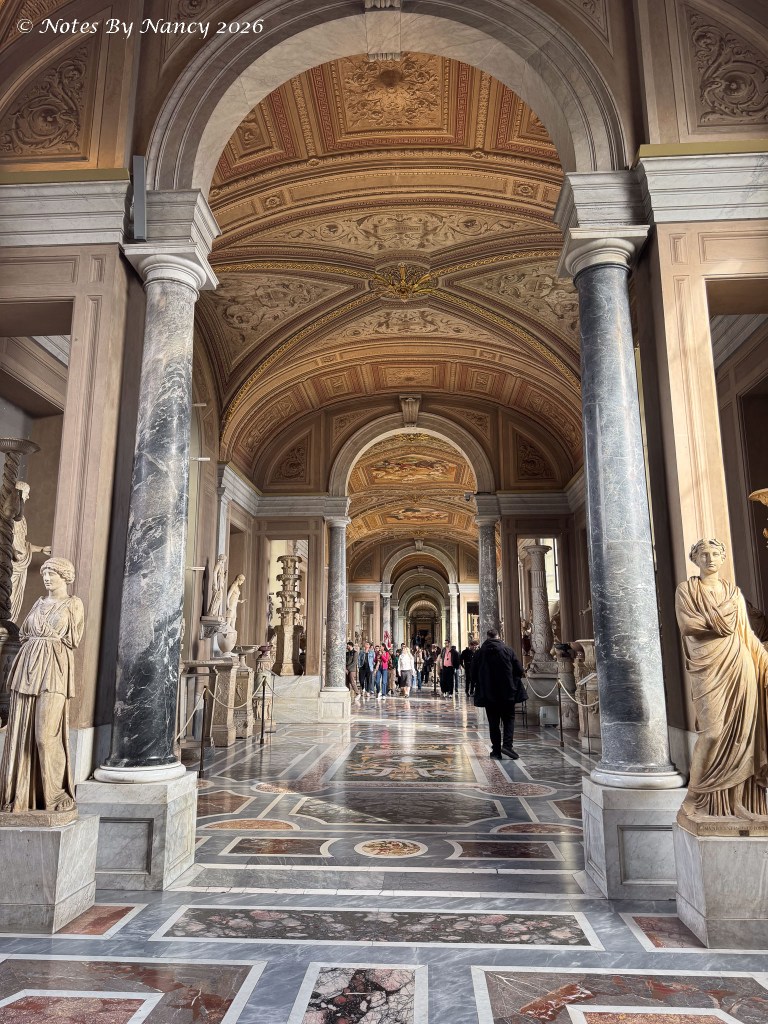
Gallery of Tapestries
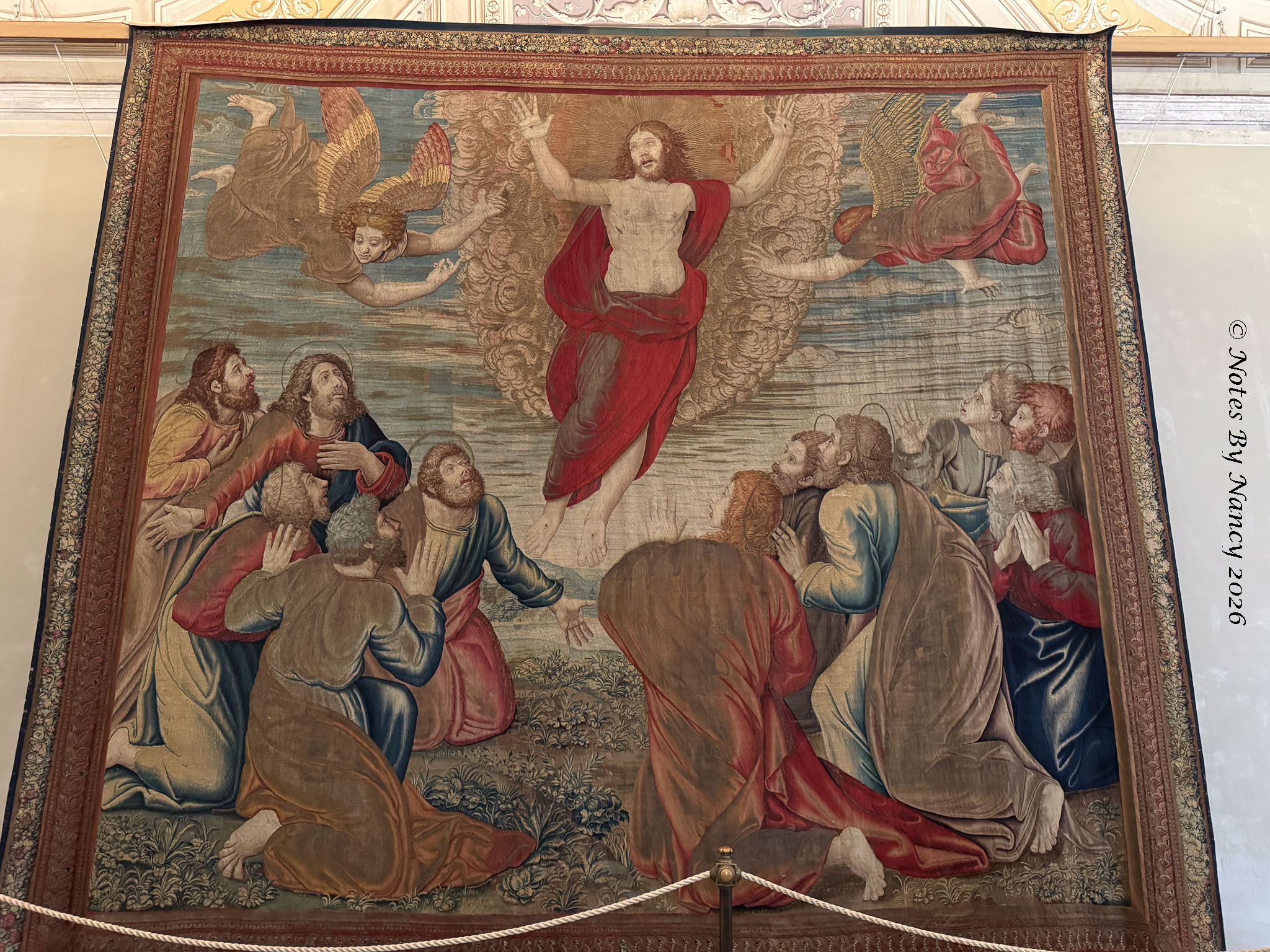
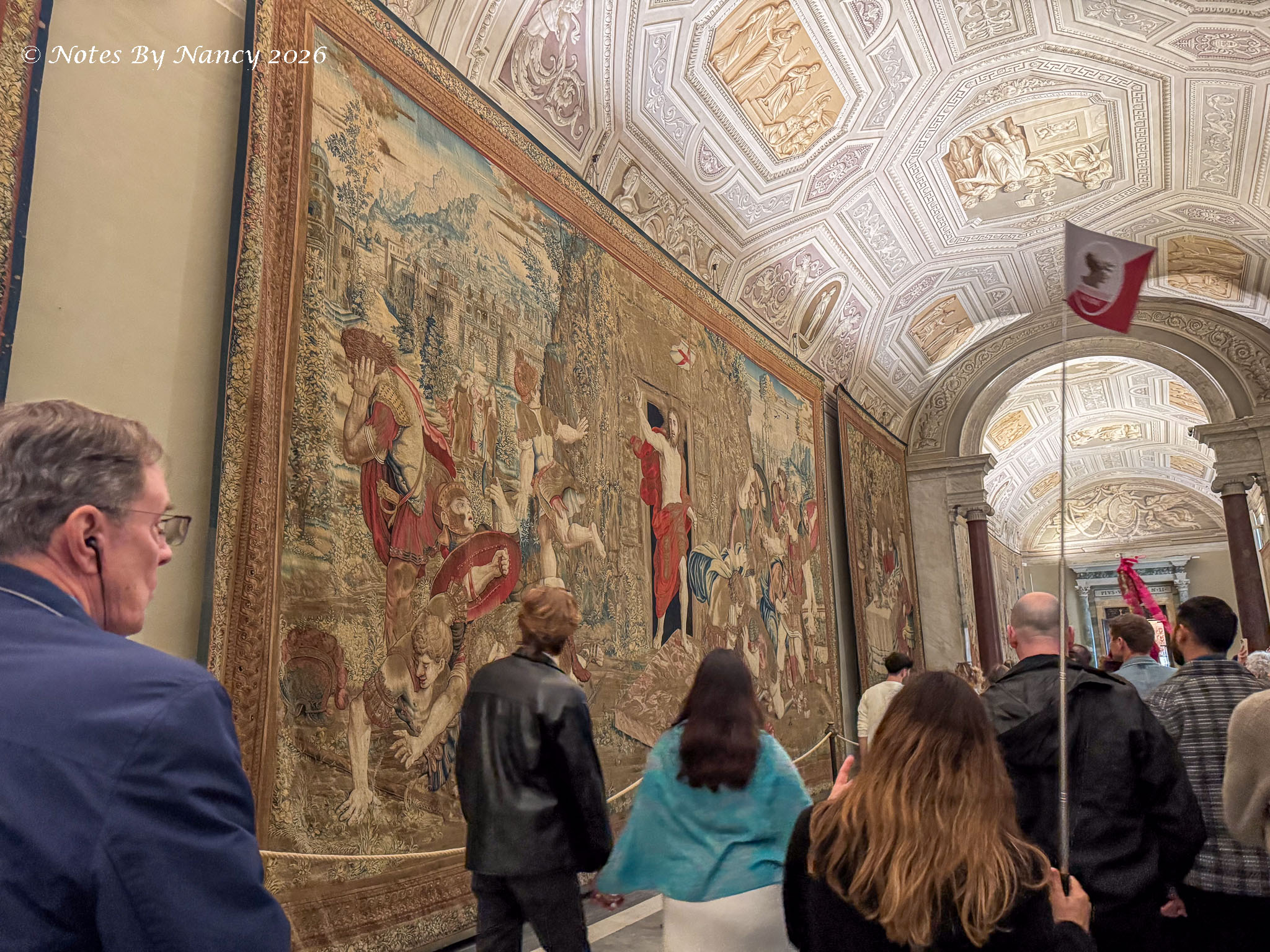
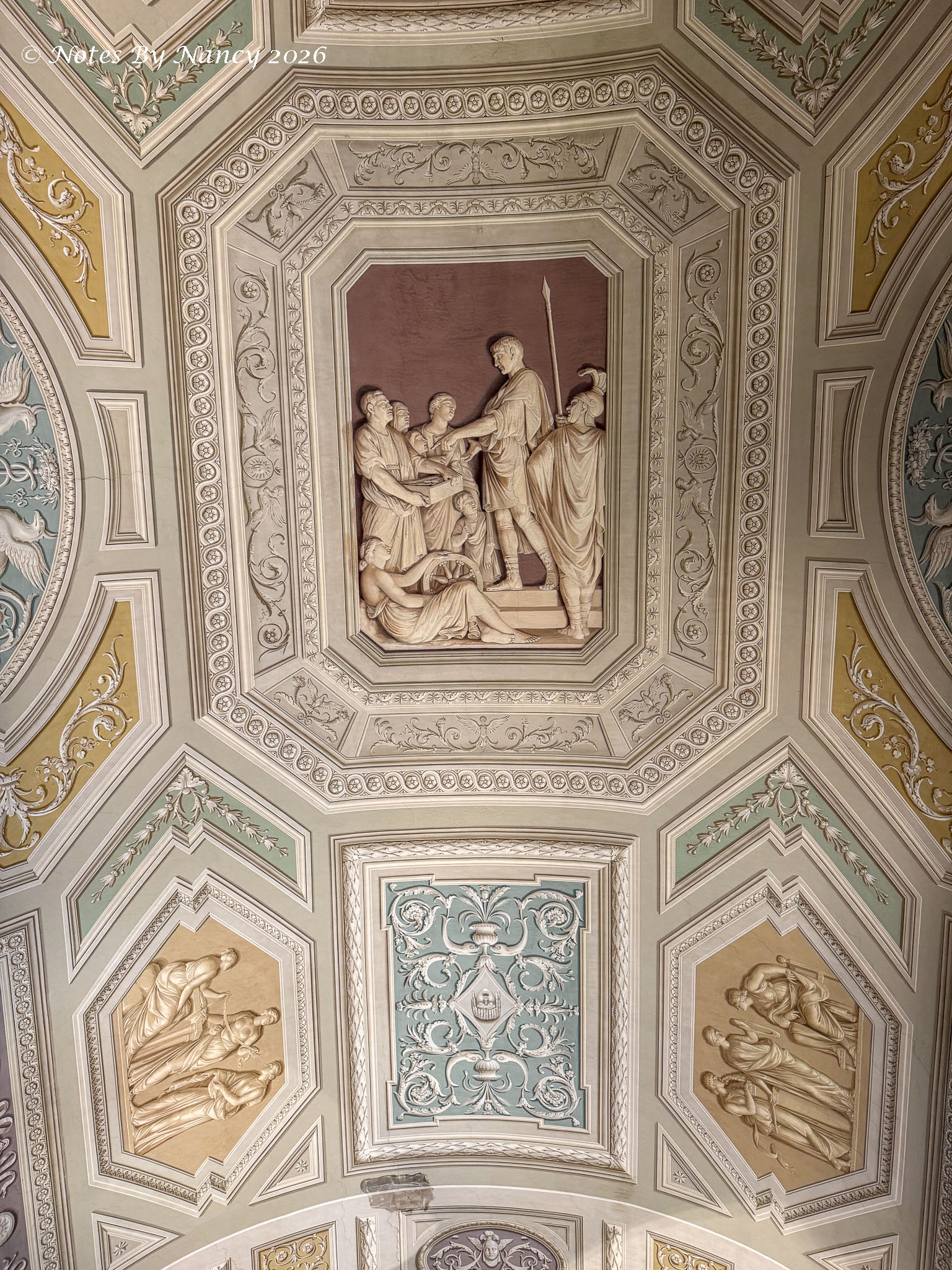
Even though the focus is the walls with the huge tapestries, the ceilings are always just as interesting.
Gallery of Geographical Maps
Each of the 40 panels in this long gallery (120 meters by 6 meters) contains a cartographical map of a region of Italy (mainland and islands) entirely to scale. Per the Vatican Museum website, it was constructed between 1578-1580 and was the first time that the entire peninsula of Italy, then consisting of many political divisions, was presented “as a geographical, historical, religious and cultural unit”.
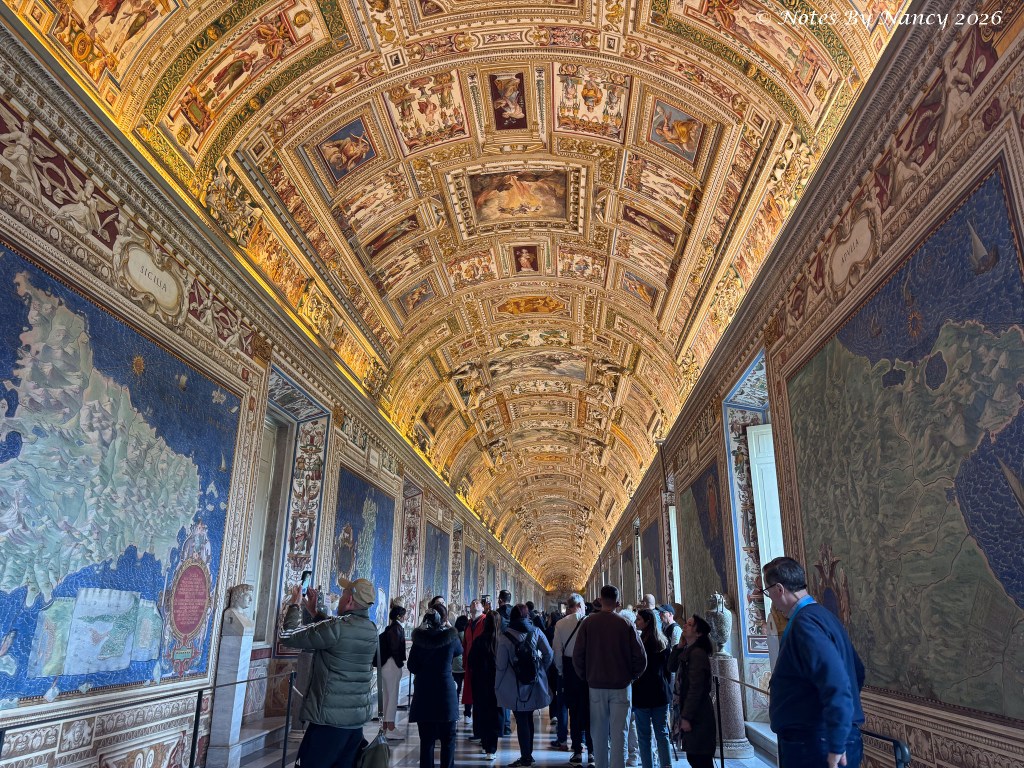
The detail available from 16th century cartographers is amazing – you’d think they had satellite images. It was impossible to get a good picture of a single map due to their size and the crowd of people.
Exiting this hall, we traversed a stairway and wound our way into the Sistine Chapel which I described earlier.
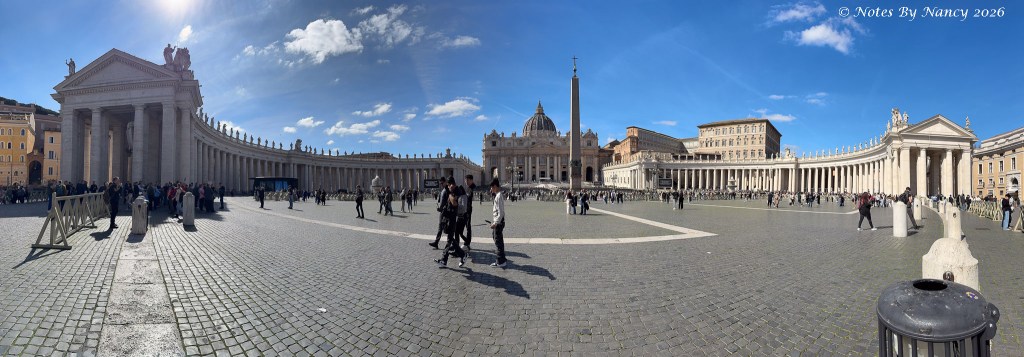
Then, we made our way outside and found ourselves in St. Peter’s Square with the basilica looming.
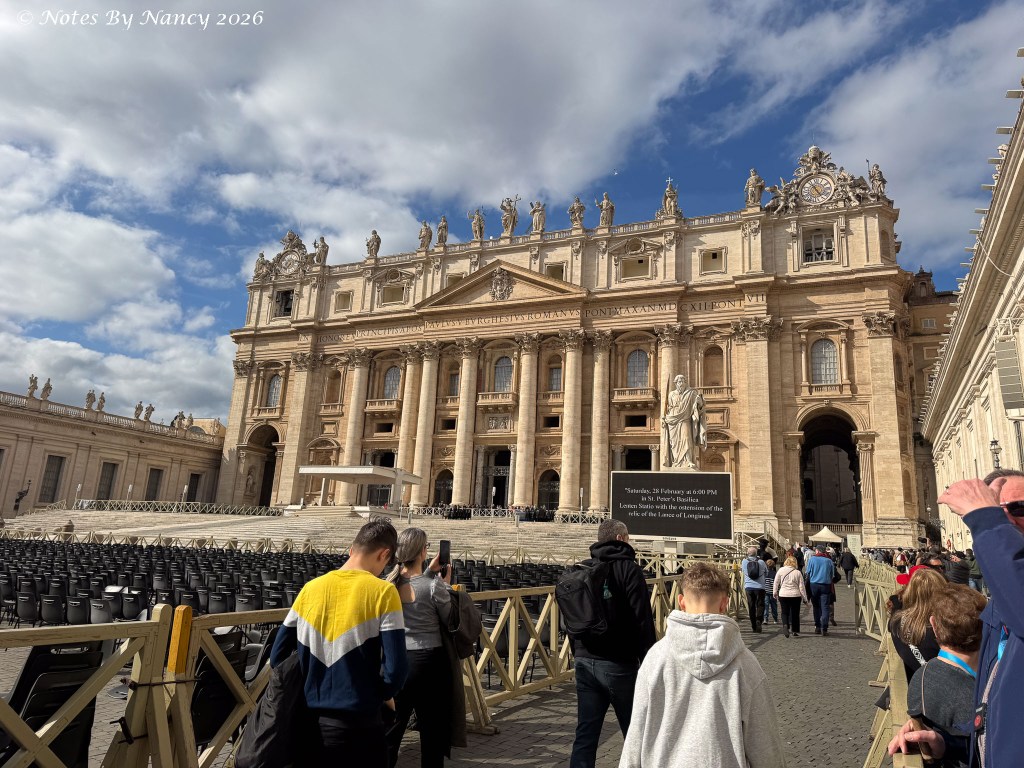
St. Peter’s Basilica
The current 16th Century Renaissance Basilica seen today is built on the site of the earlier basilica constructed in the 4th Century by Emperor Constantine the Great and Pope Sylvester over the tomb of Peter the Apostle. We first descended beneath the basilica into the necropolis and grottoes containing Peter’s tomb as well as graves of over 90 popes, plus some church officials and other notable figures like Queen Christina of Sweden; then we explored the great interior containing so many Renaissance masterpieces.
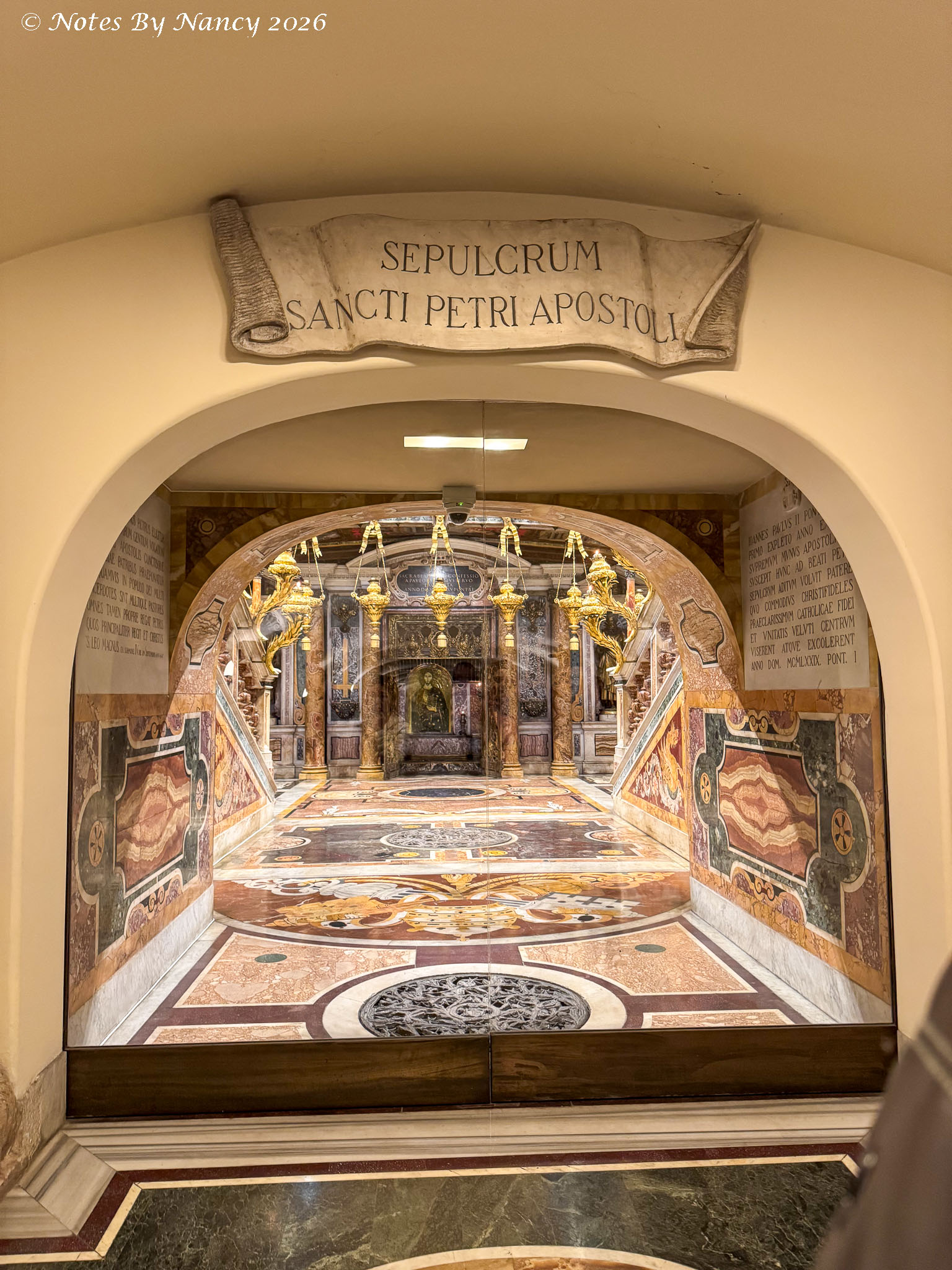
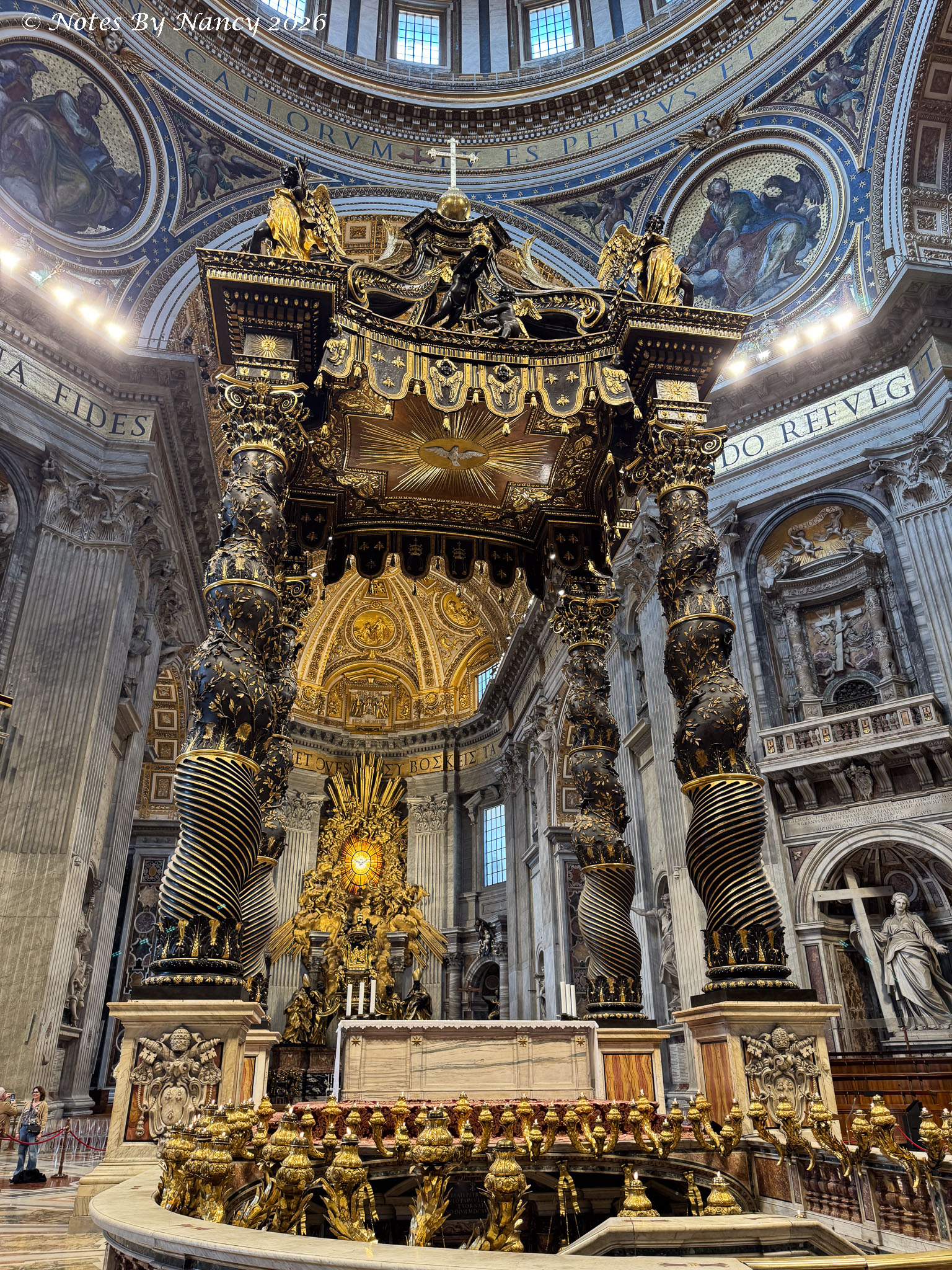
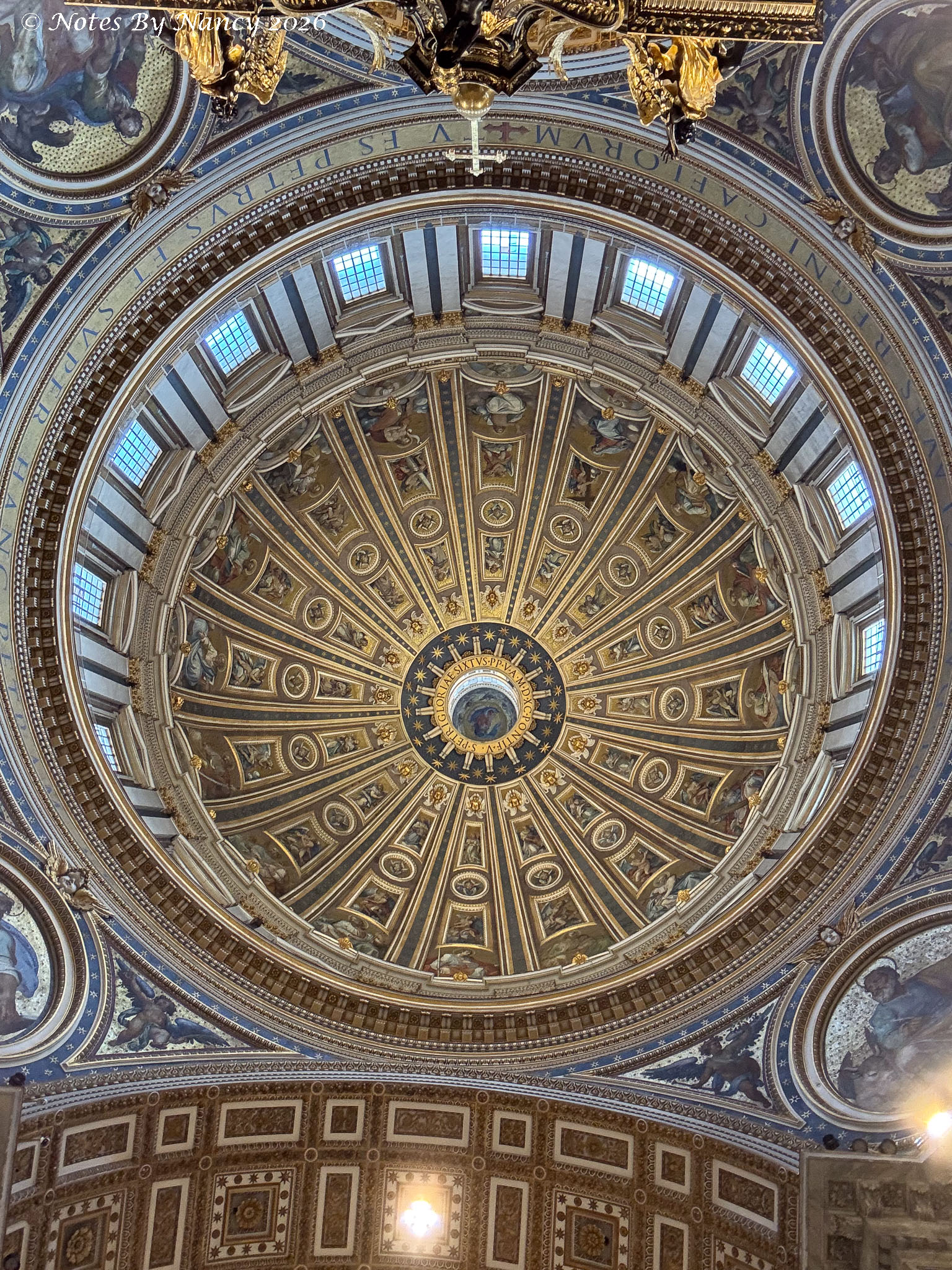
The decorative tomb of St. Peter above which is the nave of the basilica with the main altar “covered by Bernini’s canopy under Michelangelo’s dome”.
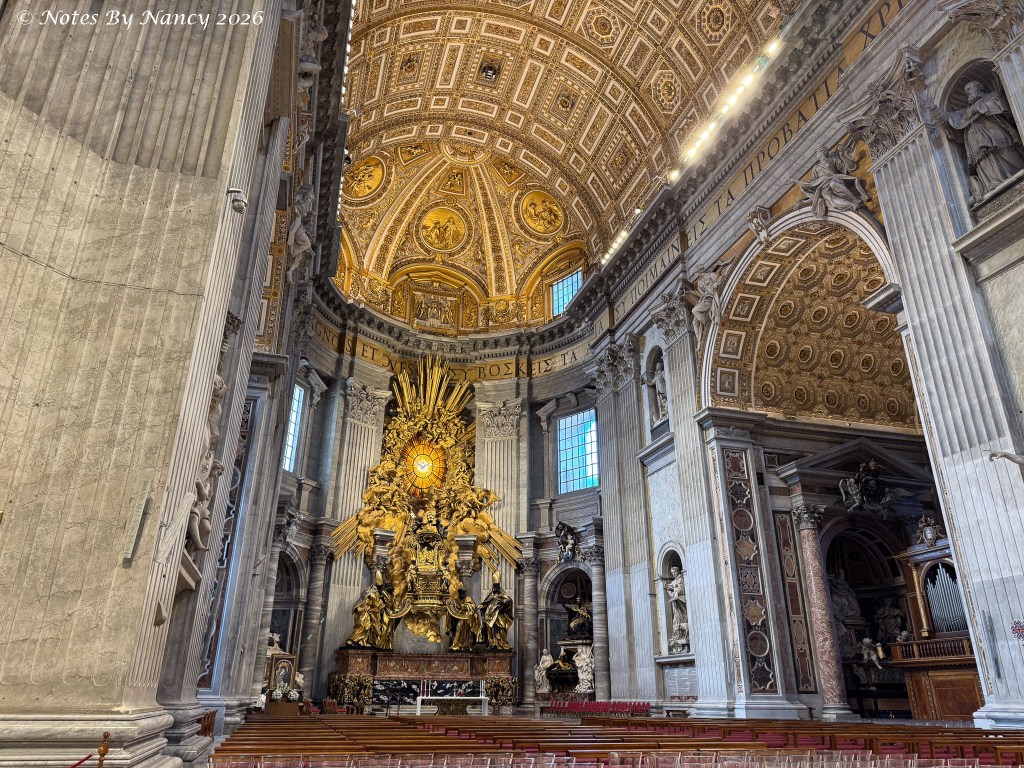
Apse of St. Peter’s Basilica – Chair of St. Peter (gilded bronze sculpture by Bernini surrounds the relic).
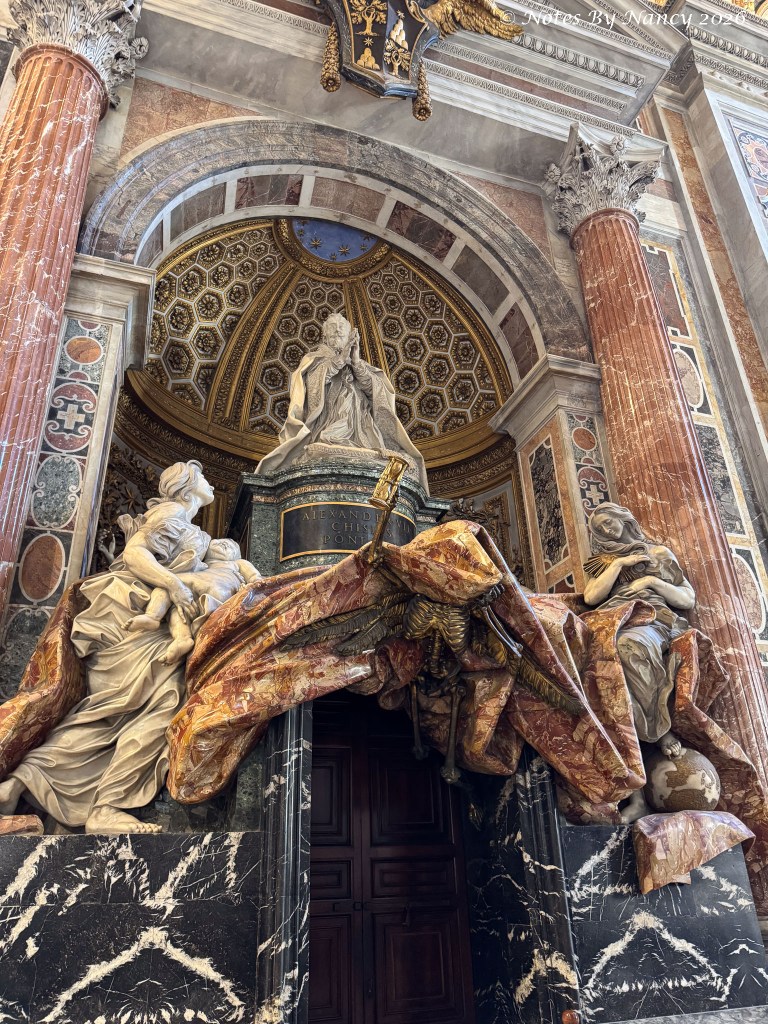
South Transept Doorway – Tomb of Pope Alexander VII (sculpture by Bernini)
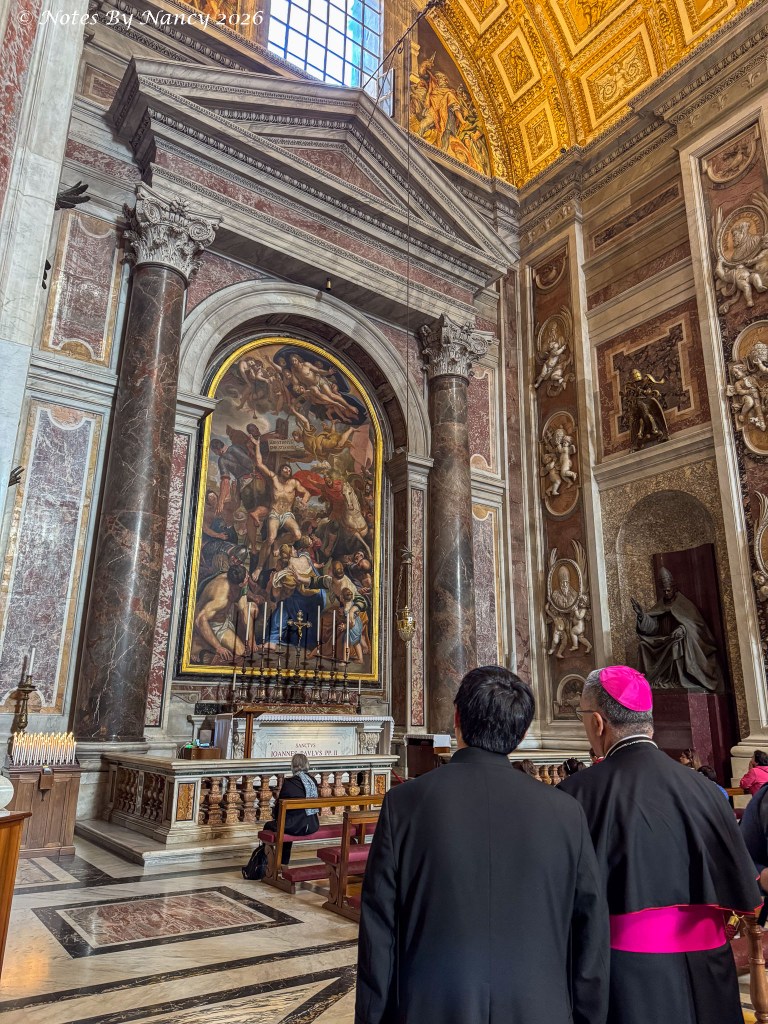
Chapel of St. Sebastian – 1730s mosaic by Pier Paolo Cristofari and the tomb of Pope John Paul II
Michelangelo’s Pietà (behind bulletproof glass)
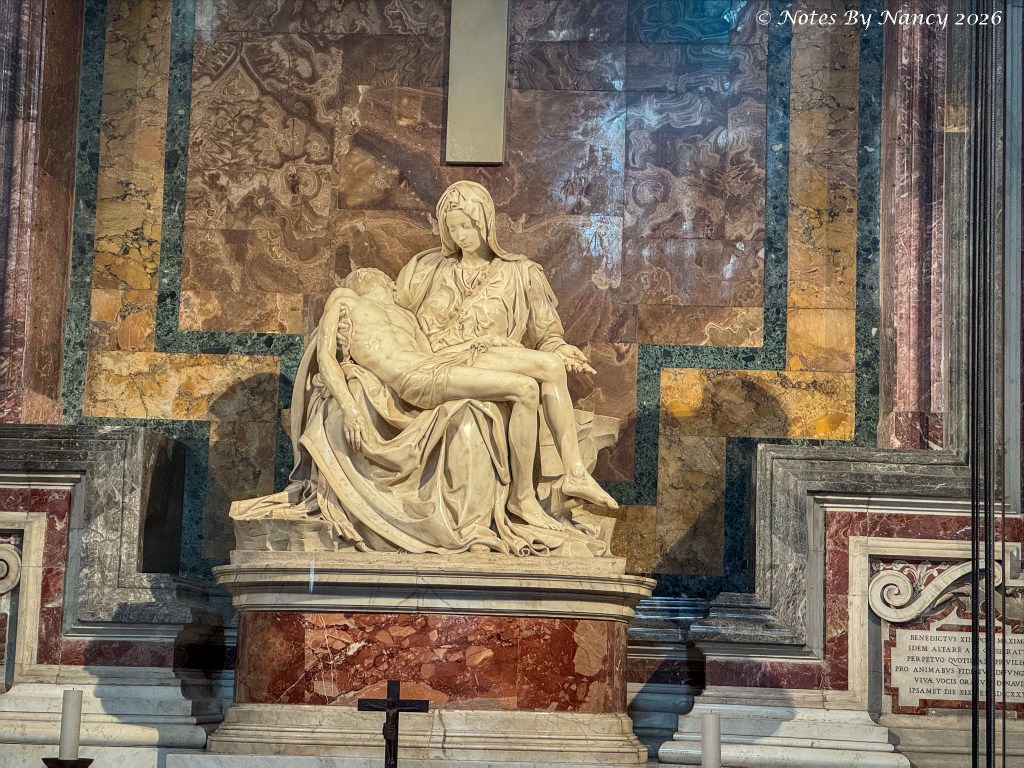
While you cannot experience this early work of Michelangelo (he was 23) up close thanks to an attack by a madman with a hammer in 1972, its magnificence still transmits through the bulletproof, shatter-proof, high transparency glass. When the “father of art history” Giorgio Vasari (1511–1574) saw it, he wrote “Certainly it is a miracle that a stone, ‘from the beginning’ without any form, has ever been reduced to that perfection, which nature with difficulty is able to shape in the flesh”. It is the only work that Michelangelo ever signed (along Mary’s sash) after learning that it was being attributed to someone else.
The lithe and limp body of Jesus is held tenderly by his mother, Mary. To me, her expression is not one of grief or sorrow – it is serene, like she knows this isn’t the end. And, while real-time she may not have known what was coming next – the Resurrection – Michelangelo knew and we know that in Christ’s resurrection from the dead believers have new life and that gives us hope now.
What a God we have! And how fortunate we are to have him, this Father of our Master Jesus! Because Jesus was raised from the dead, we’ve been given a brand-new life and have everything to live for, including a future in heaven—and the future starts now! God is keeping careful watch over us and the future. The Day is coming when you’ll have it all—life healed and whole.
1 Peter 1:3-5 (The Message)
Lunchtime Near the Vatican
Exiting the Basilica into St. Peter’s Square, we waited for both groups to join back together and receive our directions for when and where to meet after lunch on our own.
Dave and I found a quaint trattoria a couple of blocks away. The waiter talked Dave into the mixed seafood daily special – it was interesting! I got a more visually pleasing dish.
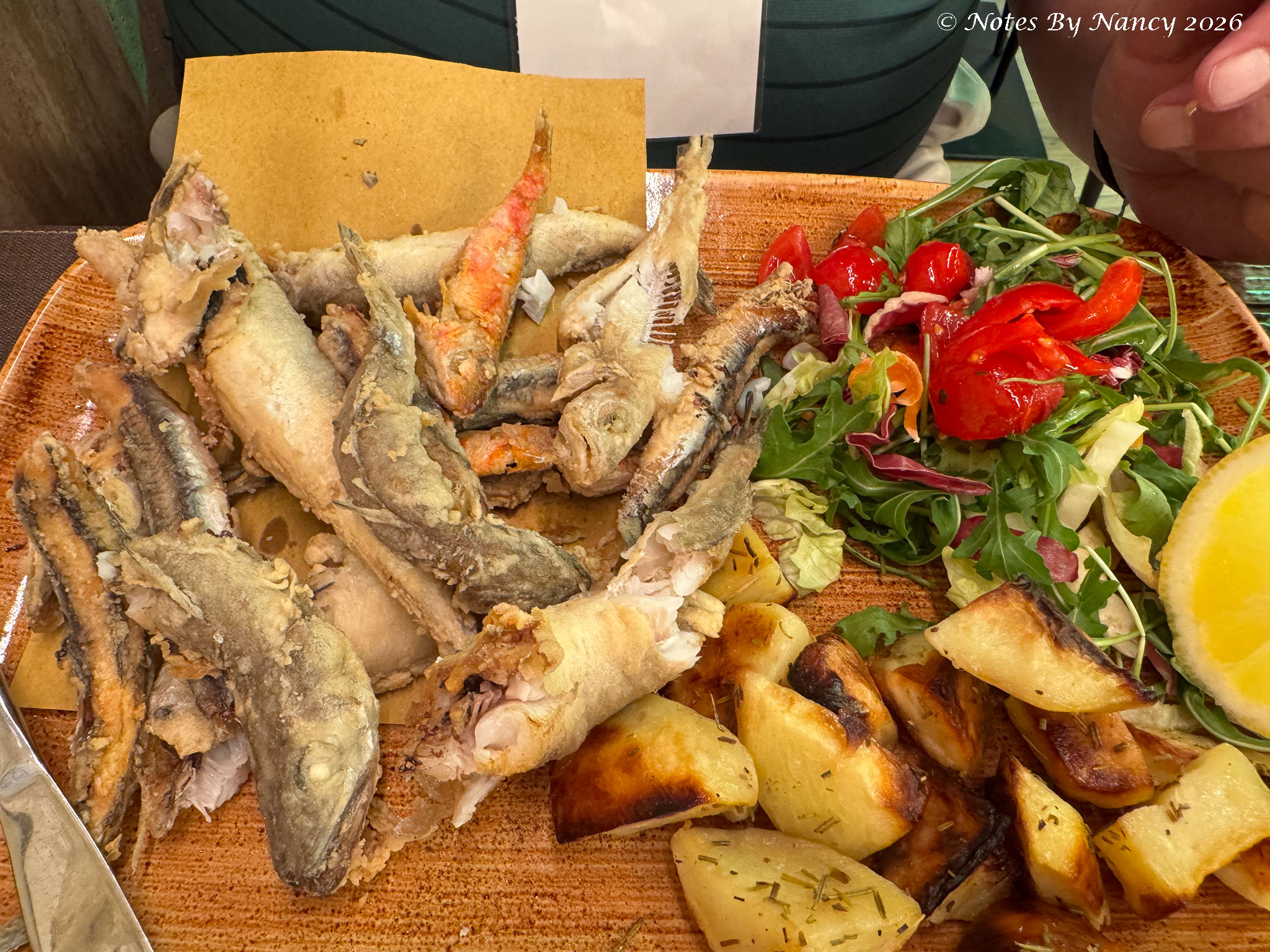
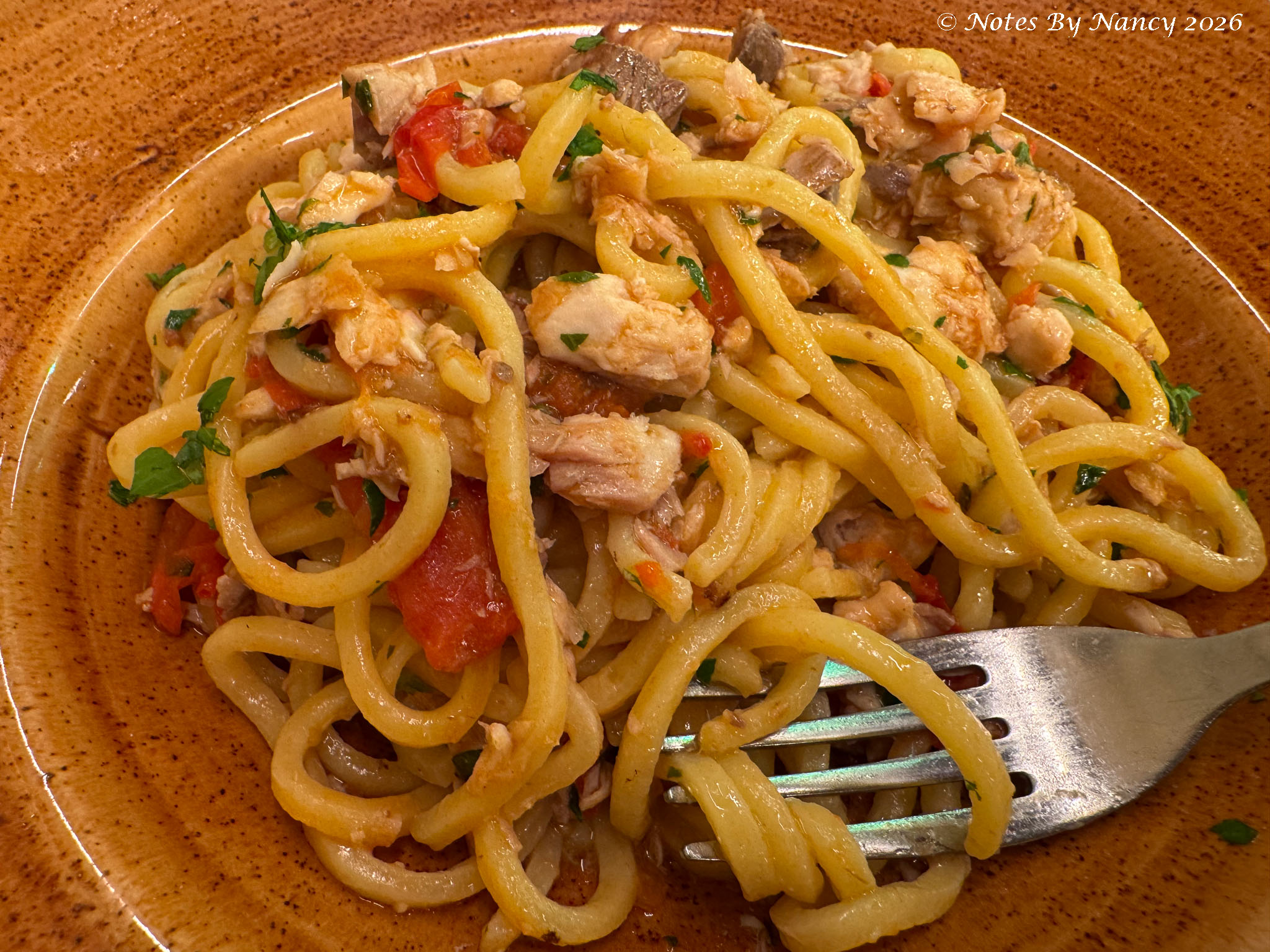
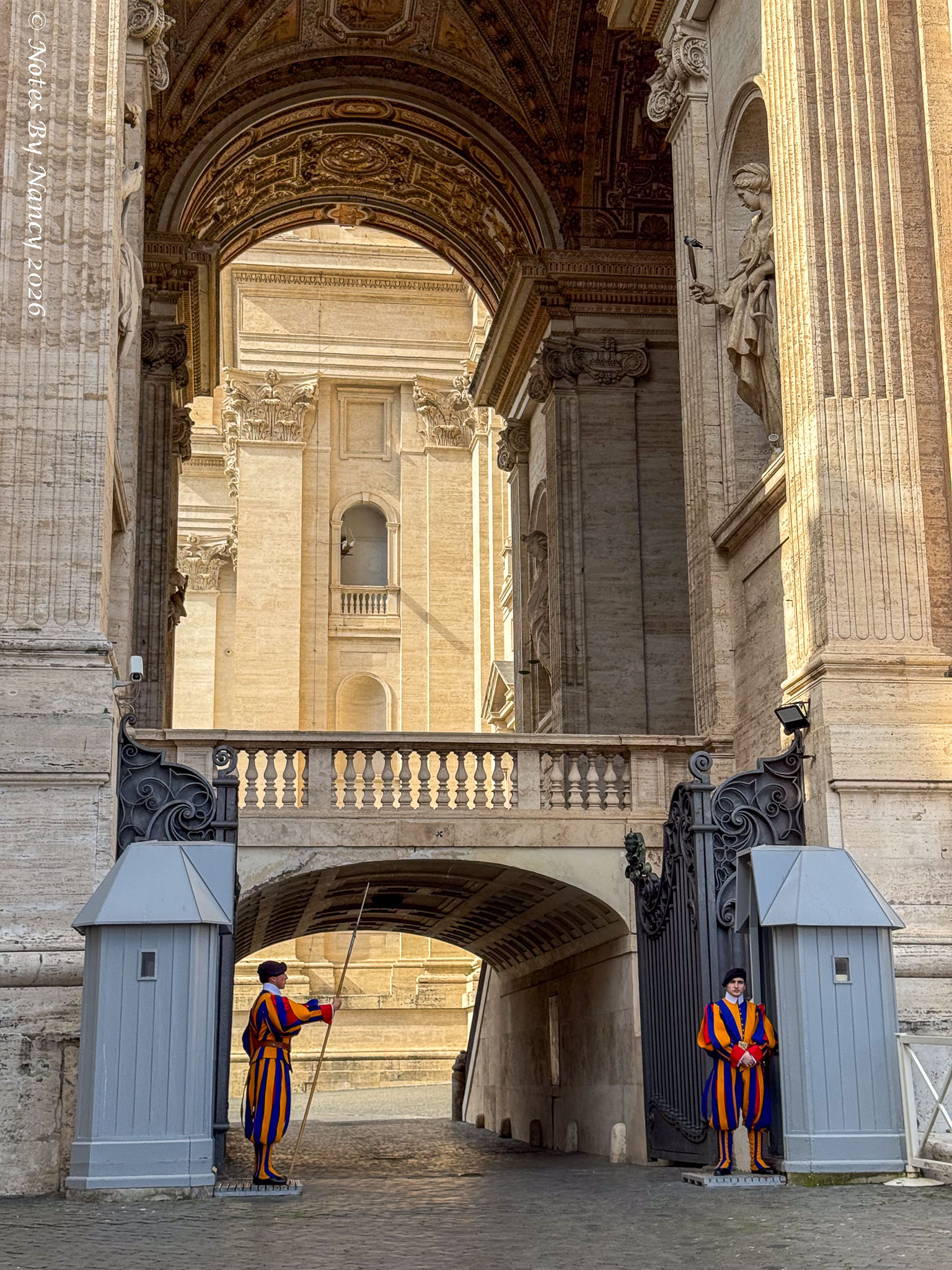
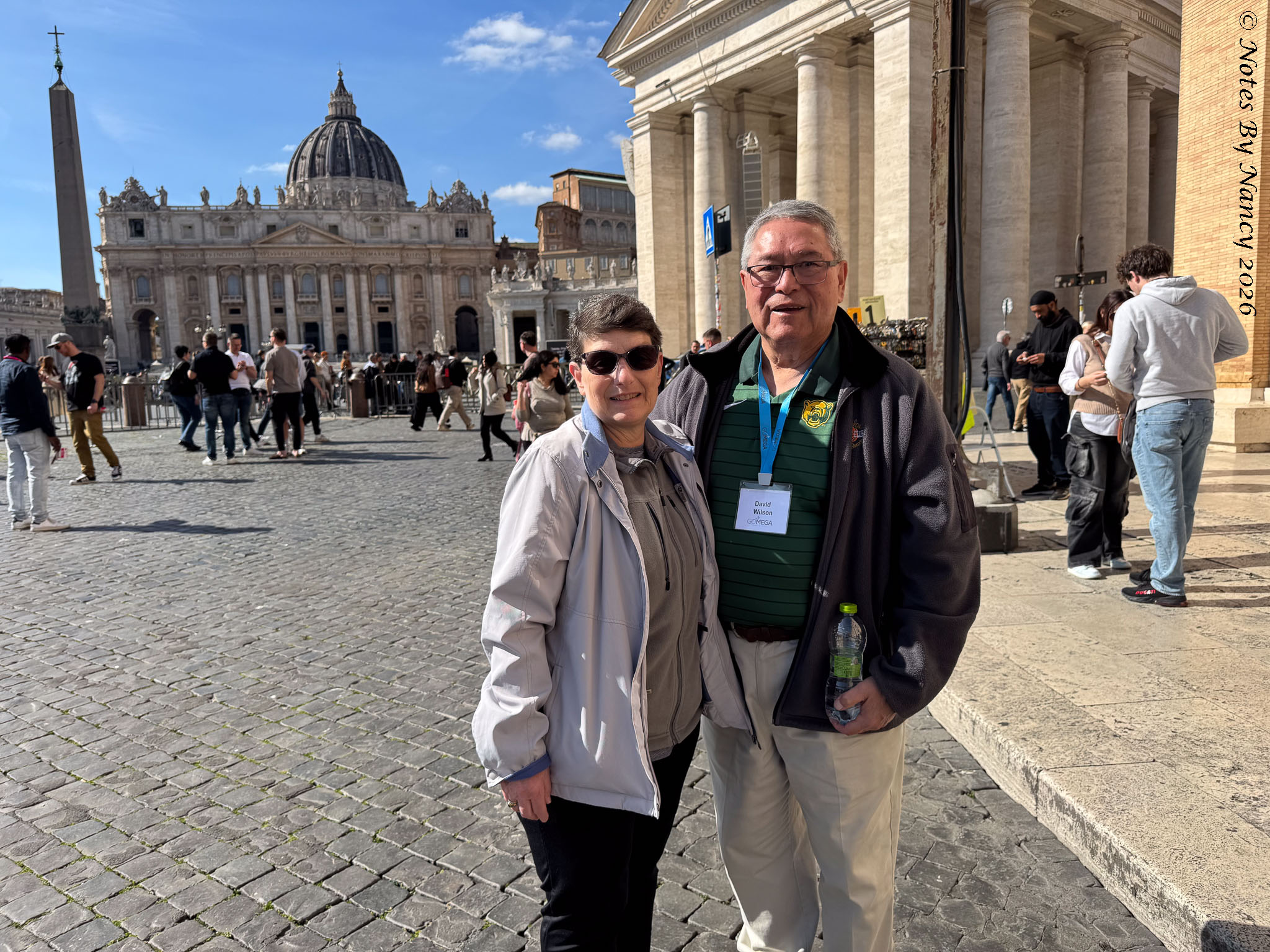
We took a few more pictures around the square before reuniting with everyone to continue our afternoon visiting Imperial Rome.




 Notes By Nancy
Leave a reply to Anonymous Cancel reply