
Disclaimer: I’m sticking with my “Montana Adventure” theme even though 96% of Yellowstone National Park is in Wyoming!
After breakfast in town (West Yellowstone) at the Running Bear Pancake House, we joined the 4-lane line to enter through the park’s west entrance. By the last day, we figured out the rightmost lane was fastest for us since we had a Senior Lifetime pass and that lane was for all types of passes (no payments).
Our destination was the Old Faithful area, a 50 to 60-minute drive from the entrance, to experience Yellowstone’s most famous feature and explore the south Upper Geyser Basin, then as much of the north Upper Geyser Basin as we could.
Upper Geyser Basin – Old Faithful
We arrived around 9:30, parked, and made our way through Old Faithful Lodge to the bathrooms before heading out to the Old Faithful Observation Deck.
I highly encourage using the National Park Service app available for both iPhone and Android which covers over 400 NPS units. The map function works using GPS, so typically it is best as you drive through the park to know what features, parking areas, restrooms, etc. are coming up next as you drive. It has many other features from self-guided tours to geyser predictions in Yellowstone. There is also an app called GeyserTimes which covers more features than the NPS app.

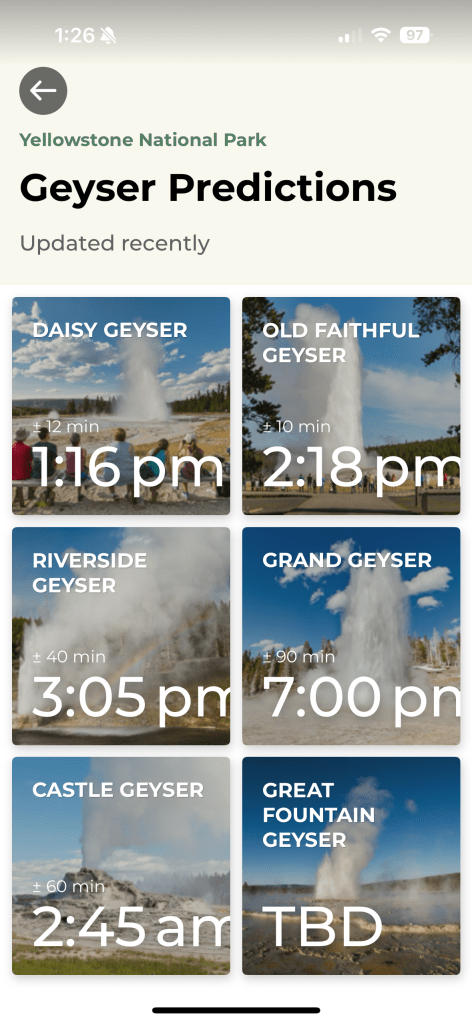
I used these apps to see when the next eruption would be for Old Faithful – it’s roughly every 1 ½ hours.
This is an example from the NPS app which tracks the 6 geysers shown here.
The app said we were entering the “window” for Old Faithful’s next eruption, so we found a bench on which to wait and admire the lone bison resting nearby, then rolling around.
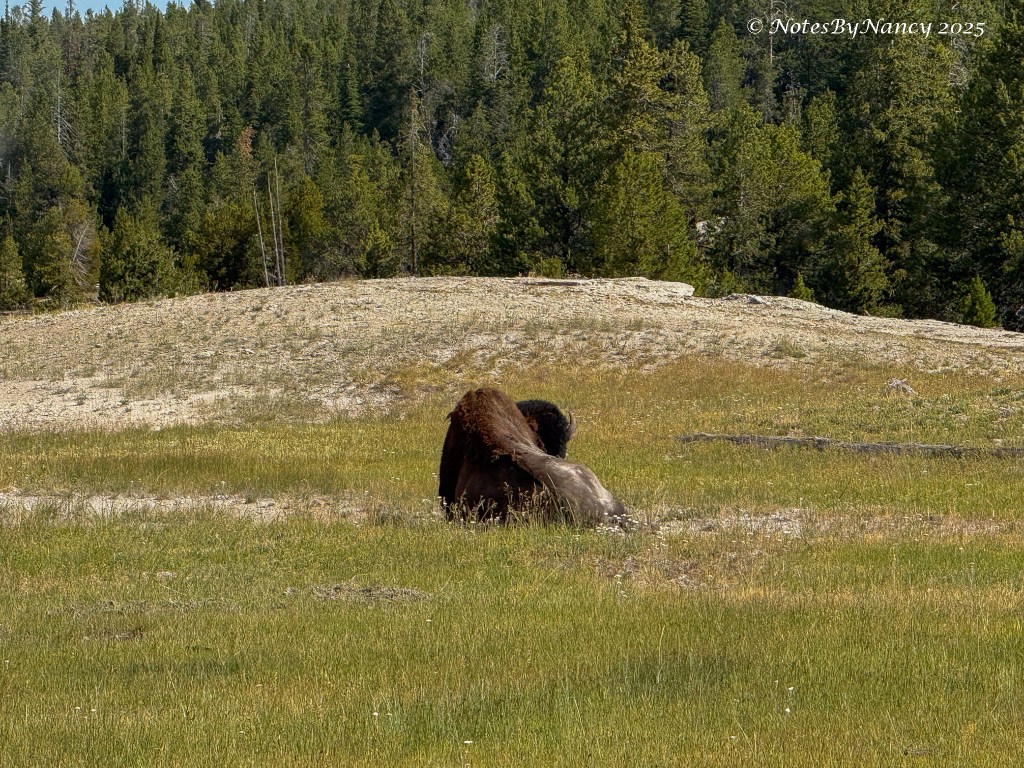
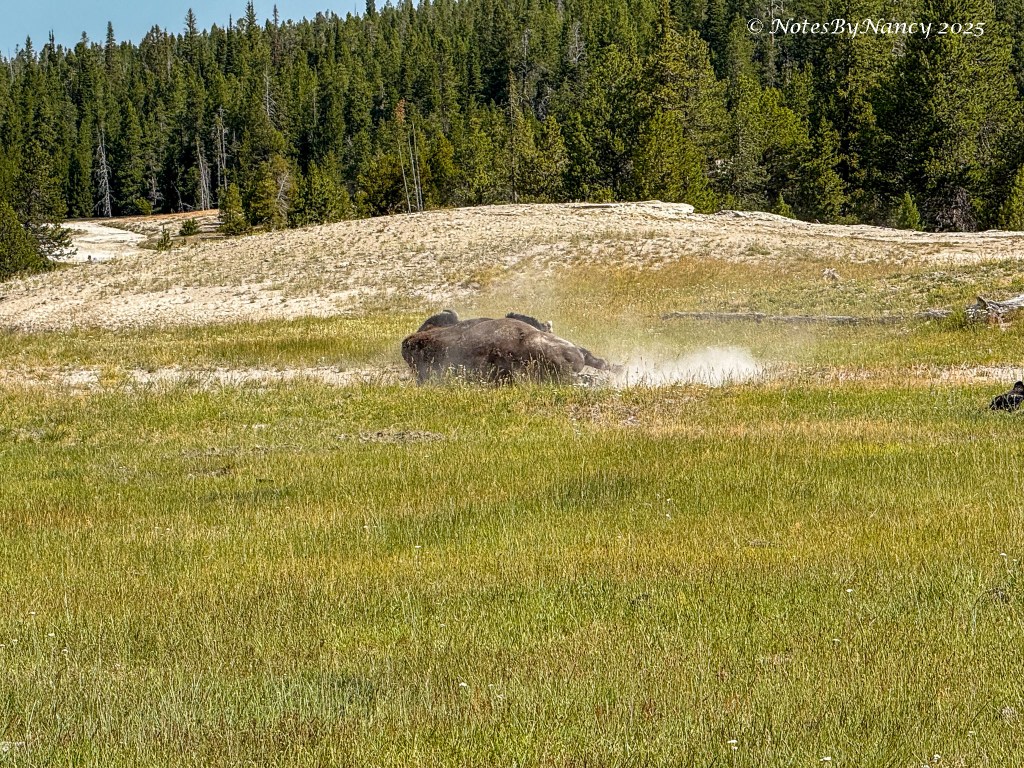
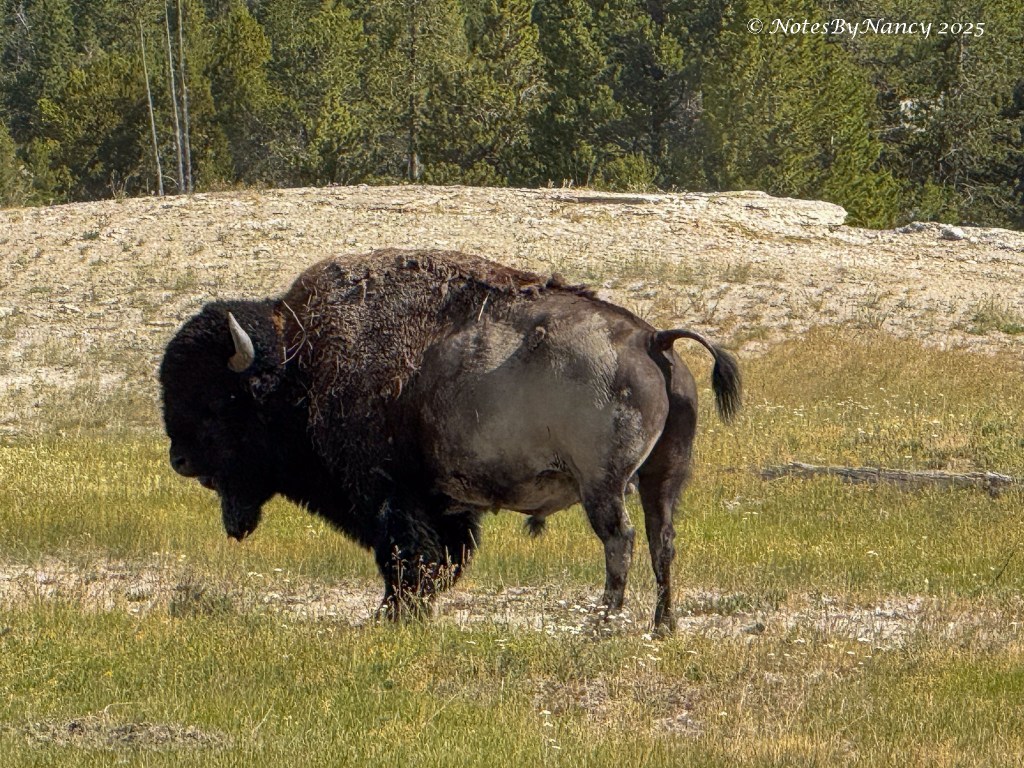
When he stood up, we wondered if that was a signal the geyser was about to start. Not long afterward we started seeing an increase in steam and water started to gurgle. The bison was nonchalantly grazing and moving even closer to the geyser!
And there she goes!
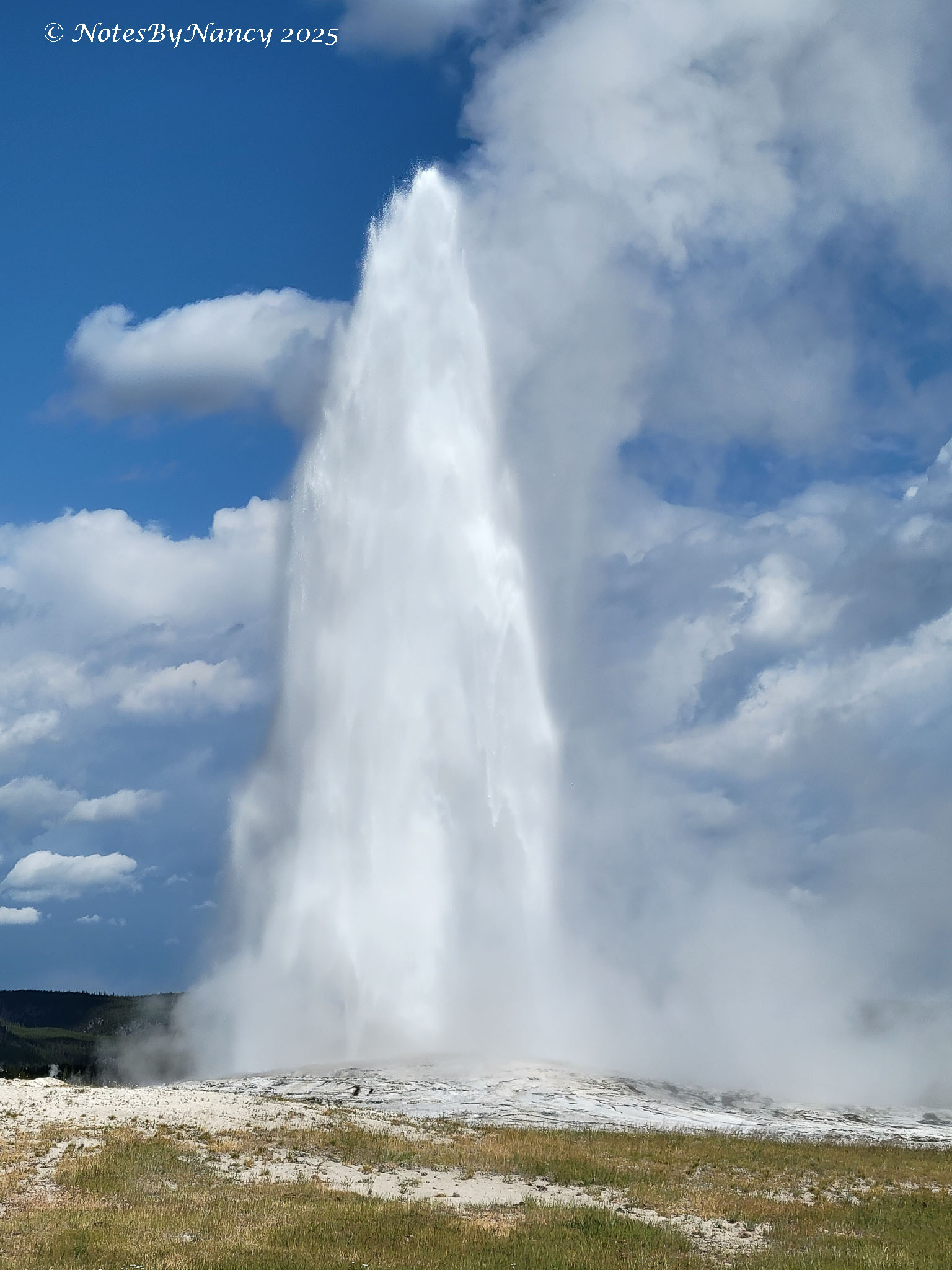
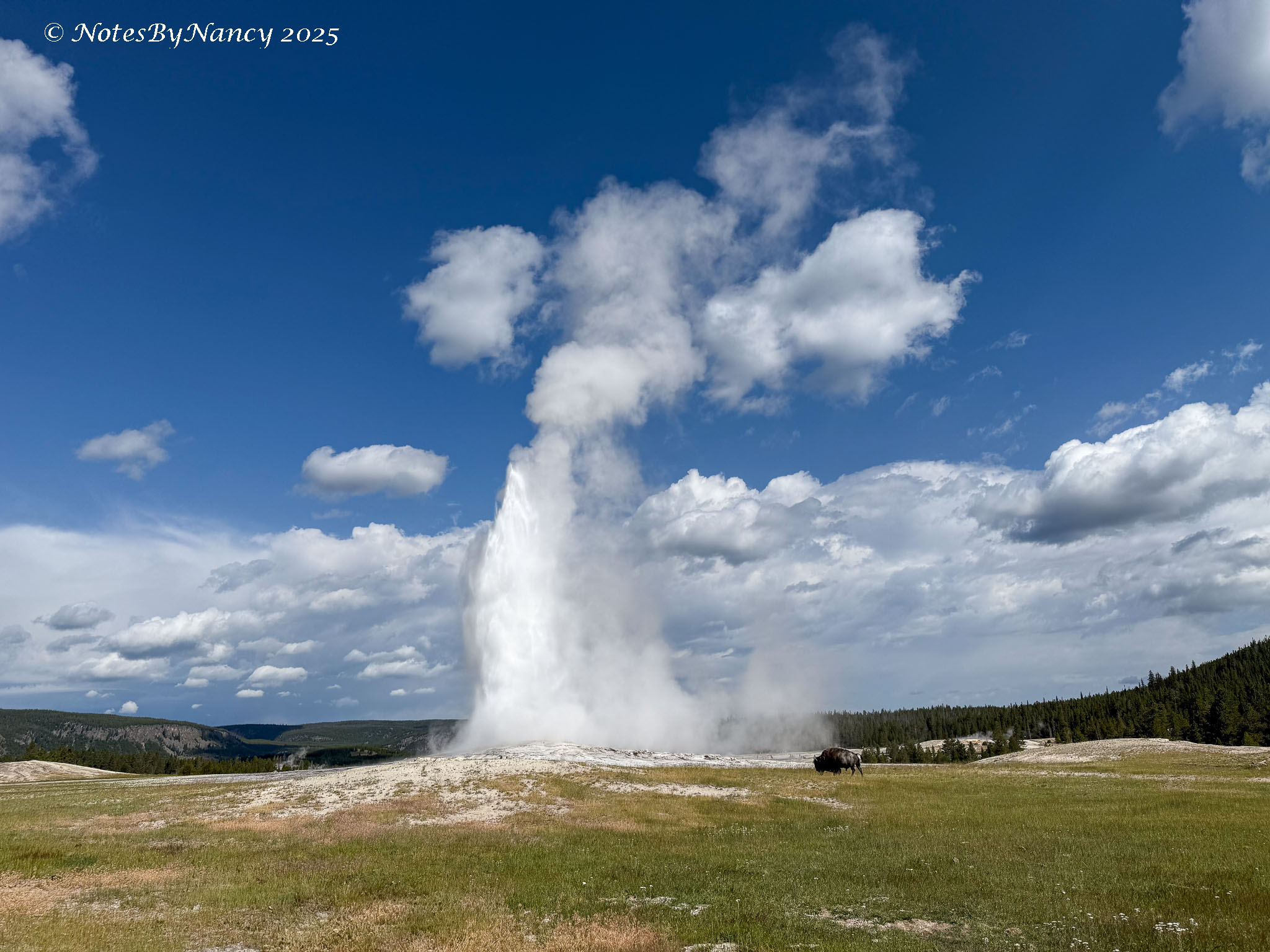
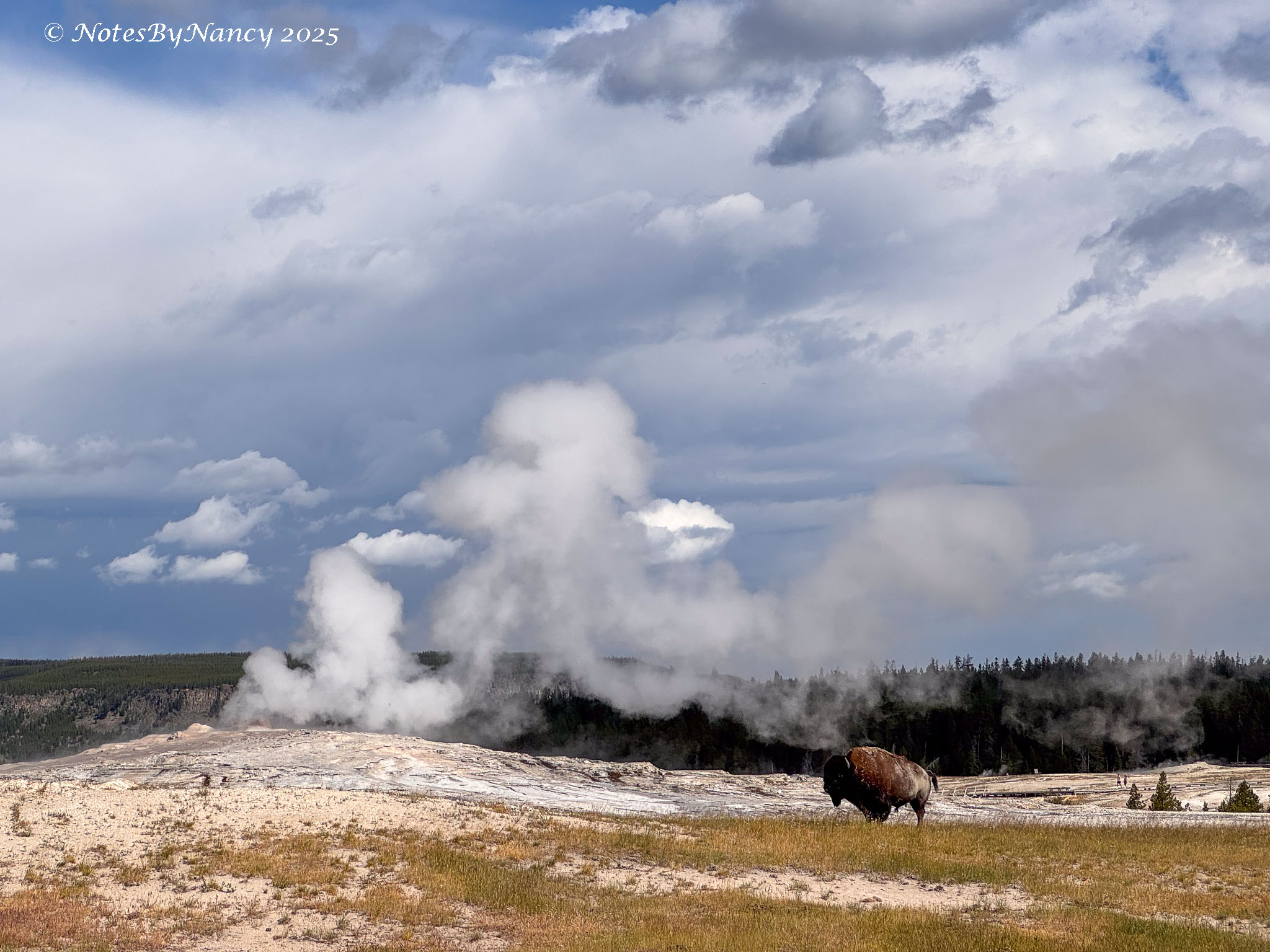
Approximately 3 ½ minutes later, everything calmed back down to build up for the next eruption in 90 minutes or so! Here’s the link to my video of the event.
Upper Geyser Basin Trail – Nearby to Old Faithful
Our plan was then to walk the Upper Geyser Basin Trail and see as many other geothermal features as possible.

Yellowstone National Park – Upper Geyser Basin – Blue Star Spring 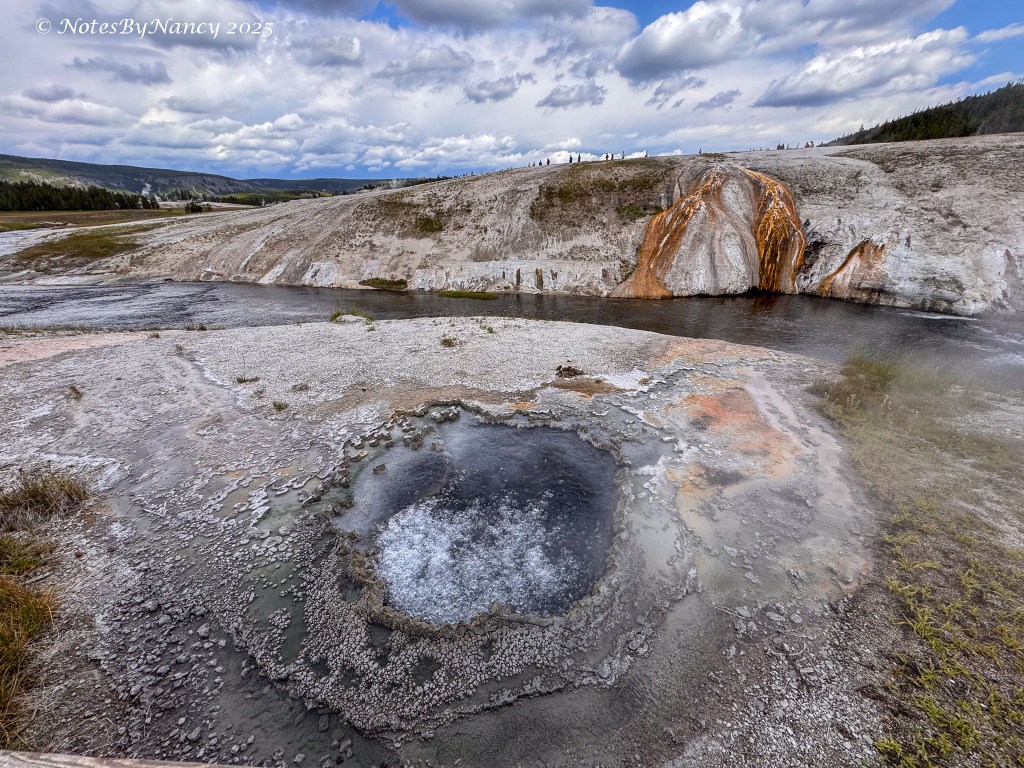
Yellowstone National Park – Upper Geyser Basin – Unnamed spring near Chinese Spring 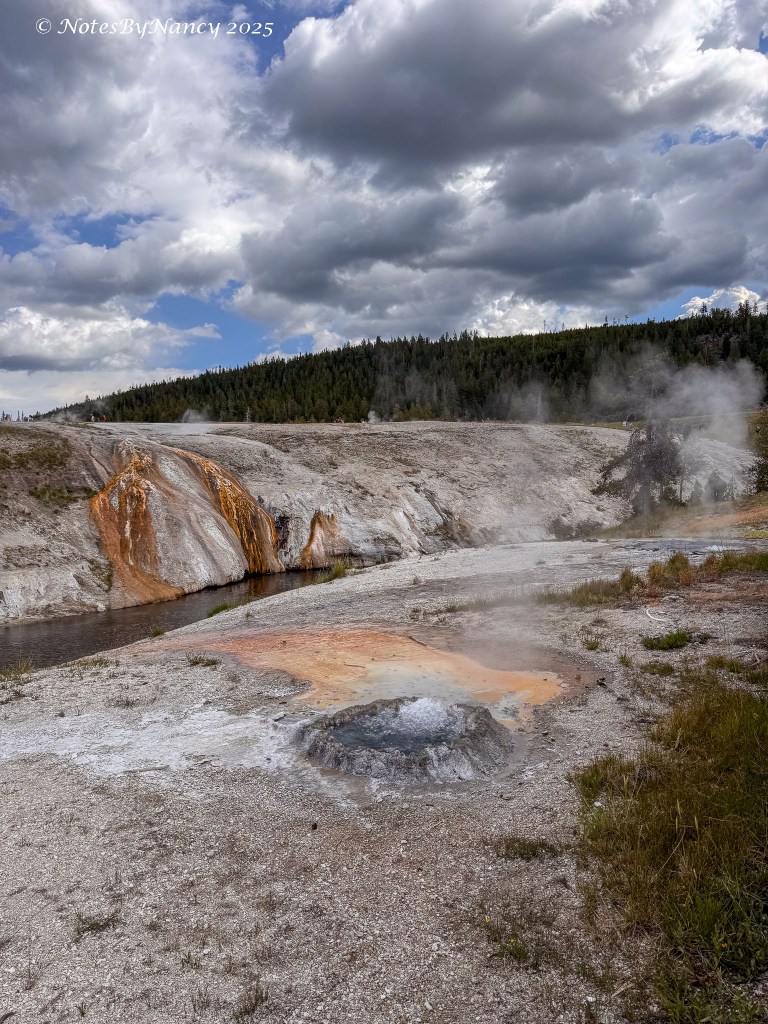
Yellowstone National Park – Upper Geyser Basin – Chinese Spring 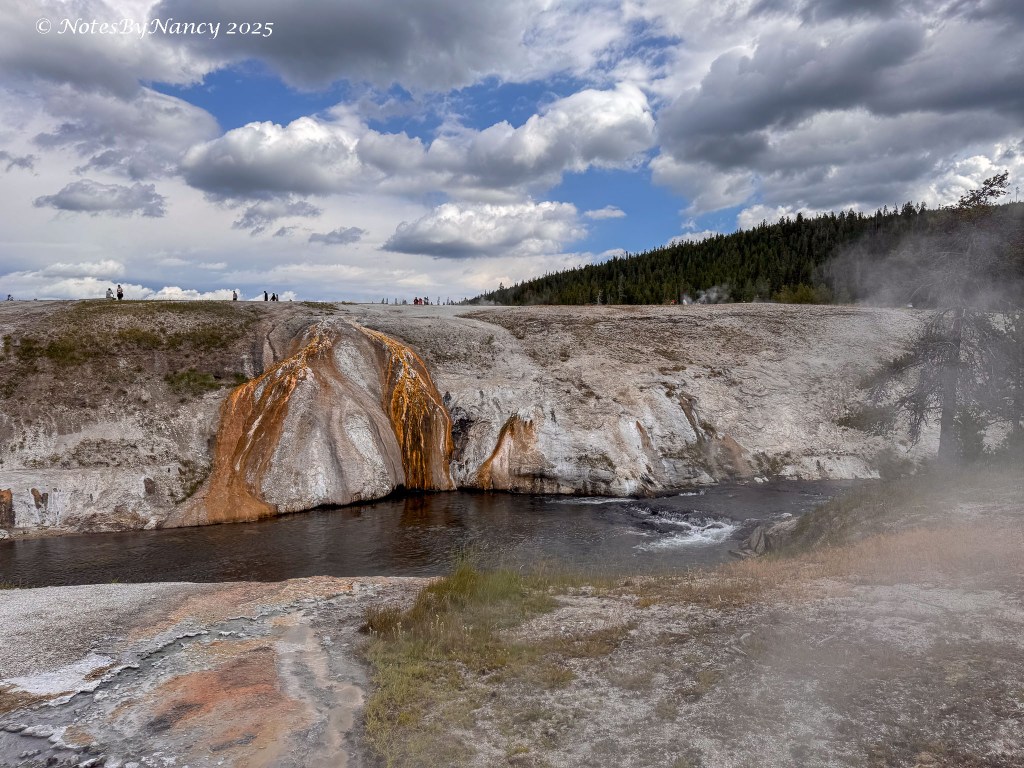
Yellowstone National Park – Upper Geyser Basin – Cascade Geyser across the Firehole River 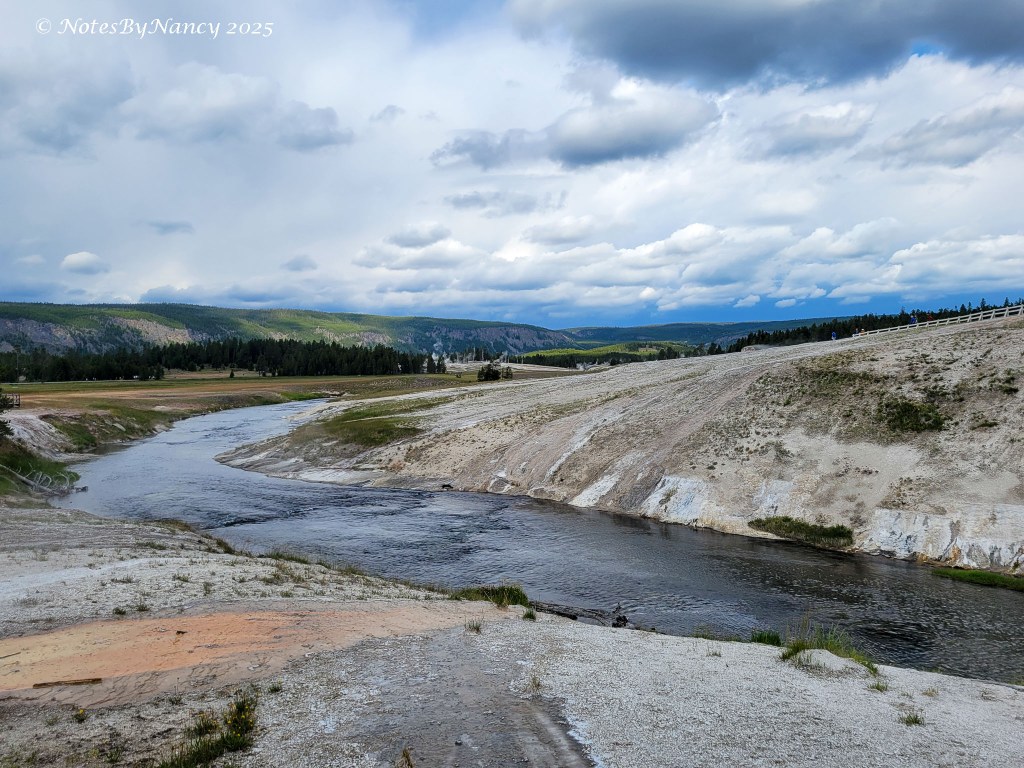
Yellowstone National Park – Upper Geyser Basin – Firehole River
As we turned back towards Old Faithful Inn and approached where the boardwalk joined the bike path to continue further on the Upper Geyser Basin Trail, the approaching dark clouds were getting more ominous. We decided to head back to the Old Faithful Lodge (to be closer to the car) and check the radar to decide whether to wait it out or try our luck elsewhere. A big clap of thunder had me picking up the pace to get inside!

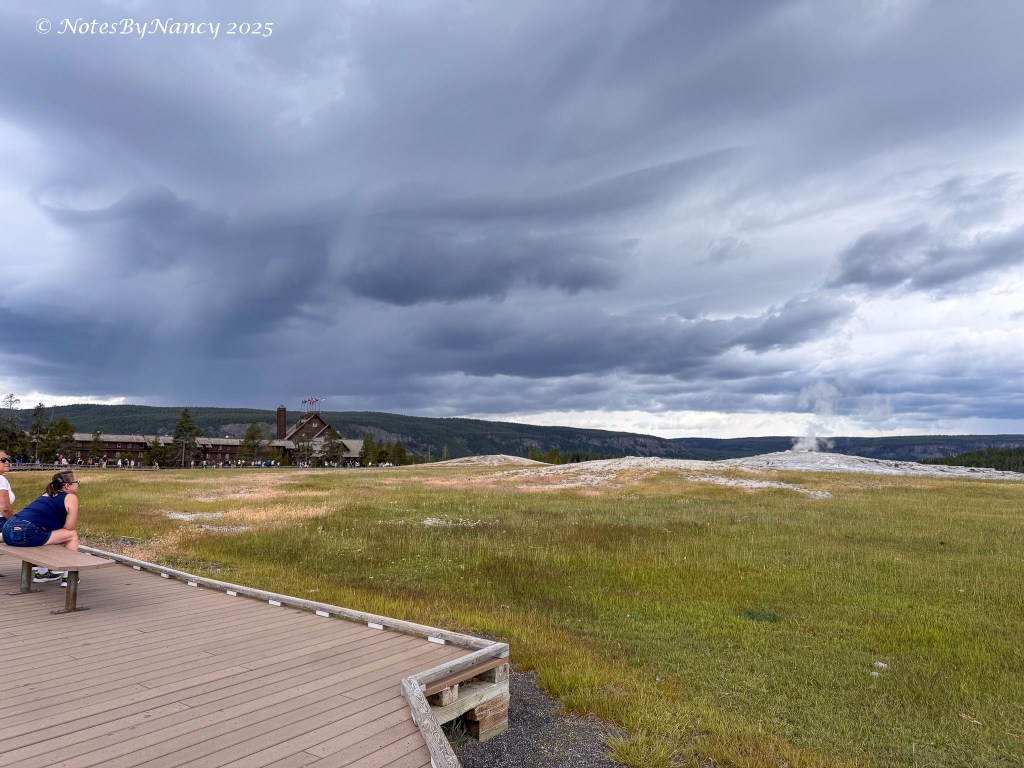
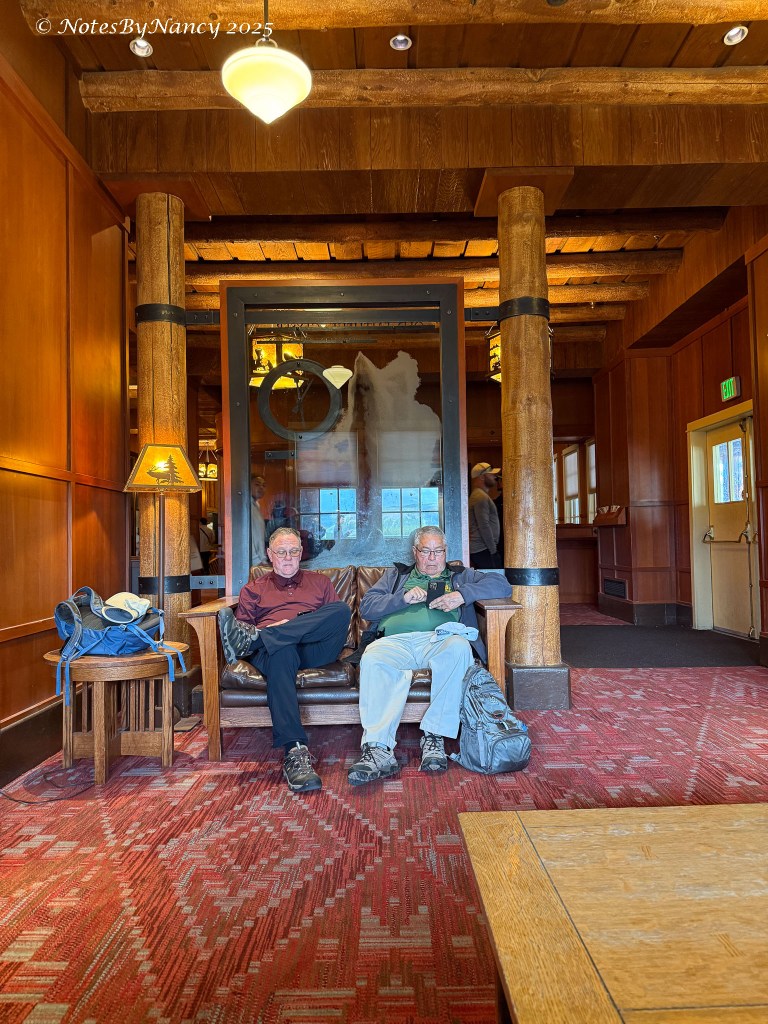
The radar indicated that the storm was likely to pass in 30-45 minutes, so we hung out at the Lodge.
Keith was probably reading the news and Dave refreshing the radar on the weather app!
When the lightning left the area, we headed over to the Visitor Education Center to review the exhibits explaining all the geothermal features, animals, and geology of the park. It is very well done with lots of hands-on exhibits – good for kids and adults! My favorite was the pH level exhibit which showed common items at various pH levels from 0-14 (most acidic = 0, most alkaline – 14) and a matching feature in the park in that same level. For example, pH 7 is “neutral” like pure water, Mud Volcano at pH 2 is acidic, comparable to lemon juice or vinegar, and Old Faithful is pH 9, similar to baking soda on the alkaline side.
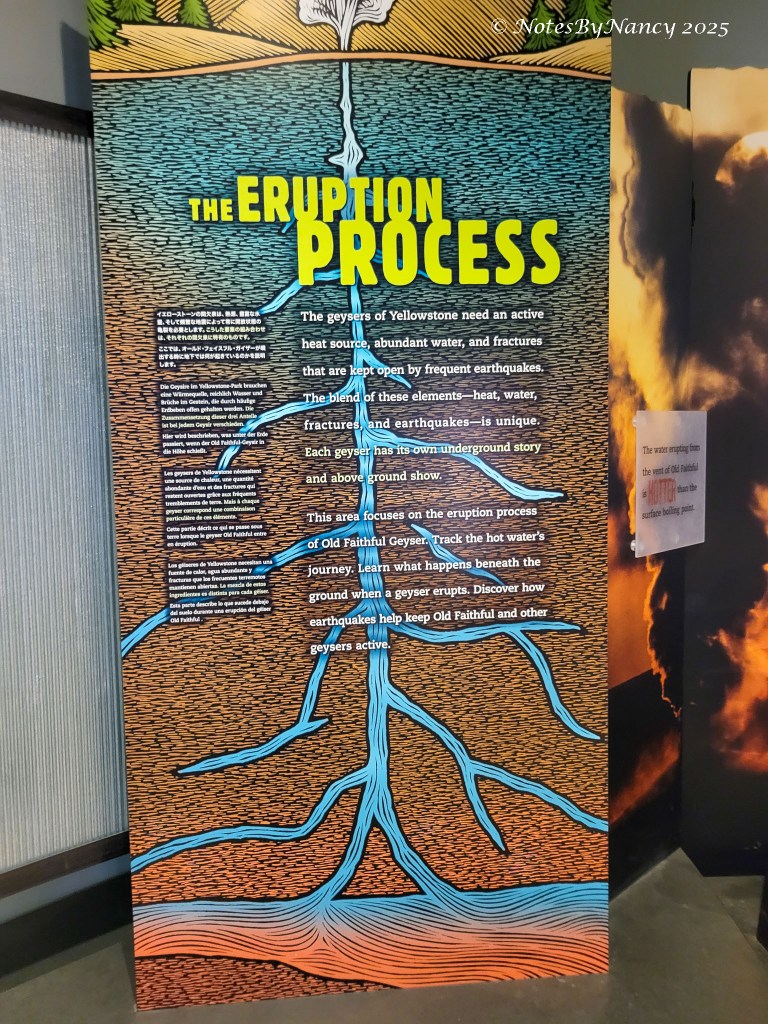
Of course, the best-known features are the geysers, and this display described how they work.
Upper Geyser Basin Trail – Castle Geyser
Leaving the Visitor Center, we decided to walk the bike path part of the Upper Geyser Basin Trail towards Castle Geyser, then to Grand Geyser and hopefully get as far as the Morning Glory pool.
We stopped first at Castle Geyser, which kept giving appearances of nearing a major eruption and according to the sign and the apps, it was also in its “window”.
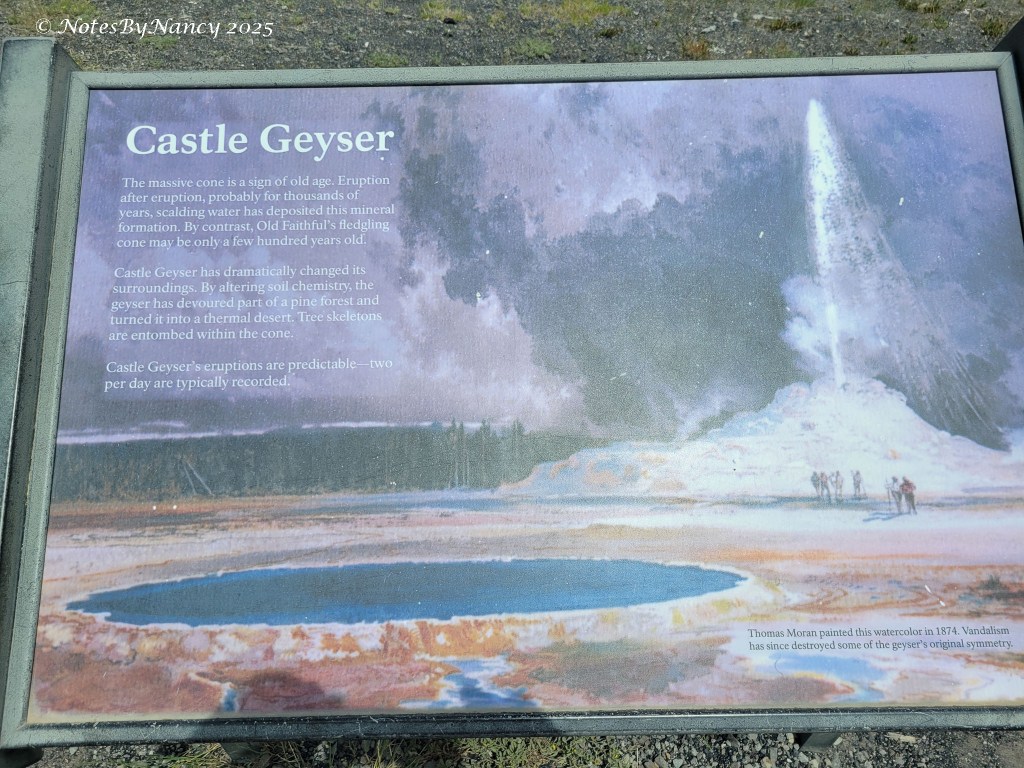
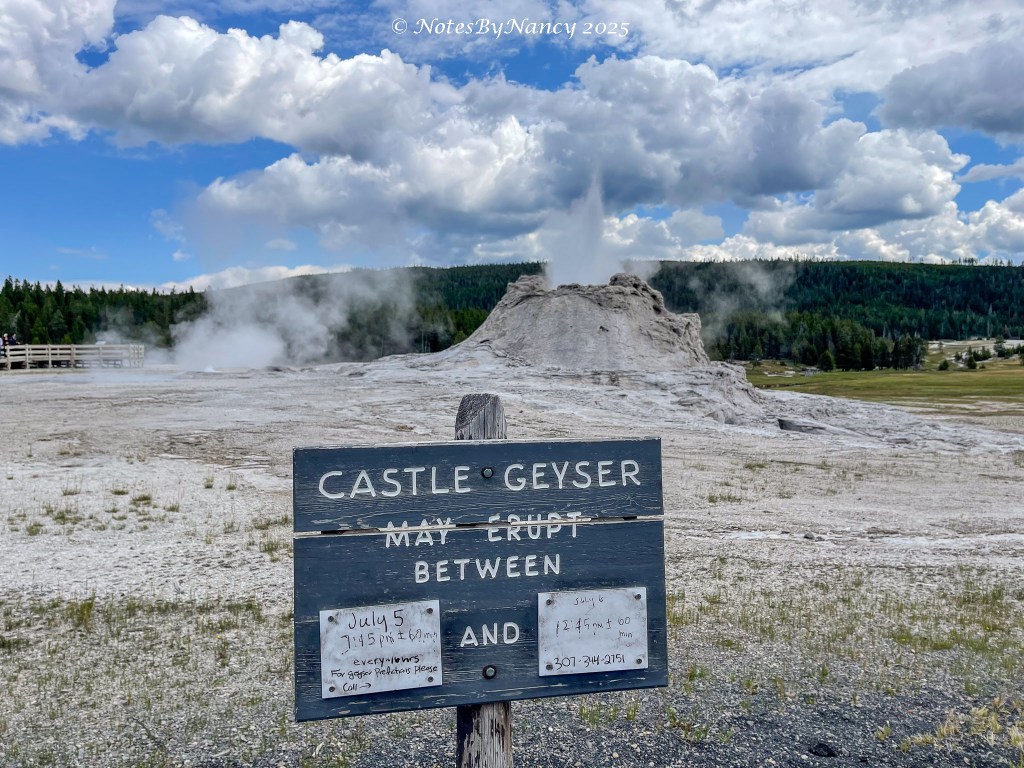
We sat and watched it for a while but only caught a minor eruption as major eruptions will reach a height of 70-100 feet. You can see Turquoise Shell Spring bubbling to the left of Castle Geyser.
Not knowing more about Castle Geyser’s eruption pattern, we moved on as we still had a mile to go to reach Morning Glory Pool. We could see other geysers erupting and many springs along the path.

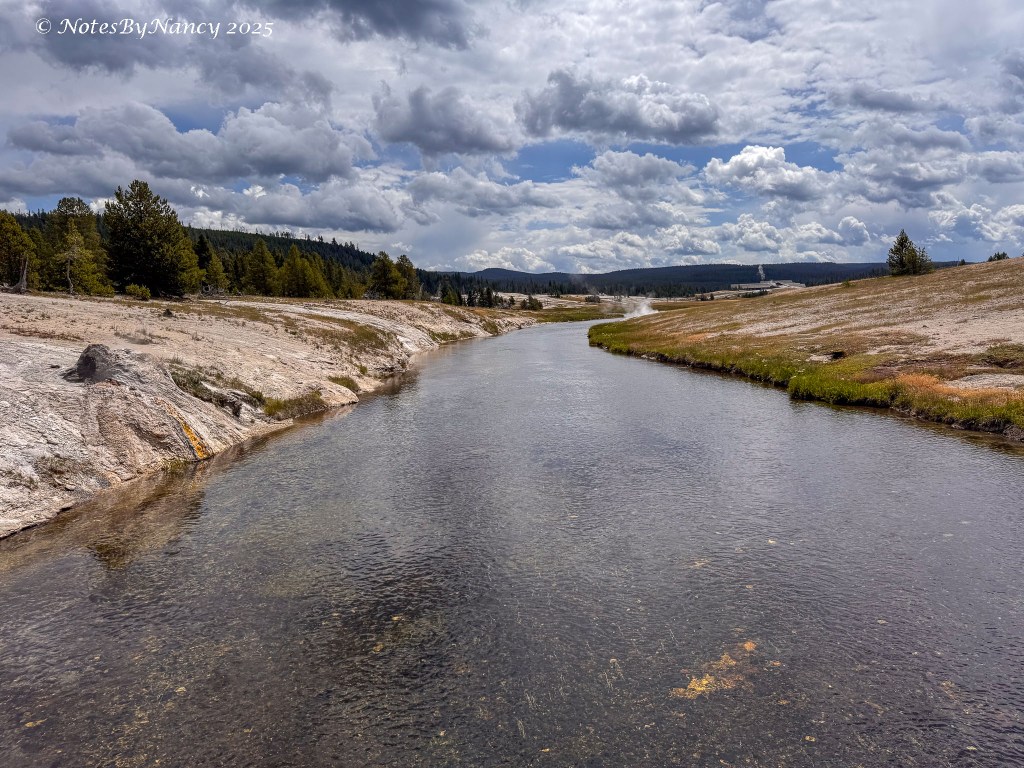
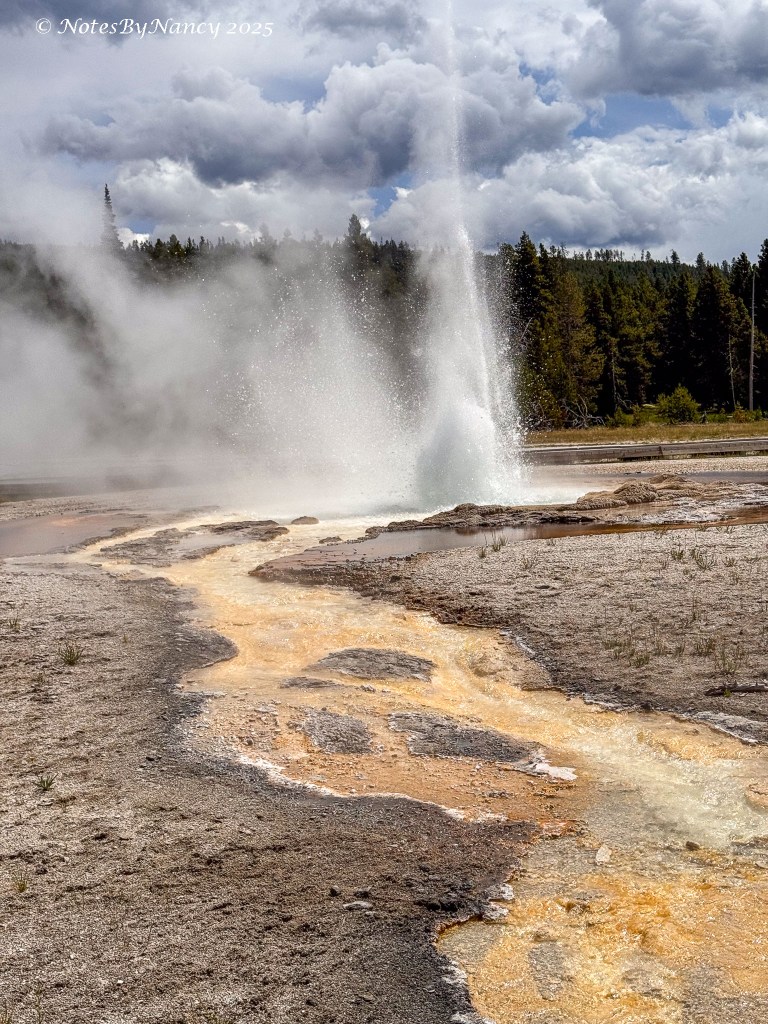
We saw Spasmodic Geyser, but didn’t get close enough for video which is needed to really capture its essence as you might guess from the name. It reminded me of a little kid jumping up and down and yelling “look at me! look at me!” trying to get your attention away from the grander geysers!
Which brings us to…
Upper Geyser Basin – Grand Geyser Group
As we approached Grand Geyser, we spotted a barrier just past the viewing area. The rest of the trail was currently off-limits as sections of the boardwalk needed to be repaired. And this is not a place you want to go off-trail walking as the ground could give away any second to a hidden thermal pool or spring.
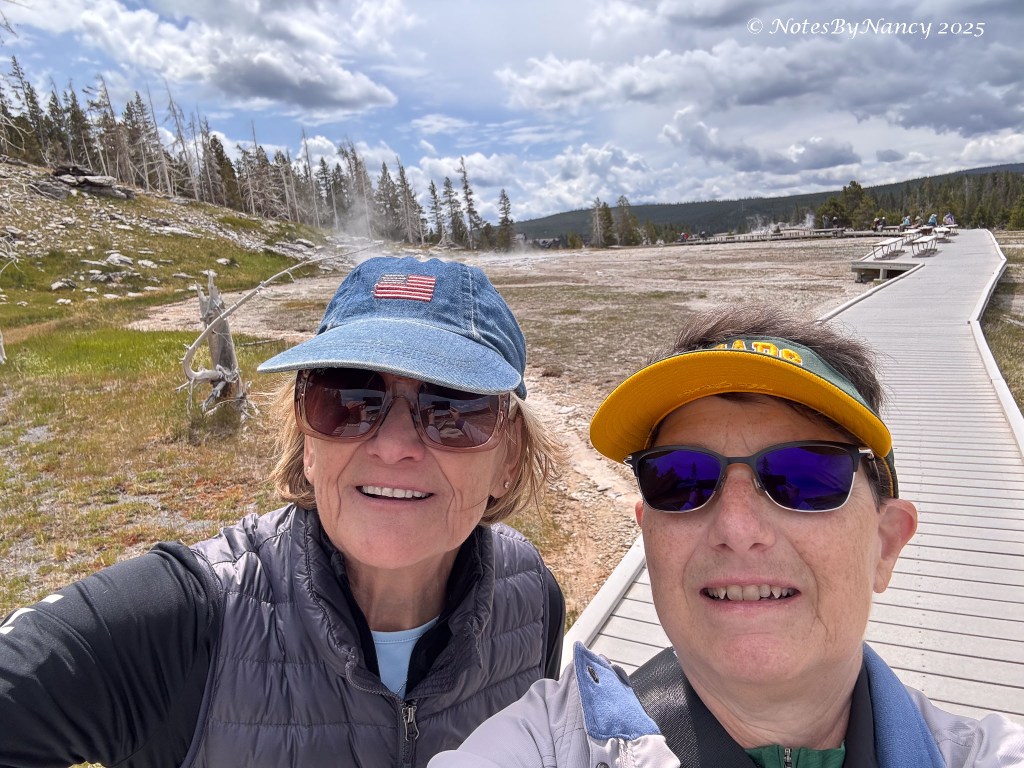
Paula and I walked to the barrier and took a selfie with the Grand Geyser group behind us.
Then we went back to wait for Grand Geyser as the app (and the sign by it) said it was in its window for an eruption. Whereas the times listed for Old Faithful are plus/minus 10 minutes; the times for Grand are plus/minus 90 minutes! But, since our walk to see other features further on was prevented, we had nothing better to do than sit and wait to see the tallest predictable geyser in the world!
From the NPS website:
Grand Geyser, the tallest predictable geyser in the world, erupts with powerful bursts, reaching between 150-200 feet (45-61 m) high. Its interval ranges from 6 to 15 hours, although recently, it has averaged 7-8 hours. Eruptions last between 9-12 minutes. About 50 percent of the time, the geyser will stop erupting after 8 or 9 minutes and then resume activity after a brief pause. Grand frequently has between two to four bursts and often the subsequent bursts are taller than the first.
Grand Geyser is connected to many hydrothermal features, most noticeably Vent and Turban Geysers. Vent and Turban usually erupt nearly in sync with the start of a Grand eruption and continue to erupt for about an hour after Grand finishes.
Vent Geyser will not erupt again until the next time Grand erupts. Between Grand Geyser’s eruptions, Turban Geyser erupts about every 20 minutes. These are small eruptions that are about five minutes in length.
Grand’s pool empties after an eruption, slowly refilling over the next few hours. After about five hours, the water in Grand’s pool noticeably rises and falls in 20-minute cycles that correspond to the eruptions of Turban Geyser. Grand Geyser will usually erupt just prior to or within a minute of a Turban eruption.
As we waited, we ate the sandwiches we’d brought with us as it was lunchtime.
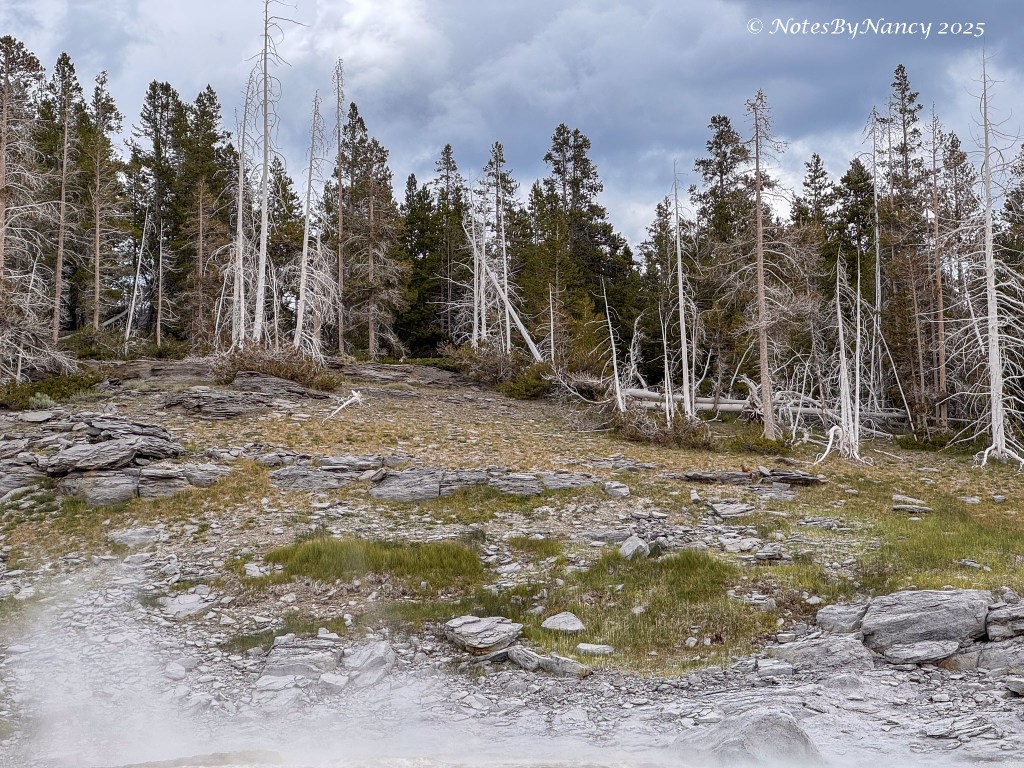
Some marmots on the hillside behind the geyser entertained us and we marveled at them living in an area clearly inhospitable to the trees (turned white from the geyser spray). There is a marmot on the dark gray rocks just below the tree line on the right.
There was a couple sitting nearby and the woman kept making notes in a journal and noting the time in relation to the small eruptions we kept seeing from Turban Geyser. She came over and asked if we knew what to look for. Since we hadn’t read the above information about how Turban, Vent, and Grand Geysers are linked, we said no, but we expected a show! She gave a very detailed explanation of how the three features connect and the usual timings and order of things. After learning about that, we really did expect a show and appreciated the build-up that Turban provided every 20 minutes lending to the anticipation for the GRAND eruption.
The woman is one of the “geyser watchers” who record the data that feeds into the apps predicting the geyser eruption times. She said she’d been coming to the park for the past 22 summers. After almost 1 ½ hours of watching Grand’s pool rise and fall, it suddenly didn’t fall, and the show really began! The eruption lasted almost 9 minutes and it really was worth the wait as all three features were erupting.

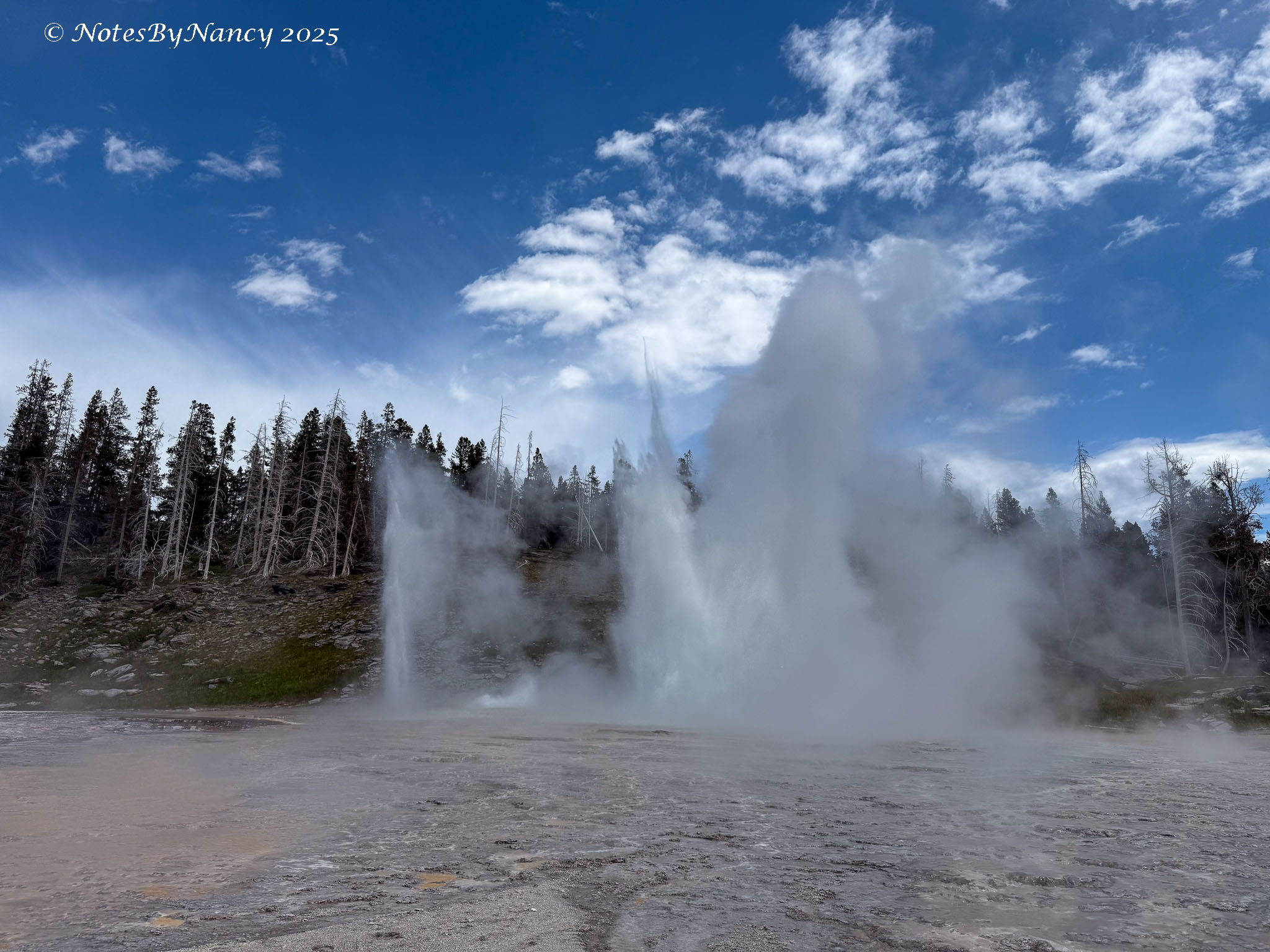
If you have the time, here is my video!
Once the show was over, everyone had to return the same direction down the boardwalk.
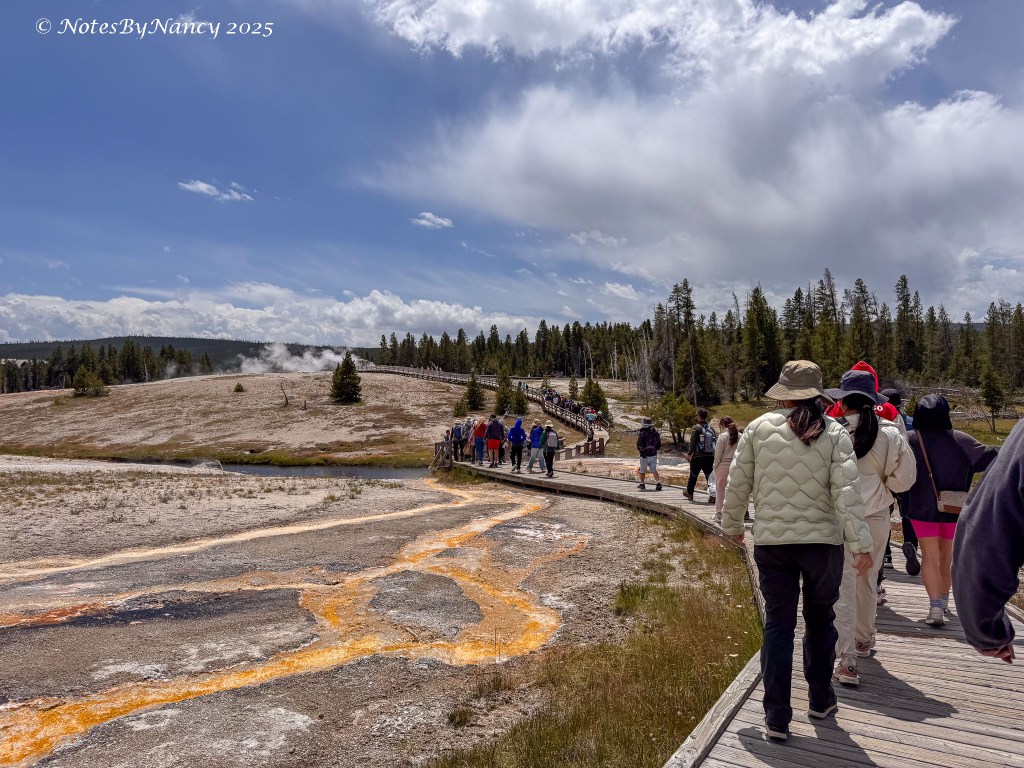
It was a little bit crowded!
Time to move on to our next destination – Midway Basin with its famous Grand Prismatic Spring. However, as we approached that area, we could see that it was a madhouse with vehicles lining the road outside the parking lot and rangers moving people along. So, we decided to keep going and hoped that Firehole Lake Drive was open in the Lower Geyser Basin…but it was closed, so no repeat of watching Great Fountain Geyser which Dave and I saw on our prior trip. I couldn’t find any updates on why it was closed, perhaps an unstable feature like the one in Biscuit Basin that exploded last year (and erupted again a couple of days before we were there. There is now a webcam posted to capture events since this area is closed).
Lower Geyser Basin – Fountain Paint Pots
Thankfully, Fountain Paint Pots, near the exit of Firehole Lake Drive, was less crowded than Midway Basin and we quickly found a parking spot. There is a ½-mile boardwalk around the features here, so it doesn’t take much time.

Yellowstone National Park – Lower Geyser Basin – Fountain Paint Pots 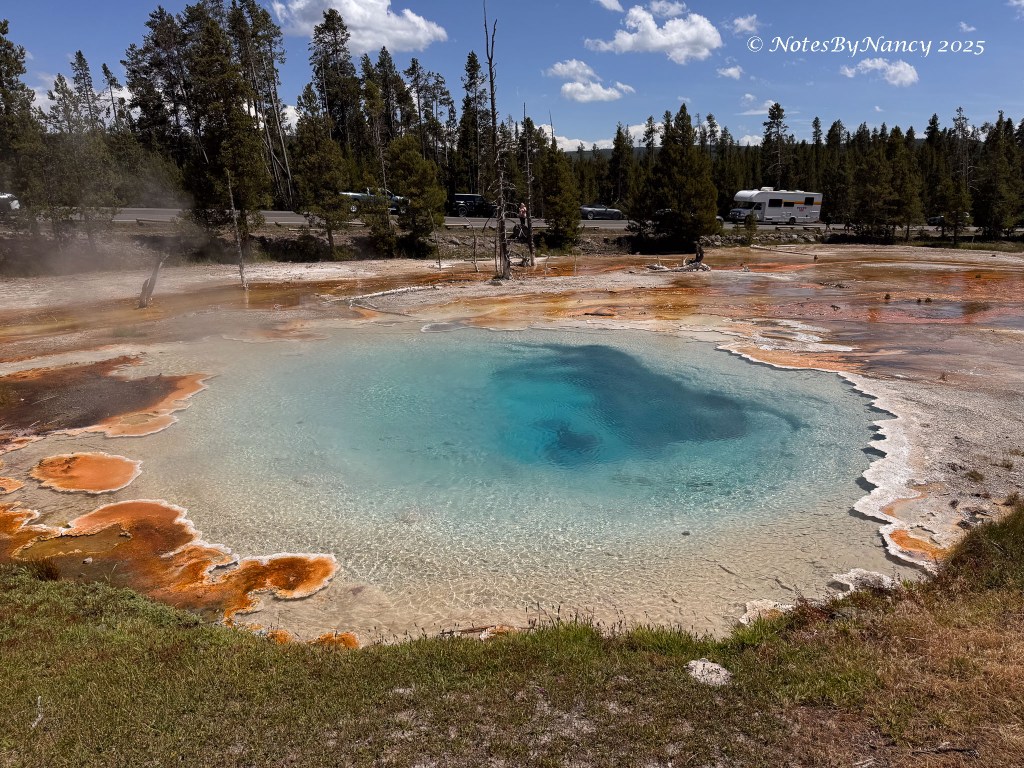
Yellowstone National Park – Lower Geyser Basin – Fountain Paint Pots – Silex Spring 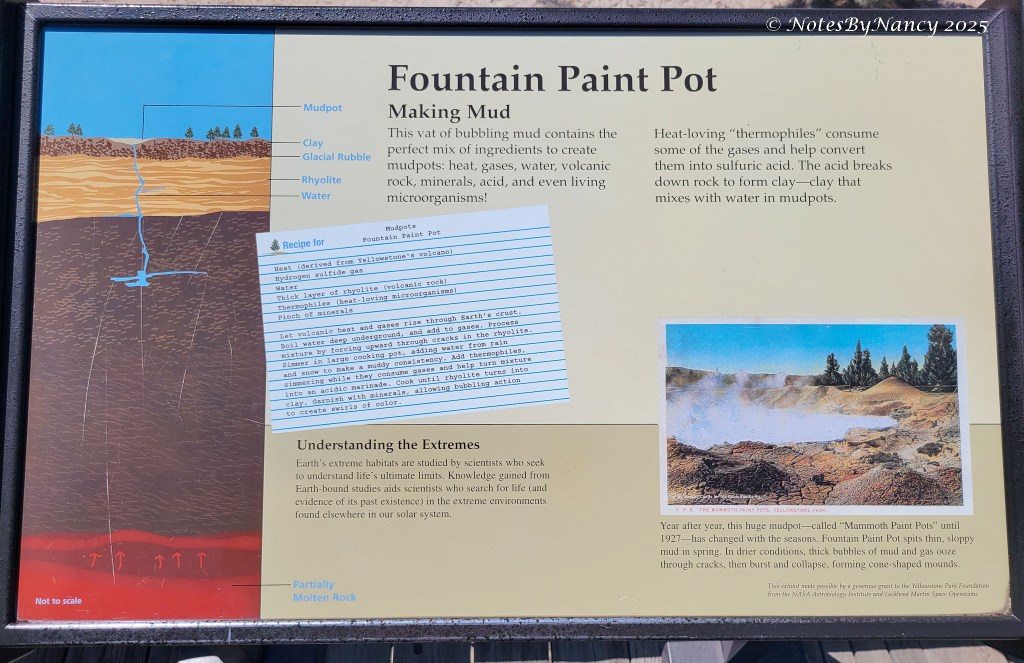
Yellowstone National Park – Lower Geyser Basin – Fountain Paint Pots 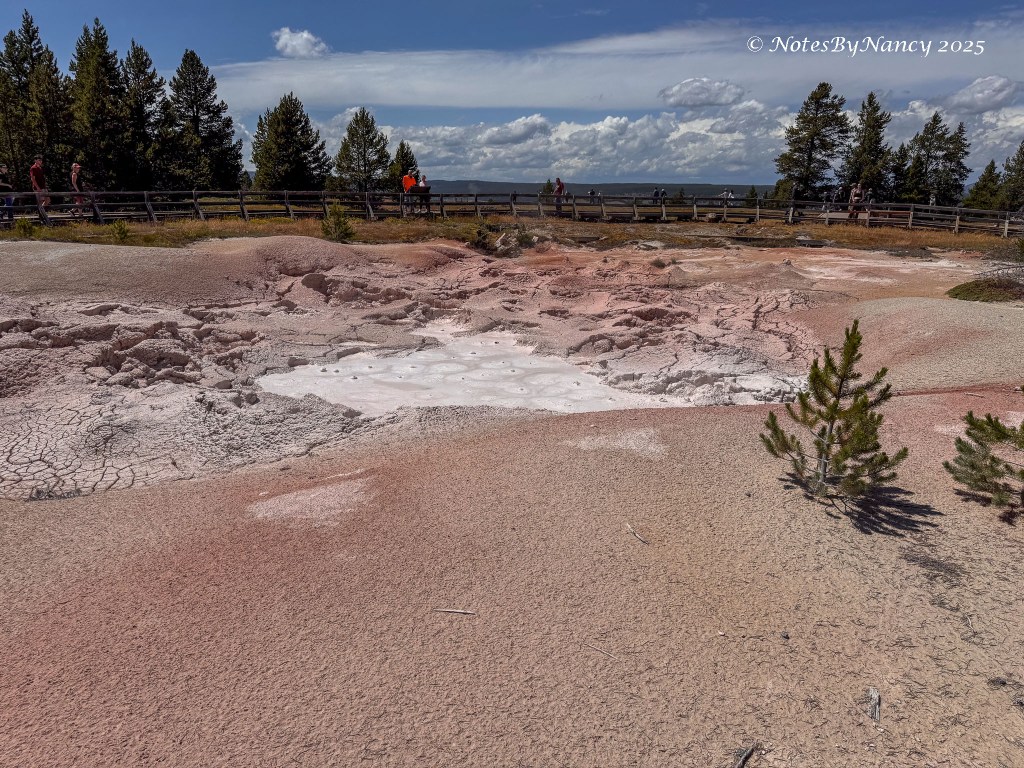
Yellowstone National Park – Lower Geyser Basin – Fountain Paint Pots 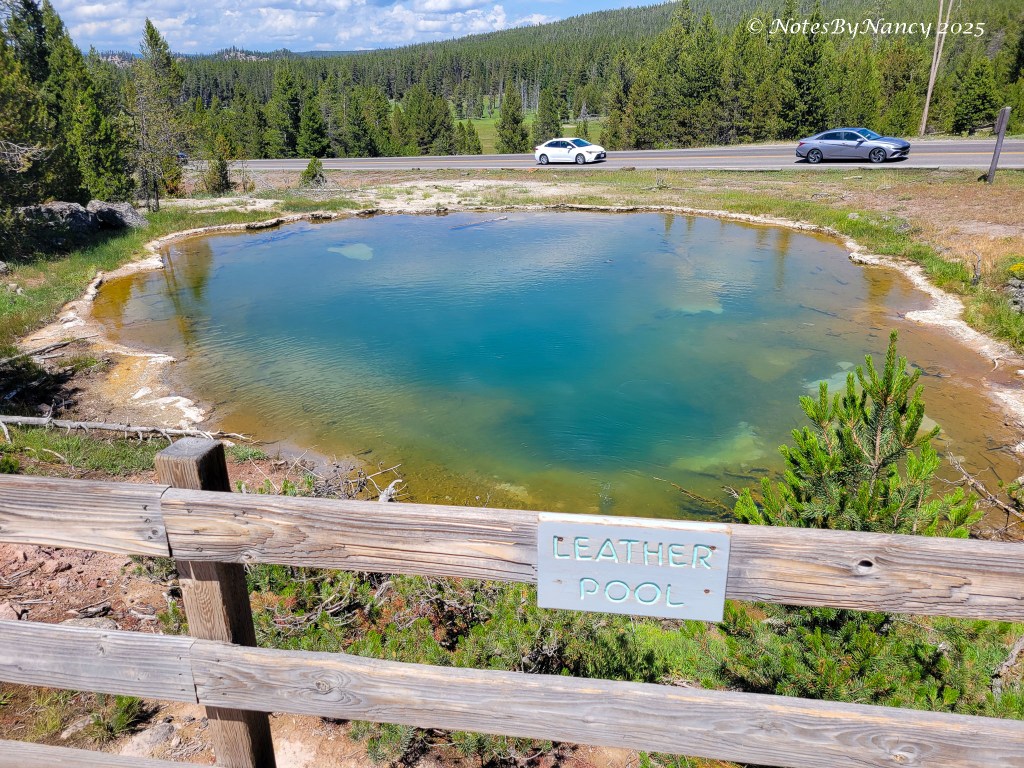
Yellowstone National Park – Lower Geyser Basin – Fountain Paint Pots – Leather Pool 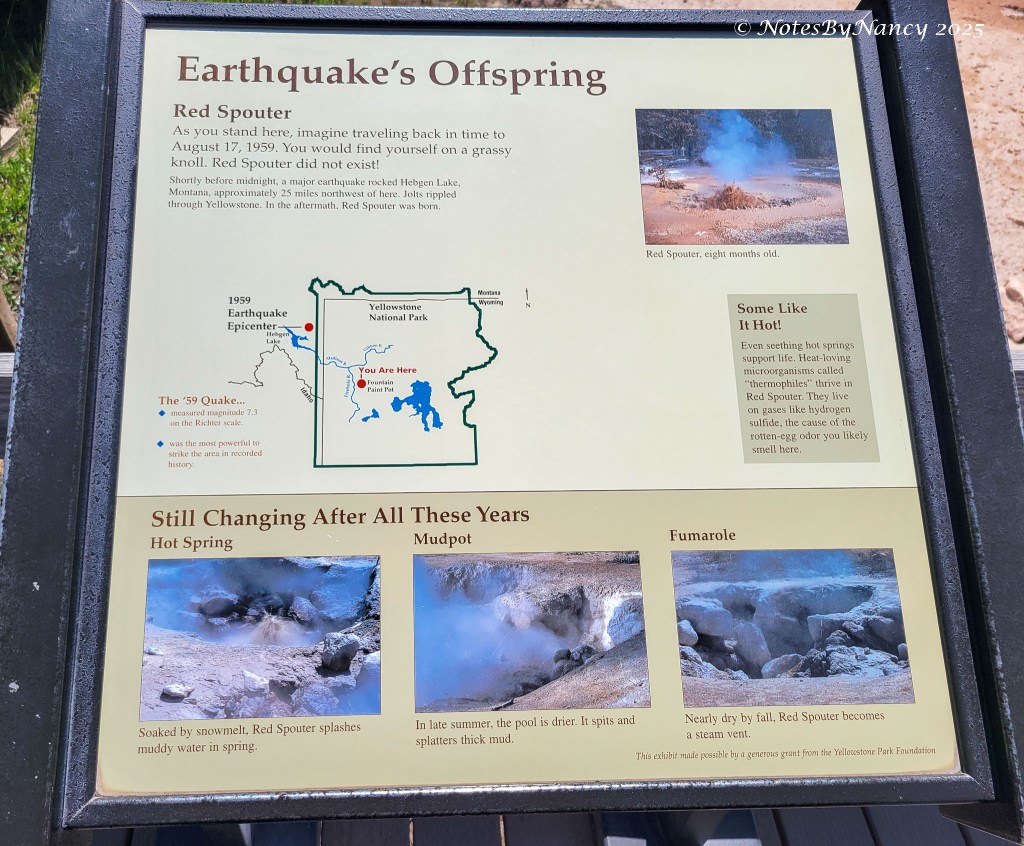
Yellowstone National Park – Lower Geyser Basin – Fountain Paint Pots – Red Spouter 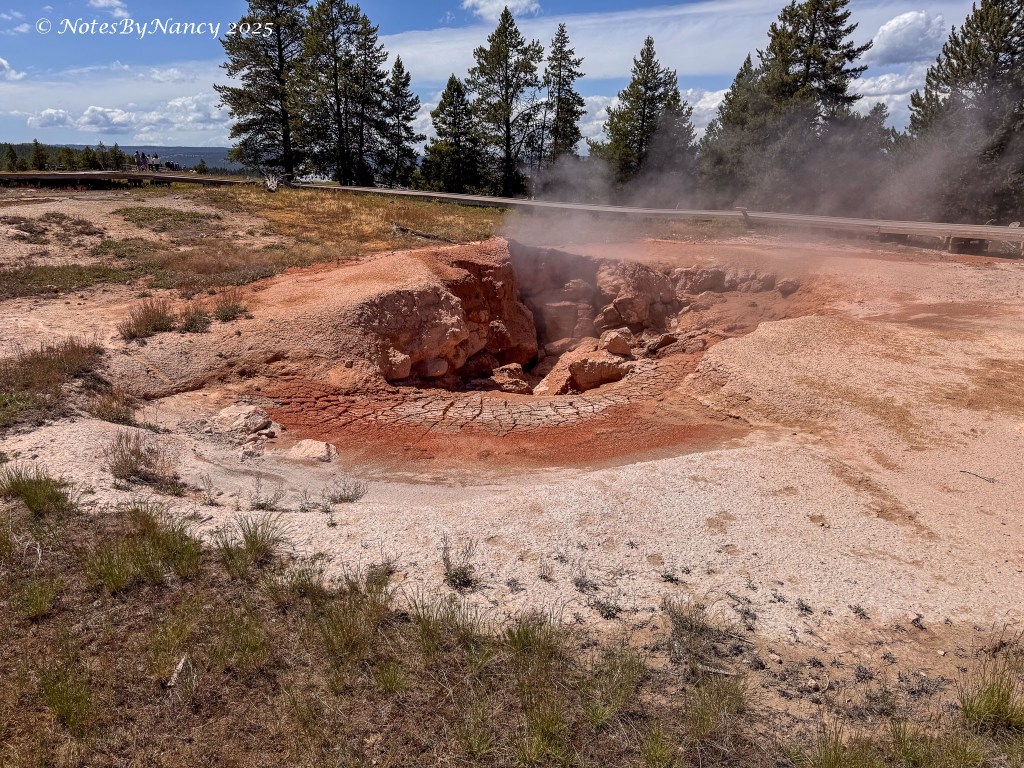
Yellowstone National Park – Lower Geyser Basin – Fountain Paint Pots – Red Spouter 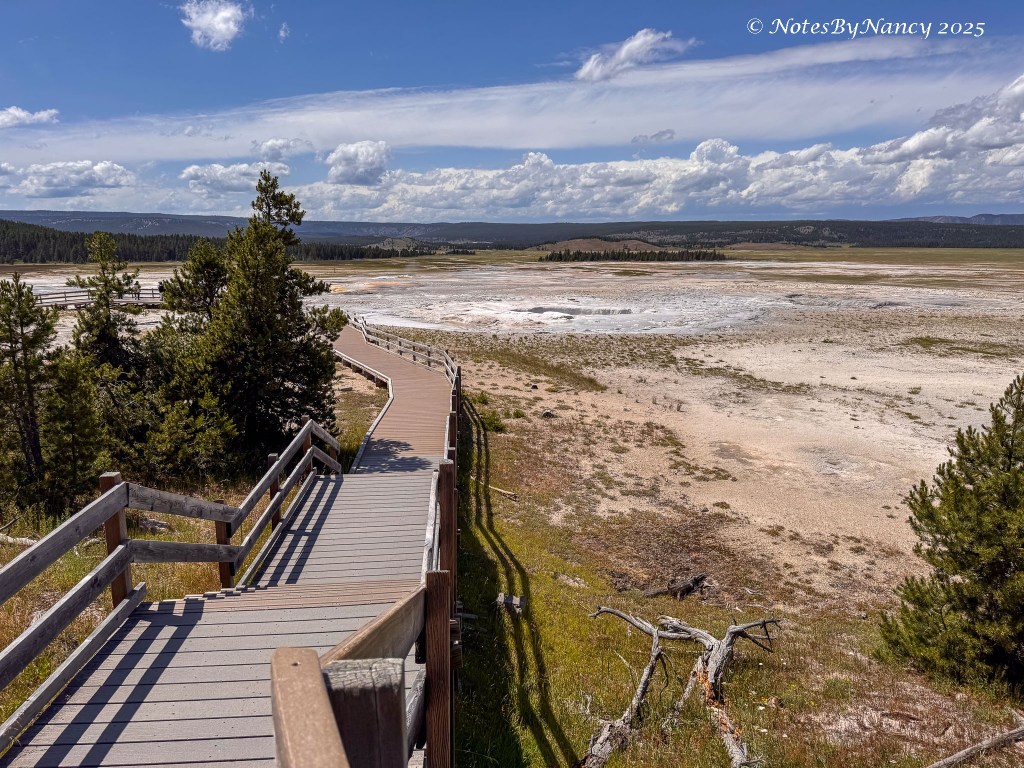
Yellowstone National Park – Lower Geyser Basin – Fountain Paint Pots – Morning Geyser 
Yellowstone National Park – Lower Geyser Basin – Fountain Paint Pots – Tree Remains
This basin seems even more desolate than the Upper Geyser Basin to me. Only one geyser in the area was spouting off – I think it was Clepsydra per this description from the NPS website: This nearly constant performer splashes from several vents and its steam can be seen throughout the Lower Geyser Basin. Its name is Greek for water clock, and was given because the geyser used to erupt regularly every three minutes. Since the 1959 Hebgen Lake Earthquake, however, Clepsydra erupts almost without pause. Sometimes it quits during Fountain Geyser’s eruption.
We decided to call it a day and see if we could spot any animals along the Madison River Valley on our 45-minute drive back to the house. But nothing – I think they were hiding from us!
As we went through town, we stopped at the grocery store to pickup more breakfast and snack items, then went to Firehole BBQ to get brisket, ribs, beans, and slaw to go.
We thought we might go back out when it got a little later and the animals started moving more after the heat of the day. But about an hour after we arrived at the house, it started raining hard and hailing. Just pea-sized, but every time the storm seemed to be over, it started up again!
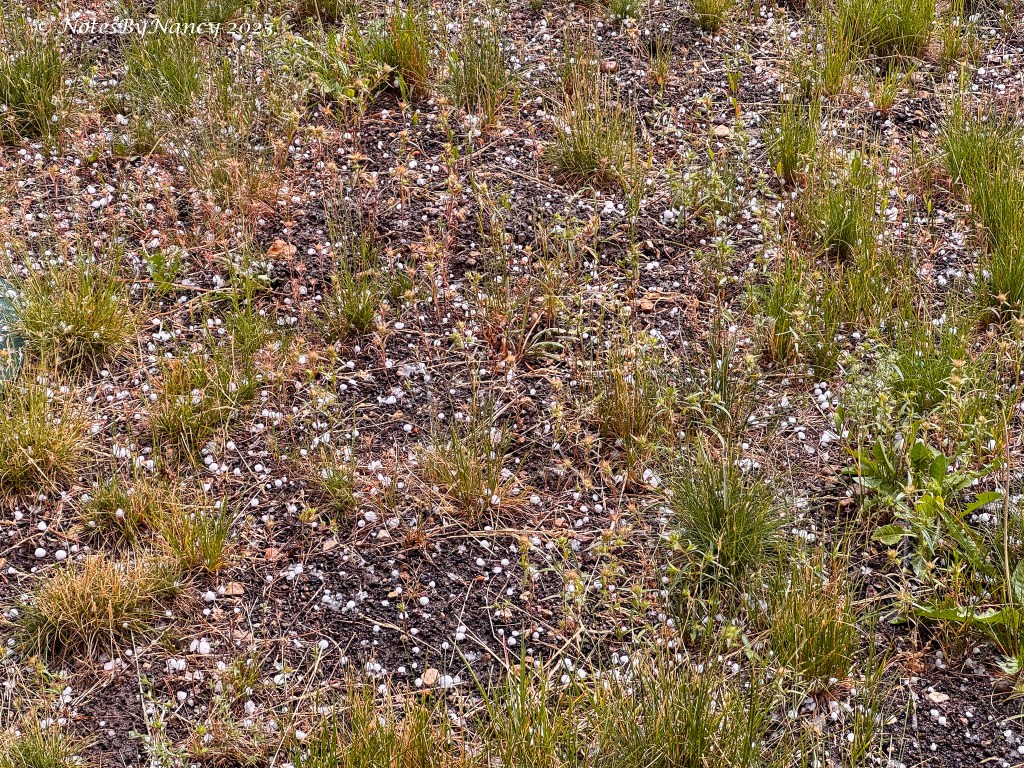
Needless to say, we stayed in for the evening and you can guess what we did… Yep! More cards and delicious BBQ by the way!
 Notes By Nancy
Leave a comment