
Due to Dave’s frequent work travel to Aberdeen, Scotland, he racked up quite a few British Airways Avios (miles) points. Unfortunately, they are notoriously difficult to use, especially from Houston. We’ve been trying to optimize their usage on every trip we’ve taken to Europe the past few years, but either couldn’t find availability or the exchange ($ to points) was terrible. We were able to keep the account active with a subscription tied to it for several years, but then that option was discontinued. We were approaching the expiration date to use them, so we were determined to make it work for this trip.
We were able to book multi-city business class with the Avios points, plus a $500/person fee for each trip through London Heathrow going to Bucharest and coming back from Budapest. So, $1000/person for business class airfare there and back (and using the majority of Dave’s points), we can live with! What drives me crazy these days is having to then pay extra to select our seats. But, it is still a significant savings over full-price business class fares.
We determined a few years ago that the cost difference for using a car service to/from our local airport versus parking at a shuttle lot for trips over 10 days was negligible. After our return trip from Canada last year following the mess that Hurricane Beryl (Note 53) left, we decided to start using a car service for every trip! It is much less stress overall, especially on the return following a long flight (especially if coming from an international destination). Our driver to the airport was early as usual and we had no issues getting to the airport drop-off for departures. IAH has completed most of the work around the international terminal, but there is still a ton of (re)-construction ongoing. Check-in and security screening went quickly and we headed to the BA Lounge to wait until time to head to the gate for boarding.
When we arrived at the gate, we learned than the crew was late arriving to the airport, so we ended up delayed about 30 minutes. Upon boarding we acquainted ourselves with the plane and our seating layout. Unfortunately, we were on an older model aircraft sorely in need of refurbishment. The design of the business class seating is a 2-3-2 layout, with the seats alternating facing forward/aft. The seats lie flat, but the awkward part is having to climb out over the feet of the person in the row behind you if you are in a window seat (or the middle seat). The newer business seat configurations avoid that. We both had issues with the seat either going to the flat stage or coming back up to sitting mode. The monitor screens also had issues with staying in place. Even the flight attendants were frustrated with all the issues on this aircraft and commented more than once it needed to be updated. I hope we don’t get that model plane on our return! The food was also some of the worst I’ve ever had in business class. Although the flight attendants were great and we got where we were going on-time and safely, BA is not going to be very high on my list for future flights.
Although we left late, that time was easily made up and we arrived at London Heathrow Terminal 5 around 6:40am. Our flight to Bucharest was in Terminal 3 at 8:45, so we hurried to find the bus transport from T5 to T3. We arrived in T3 and cleared security fairly quickly only to find that our gate wasn’t going to be posted for another 45 minutes, so we headed to the BA Lounge to wait.
Our flight arrived in Bucharest around 2:15 and our driver from Welcome Pickups (we had used them previously on our Portugal trip) was waiting us to take us to our hotel, the JW Marriott Grand Hotel Bucharest, which is the hotel used by Viking. The driver gave us some basic country and city information, provided some restaurant recommendations, and pointed out various parks, monuments, and buildings on our drive. As it was Easter Sunday and a beautiful, sunny 23 degrees Celsius (73 Fahrenheit), it seemed like everyone had gone to the parks as we drove by.
Our main goal on arrival was finding an ATM to get Romanian Leu (there are two in the hotel), eating dinner (we opted for the hotel’s Italian restaurant as we were too tired to go to one our driver recommended tonight) and getting a good night’s sleep ahead of our full-day trip to Transylvania tomorrow.
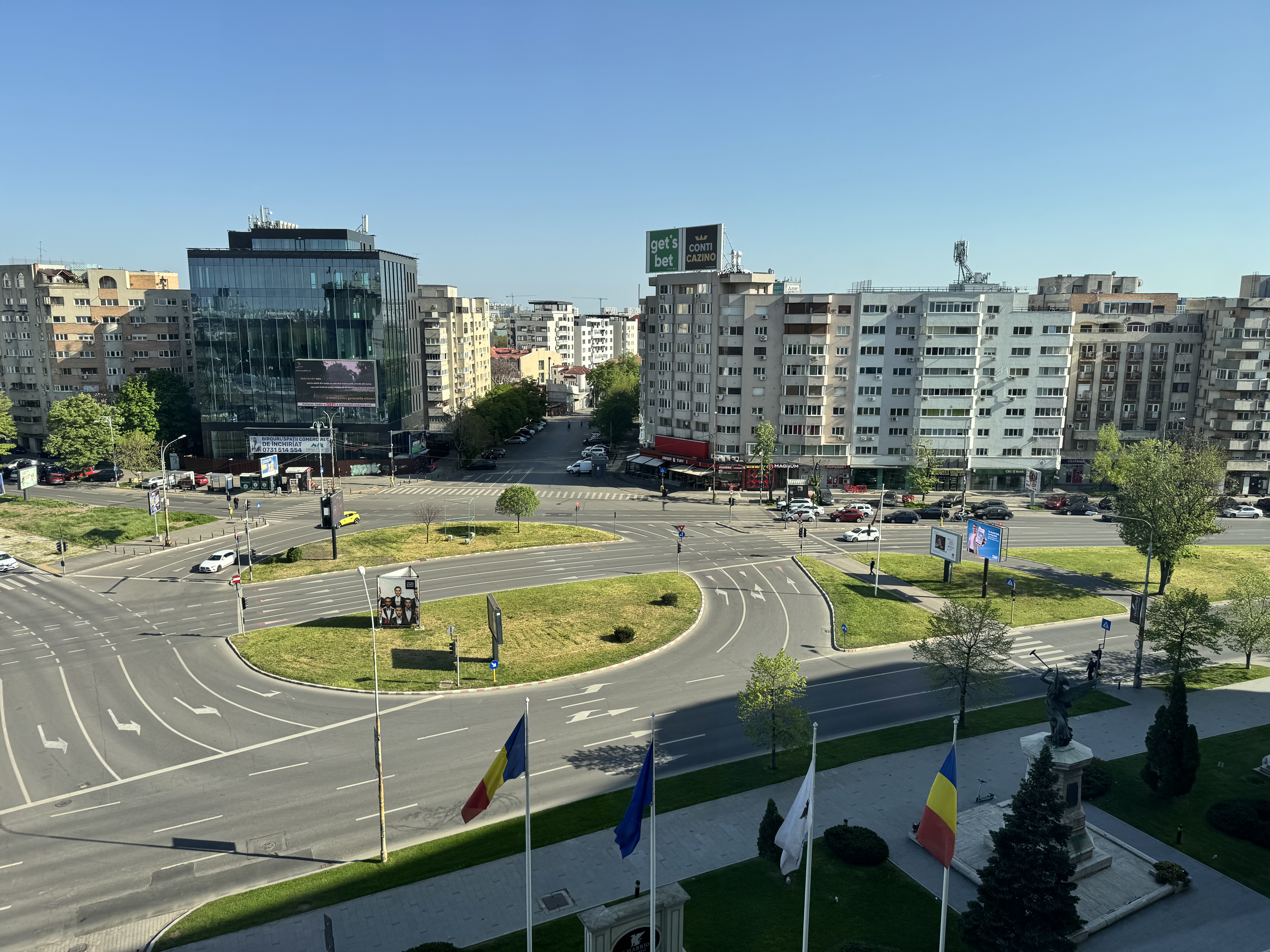
Below are a couple of pics from our hotel window. The small chapel in the foreground is “Saint John Chrysostom” Church (2011), the People’s Salvation Cathedral (National Cathedral) is behind it, and the massive Palace of Parliament (more on it is a couple of days) can be seen behind the cathedral. There’s a saying “everything is bigger in Texas”, but it appears that the Romanians are not to be outdone either! The cathedral on which construction began in 2010 (and still ongoing though services are held there now) is the largest Orthodox church in the world. There is lots of controversy as much of the funding has come from the state (taxes), not the church.

More About Romania and Bucharest
Note: Most of the information below is from Wikipedia, The World Factbook, and the book The Balkans by Captivating History.
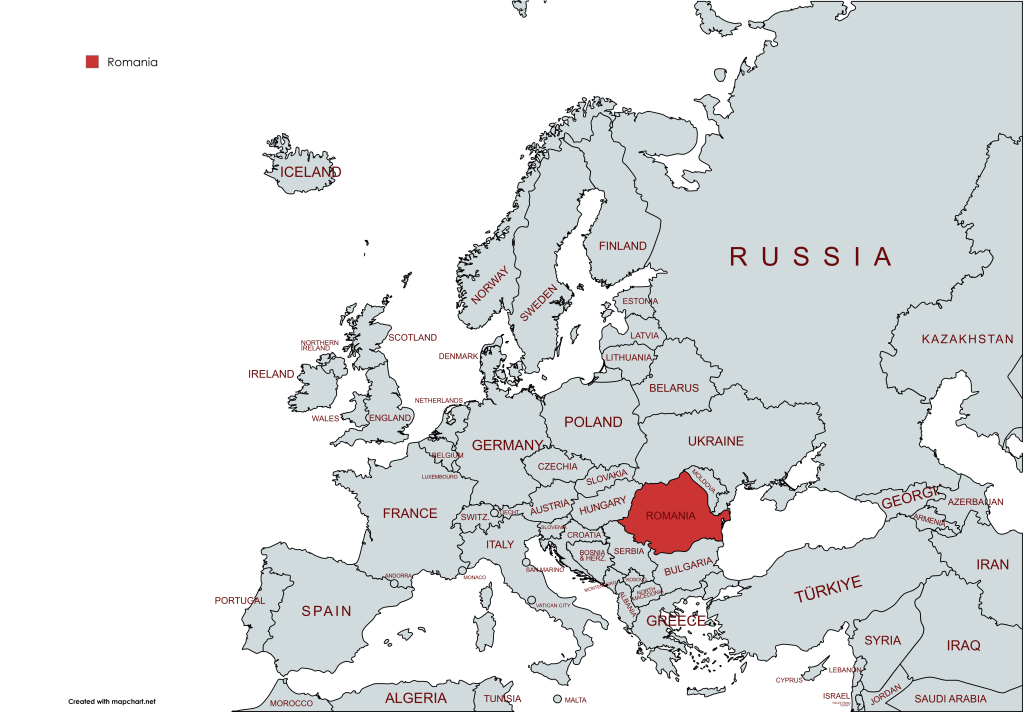
Romania is the largest country on the Balkan Peninsula with a total area of 238,391 sq km (slightly larger than the US state of Minnesota) and an estimated population of 18 million. It is surrounded by Moldova and Ukraine to its North and Northeast, the Black Sea to the East, Bulgaria to the South, Serbia to the Southwest, and Hungary to the Northwest.
This area was controlled by the Turkish Ottoman Empire for centuries until the late 1870s. The principalities of Wallachia and Moldavia officially united in 1862 as Romania and won their war of independence in 1877-1878. Over the next decades, the country grew and shrunk with various conflicts in the region. Following WWII, as one of the Axis countries, its borders were adjusted, and the region fell to the USSR’s influence becoming one of the Iron Curtain countries. Nicolae Ceaușescu ruled the country from 1965 until a violent overthrow in 1989. He and his wife, Elena, were captured December 17 trying to escape the revolution occurring in most Soviet Bloc Communist countries. They were summarily tried and convicted of economic sabotage and genocide, then immediately executed by firing squad on Christmas Day 1989. Today Romania is a semi-presidential republic. The most recent presidential election results were annulled by the constitutional court and new elections are set for May 2025. The president serves a 5-year term. It also has a prime minister appointed by the president with consultation from the party holding an absolute majority in the Parliament. It has a bicameral legislature with an upper (Senate) and lower (Chamber of Deputies) house – both houses are elected via proportional representation and serve 4-year terms.
Romania joined NATO in 2004, the EU in 2007, and the Schengen Area in 2024 for air and sea travel.
Bucharest (Romanian spelling: București), the capital of Romania since 1862, was first mentioned in a 1459 document by Vlad III the Impaler, ruler of Wallachia (more on him tomorrow). The Romanian root word bucurie means joy. Thus, Bucharest is the City of Joy. It is also known as “Little Paris” or “Paris of the East” due to its wide boulevards modeled after the French. The current population estimate is 1.7 million for the city and 2.3 million in the metro area. The city is 239 sq km (92.29 sq mi) and the metro area is 1803 sq km (696 sq mi). That puts its metro area size on par with the City of Houston, Texas, where we live.


 Notes By Nancy
Leave a comment