
March Madness! How’s everyone’s brackets going into Final Four weekend? I’m sure everyone had the men’s and women’s teams for both UConn and NC State in their Final Four brackets, right!? LOL! Should be fun all around this weekend.
I did end up reading more than I expected between all the games, and here’s the final tally for March.
Total Books: 7 Total Pages: 2087 Longest: 360 Shortest: 126
Genres: 5 (Fiction – 2, Historical Fiction – 1, History – 1, Mystery – 2, Thriller – 1)
To start off the month, I got in a quick history (only 126 pages) of Portugal via A Traveler’s Guide to the History of Portugal: Passport to the Past by Tessa Marks.

This was a fast read and hit on the historic highlights to explain many of the sights that a traveler to Portugal will encounter. It helped put into context and reaffirm many of the sites we plan to visit on our upcoming trip. If planning a trip to Portugal and you don’t want to get bogged down in a detailed history, then this book is for you!
Looking for what to read next, I was surprised and excited to see books #7 and #8 in Louise Penny’s Chief Inspector Gamache series available on Kindle Unlimited (KU) so I immediately downloaded them. I’d read the first six books two years ago after having them recommended to me for years and finally finding them available on KU.

A Trick of the Light was the seventh in the series and was once again set in the charming, obscure village of Three Pines with all its eccentric characters and can you believe it – another murder!?!? Penny continues to develop the characters and their relationships amid the theme of darkness and light and their coexistence within art and us as humans. “Maybe it isn’t hope at all,” said Marois, “but merely a trick of the light.” is a comment by an art dealer when viewing a portrait which most saw as showing despair or grief. But couldn’t it be both?
A recurring question presented in A Trick of the Light is can a person change their nature? This question ends up applying to many of the characters in the novel and indeed to all of us. Can someone who has demonstrated nothing but evil deeds towards others truly change to showing kindness and seeking forgiveness? Can someone who is naturally “good” do evil things?
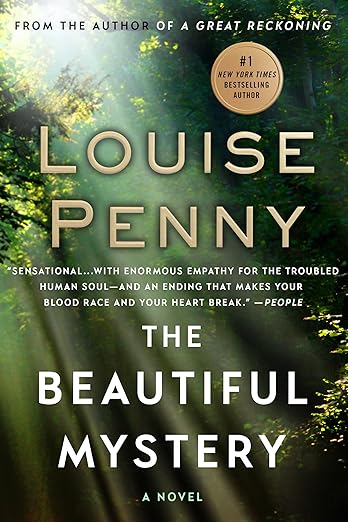
Book 8, The Beautiful Mystery, will stick with me for a long while, I think. When I reread the Amazon review before writing this, I noticed that it was named the winner of the 2012 Agatha Award for best novel, the 2013 Anthony Award for best novel and the 2013 Macavity Award for best novel. Well-deserved, I say!
From the Amazon synopsis: No outsiders are ever admitted to the monastery of Saint-Gilbert-Entre-les-Loups, hidden deep in the wilderness of Quebec, where two dozen cloistered monks live in peace and prayer. They grow vegetables, they tend chickens, they make chocolate. And they sing. Ironically, for a community that has taken a vow of silence, the monks have become world-famous for their glorious voices, raised in ancient chants whose effect on both singer and listener is so profound it is known as “the beautiful mystery.”
Then, the choirmaster is murdered. The murderer is obviously one of the victim’s 23 brothers, but no one has confessed. Chief Inspector Gamache and his trusty second-in-command, Jean-Guy Beauvoir, make the trek to the isolated setting to investigate upon the request of the abbot.
For me, the insights that Penny provides into the differences between Gamache and Beauvoir as they each continue their own internal struggles in this setting are profound. Relationships are complicated, passions flare, and motives are suspect. Including the suspects they are evaluating, everyone seems to be fighting some form of guilt and the need for forgiveness. There is despair and there is hope – which will win out?
I found myself studying Google maps in search of the approximate location of the fictional Saint-Gilbert-Entre-les-Loups to understand the isolation of the terrain, researching Catholic orders (the Gilbertine order was real, but no evidence they fled to Canada), and remembering my study of Gregorian chant in my brief music major phase. Penny’s portrayal of the singing was so vivid, I wished as I read that I could hear the glorious voices of the monks she described. I can’t wait to continue the series.
If you have an Amazon Prime account, Amazon Video has a great series called Three Pines starring Alfred Molina which is based on the Inspector Gamache novels and is worth your viewing time, too. Currently, there is only one season of ten episodes, but I’m hopeful for more.

Needing a change of pace after that, I found Cynthia Ellingsen’s The Lost Letters of Aisling, a dual time-line historical fiction novel set primarily along the south coast of Ireland. A granddaughter helps her grandmother to return to her homeland to confront the mysterious past she left behind as a young woman.
When does keeping secrets in the interest of protecting others actually protect them and when does it do more damage than intended? Will the secrets kept for so long reveal themselves? Can reconciliation occur? Can the truth heal old wounds? I’ve added Ellingsen to my list of future authors to read.
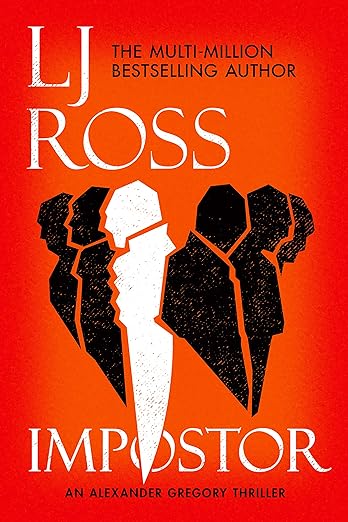
I followed that up with LJ Ross’s Imposter, the first in her Alexander Gregory thriller series. I binged Ross’s DCI Ryan series over the past couple of years, as well as her light-hearted Summer Suspense Mystery series. Gregory is a forensic psychologist who appears in the DCI Ryan novels, so I thought I’d give this series a go, too.
It’s a compelling read, revealing Gregory’s “origin story”, if you will, as he endeavors to help police understand the mind of a possible serial killer. I like Ross’s writing style and character development, but the subject matter is pretty dark and I’m probably going to space this series out quite a bit if I do decide to read it further.

Needing a lighter read, I next chose Katherine Center’s novel, Things You Save In a Fire. I enjoyed her book The Bodyguard immensely last year and my sister had downloaded this one, so why not? Center describes her books as “bittersweet comic novels”. She lives in the Houston area, and many of her settings are in Texas.
Center’s protagonists in both novels are strong, independent women in male-dominated workplaces, in this case, decorated firefighter and paramedic Cassie Hanwell who has to transfer from her Texas job to New England. Can she prove her skills and value to her new colleagues in the New England firehouse that’s never had a woman work there in its 120-year history? Can she reconcile with her estranged mother at the same time? Things are complicated further when a cute rookie joins the firehouse the same day she does. And ultimately, can she address her own need of forgiveness?

To finish the month, I continued with another Katherine Center novel, How to Walk Away. This one definitely falls more in the “bittersweet” category than comic. Another strong woman protagonist, Margaret, who must overcome almost unimaginable personal tragedy and adversity in order to find her best self and a calling beyond what’s expected.
While not nearly as light-hearted as The Bodyguard or Things You Save in a Fire, it definitely has its moments portraying the resilience of the human spirit and the range of human emotions from sorrow to joy.
Two of the most highlighted quotes by Kindle readers are:
The greater our capacity for sorrow becomes, the greater our capacity for joy.
When you don’t know what to do for yourself, do something for somebody else.
That last one, I think, is especially good advice.


 Notes By Nancy
Leave a comment